
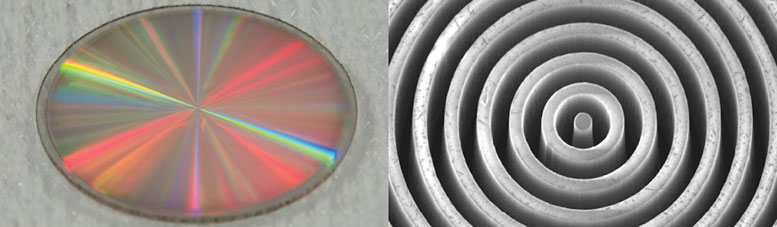
A new device on the W.M. Keck Observatory has delivered its first images, showing a ring of planet-forming dust around a star, and separately, a brown dwarf near its companion star.
The device, called a vortex coronagraph, was recently installed inside NIRC2 (Near Infrared Camera 2), the workhorse infrared imaging camera at Keck. It has the potential to image planetary systems and brown dwarfs closer to their host stars than any other instrument in the world.
“The vortex coronagraph allows us to peer into the regions around stars where giant planets like Jupiter and Saturn supposedly form,” said Dmitri Mawet, research scientist at NASA’s Jet Propulsion Laboratory and Caltech, both in Pasadena. “Before now, we were only able to image gas giants that are born much farther out. With the vortex, we will be able to see planets orbiting as close to their stars as Jupiter is to our sun, or about two to three times closer than what was possible before.”
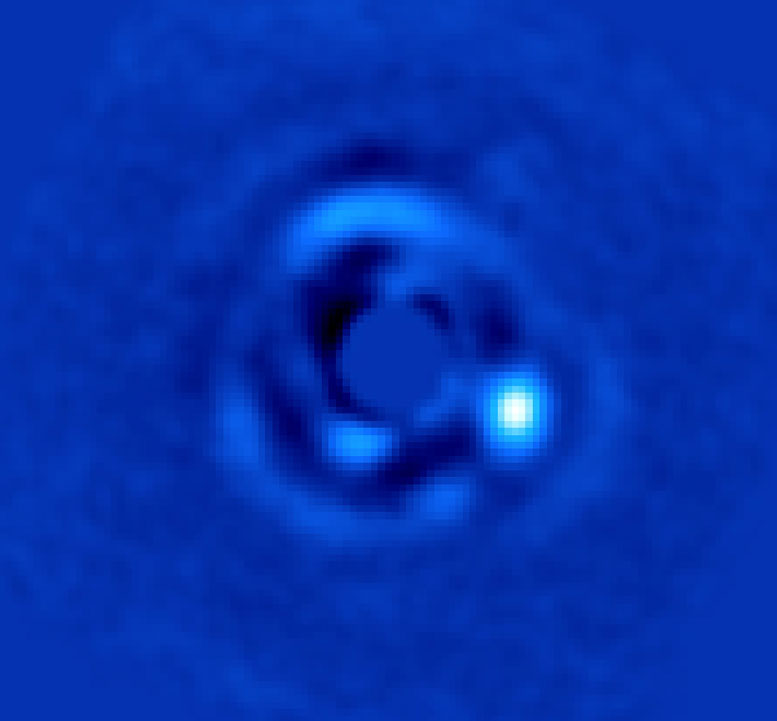
The new vortex results are presented in two papers, both published in the January 2017 issue of The Astronomical Journal. One study, led by Gene Serabyn of JPL, the overall lead of the Keck vortex project, presents the first direct image of the brown dwarf called HIP79124 B. This brown dwarf is located 23 astronomical units from a star (an astronomical unit is the distance between our sun and Earth) in a nearby star-forming region called Scorpius-Centaurus.
“The ability to see very close to stars also allows us to search for planets around more distant stars, where the planets and stars would appear closer together. Having the ability to survey distant stars for planets is important for catching planets still forming,” said Serabyn. He also led a team that tested a predecessor of the vortex device on the Hale Telescope at Caltech’s Palomar Observatory, near San Diego. In 2010, the team secured high-contrast images of three planets orbiting in the distant reaches of the star system called HR8799.
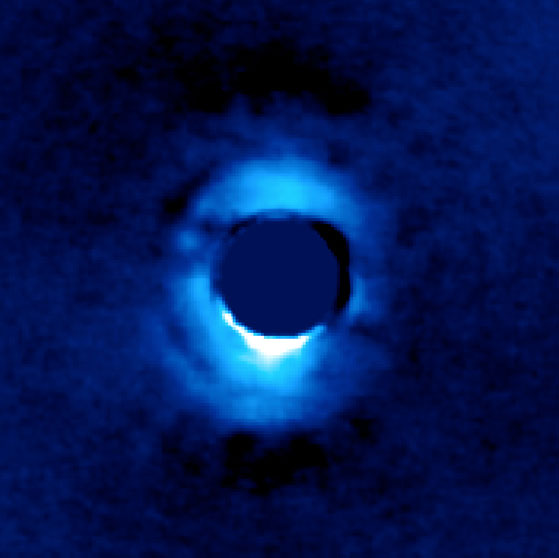
The second vortex study, led by Mawet, presents an image of the innermost of three rings of dusty, planet-forming material around the young star called HD141569A. The results, when combined with infrared data from NASA’s Spitzer and WISE missions, and the European Space Agency’s Herschel mission, reveal that the star’s planet-forming material is made up of pebble-sized grains of olivine, one of the most abundant silicates in Earth’s mantle. The data also show that the temperature of the innermost ring imaged by the vortex is about minus 280 degrees Fahrenheit (100 Kelvin, or minus 173 degrees Celsius), a bit warmer than our asteroid belt.
“The three rings around this young star are nested like Russian dolls and undergoing dramatic changes reminiscent of planetary formation,” said Mawet. “We have shown that silicate grains have agglomerated into pebbles, which are the building blocks of planet embryos.”
About the vortex coronagraph
The vortex was invented in 2005 by Mawet while he was at the University of Liege in Belgium. The Keck vortex coronagraph was built by a combination of the University of Liege, Uppsala University in Sweden, JPL, and Caltech.
The first science images and results from the vortex instrument demonstrate its ability to image planet-forming regions hidden under the glare of stars. Stars outshine planets by a factor of few thousand to a few billion, making the dim light of planets very difficult to see, especially for planets that lie close to their stars. To deal with this challenge, researchers have invented Instruments called coronagraphs, which typically use tiny masks to block the starlight, much like blocking the bright sun with your hand or a car visor to see better.
What makes the vortex coronagraph unique is that it does not block the starlight with a mask, but instead redirects light away from the detectors using a technique in which light waves are combined and canceled out. Because the vortex doesn’t require an occulting mask, it has the advantage of taking images of regions closer to stars than other coronagraphs. Mawet likens the process to the eye of a storm.
“The instrument is called a vortex coronagraph because the starlight is centered on an optical singularity, which creates a dark hole at the location of the image of the star,” said Mawet. “Hurricanes have a singularity at their centers where the wind speeds drop to zero — the eye of the storm. Our vortex coronagraph is basically the eye of an optical storm where we send the starlight.”
What’s next for the vortex
In the future, the vortex will look at many more young planetary systems, in particular planets near the “frost lines,” which are the region around a star where temperatures are cold enough for volatile molecules, such as water, methane, and carbon dioxide, to condense into solid icy grains. The frost line is thought to divide a solar system into regions where planets are likely to become rocky or gas giants. Surveys of the frost line region by the vortex coronagraph will help answer ongoing puzzles about a class of hot, giant planets found extremely close to their stars — the “hot Jupiters,” and “hot Neptunes.” Did these planets first form close to the frost line and migrate in, or did they form right next to their stars? “With a bit of luck, we might catch planets in the process of migrating through the planet-forming disk, by looking at these very young objects,” Mawet said.
“The power of the vortex lies in its ability to image planets very close to their star, something that we can’t do for Earth-like planets yet,” said Serabyn. “The vortex coronagraph may be key to taking the first images of a pale blue dot like our own.”
The Keck Observatory is managed by Caltech and the University of California. In 1996, NASA joined as a one-sixth partner in the Keck Observatory. JPL is managed by Caltech for NASA.
References:
- “The W. M. Keck Observatory infrared vortex coronagraph and a first image of HIP79124 B” by E. Serabyn, E. Huby, K. Matthews, D. Mawet, O. Absil, B. Femenia, P. Wizinowich, M. Karlsson, M. Bottom, R. Campbell, B. Carlomagno, D. Defrère, C. Delacroix, P. Forsberg, C. Gomez Gonzalez, S. Habraken, A. Jolivet, K. Liewer, S. Lilley, P. Piron, M. Reggiani, J. Surdej, H. Tran, E. Vargas Catalán and O. Wertz, 4 January 2017, The Astrophysical Journal.
DOI: 10.3847/1538-3881/153/1/43
arXiv: 1612.03093 - “Characterization of the inner disk around HD 141569 A from Keck/NIRC2 L-band vortex coronagraphy” by Dimitri Mawet, Élodie Choquet, Olivier Absil, Elsa Huby, Michael Bottom, Eugene Serabyn, Bruno Femenia, Jérémy Lebreton, Keith Matthews, Carlos A. Gomez Gonzalez, Olivier Wertz, Brunella Carlomagno, Valentin Christiaens, Denis Defrère, Christian Delacroix, Pontus Forsberg, Serge Habraken, Aissa Jolivet, Mikael Karlsson, Julien Milli, Christophe Pinte, Pierre Piron, Maddalena Reggiani, Jean Surdej, and Ernesto Vargas Catalan, 4 January 2017, The Astrophysical Journa.
DOI: 10.3847/1538-3881/153/1/44
arXiv: 1612.03091
Never miss a breakthrough: Join the SciTechDaily newsletter.
Follow us on Google and Google News.