
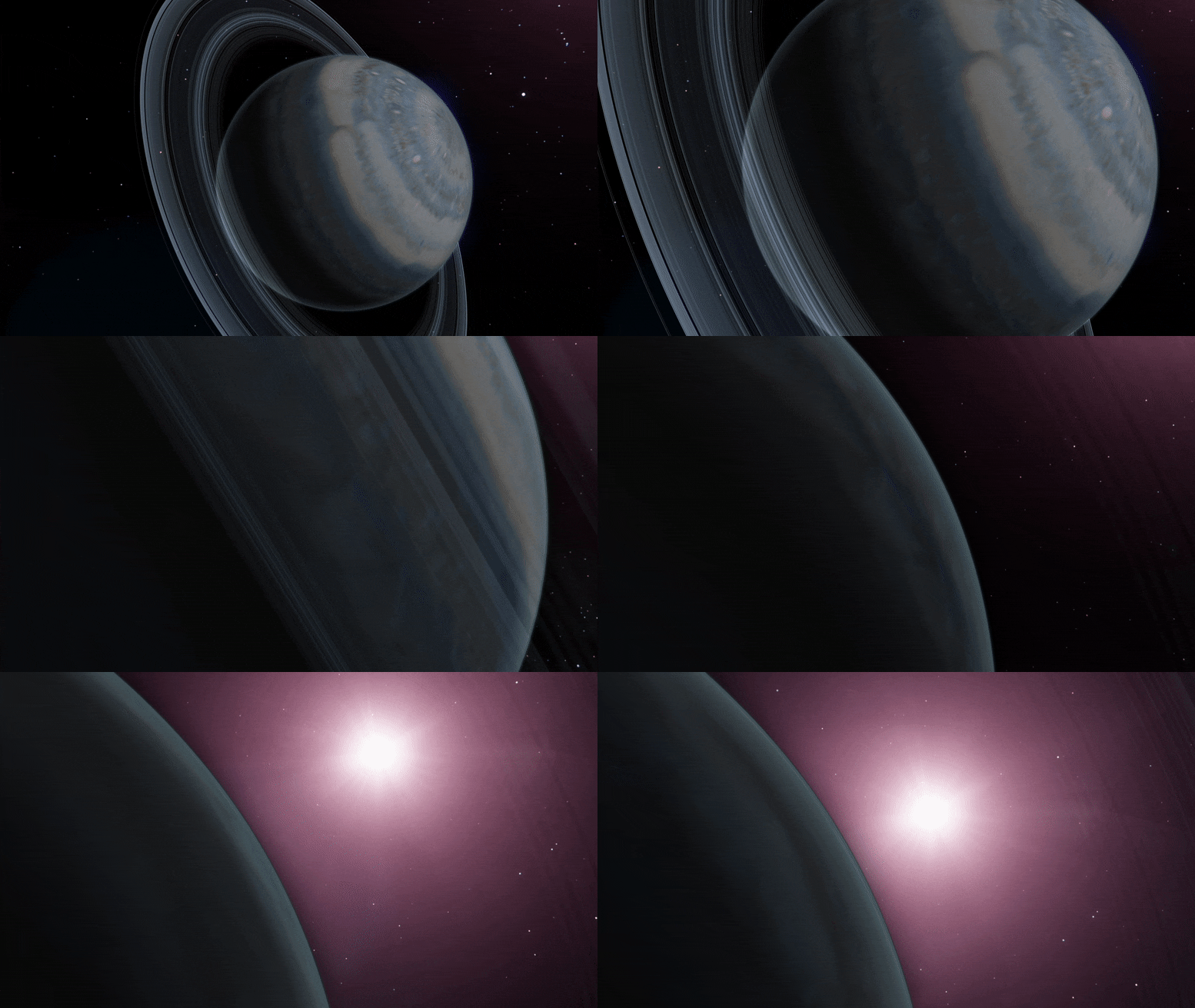
NASA’s Nancy Grace Roman Space Telescope, now under construction, will test new technologies for space-based planet hunting. The mission aims to photograph worlds and dusty disks around nearby stars with detail up to a thousand times better than possible with other observatories.
Roman will use its Coronagraph Instrument – a system of masks, prisms, detectors, and even self-flexing mirrors built to block out the glare from distant stars and reveal the planets in orbit around them – to demonstrate that direct imaging technologies can perform even better in space than they have with ground-based telescopes.
“We will be able to image worlds in visible light using the Roman Coronagraph,” said Rob Zellem, an astronomer at NASA’s Jet Propulsion Laboratory (JPL) in Southern California who is co-leading the observation calibration plan for the instrument. JPL is building Roman’s Coronagraph Instrument. “Doing so from space will help us see smaller, older, and colder planets than direct imaging usually reveals, bringing us a giant leap closer to imaging planets like Earth.”
A Home Far Away From Home
Exoplanets – planets beyond our solar system – are so distant and dim relative to their host stars that they’re practically invisible, even to powerful telescopes. That’s why nearly all of the worlds discovered so far have been found indirectly through effects they have on their host stars. However, recent advancements in technology allow astronomers to actually take images of the reflected light from the planets themselves.
Analyzing the colors of planetary atmospheres helps astronomers discover what the atmospheres are made of. This, in turn, can offer clues about the processes occurring on the imaged worlds that may affect their habitability. Since living things modify their environment in ways we might be able to detect, such as by producing oxygen or methane, scientists hope this research will pave the way for future missions that could reveal signs of life.
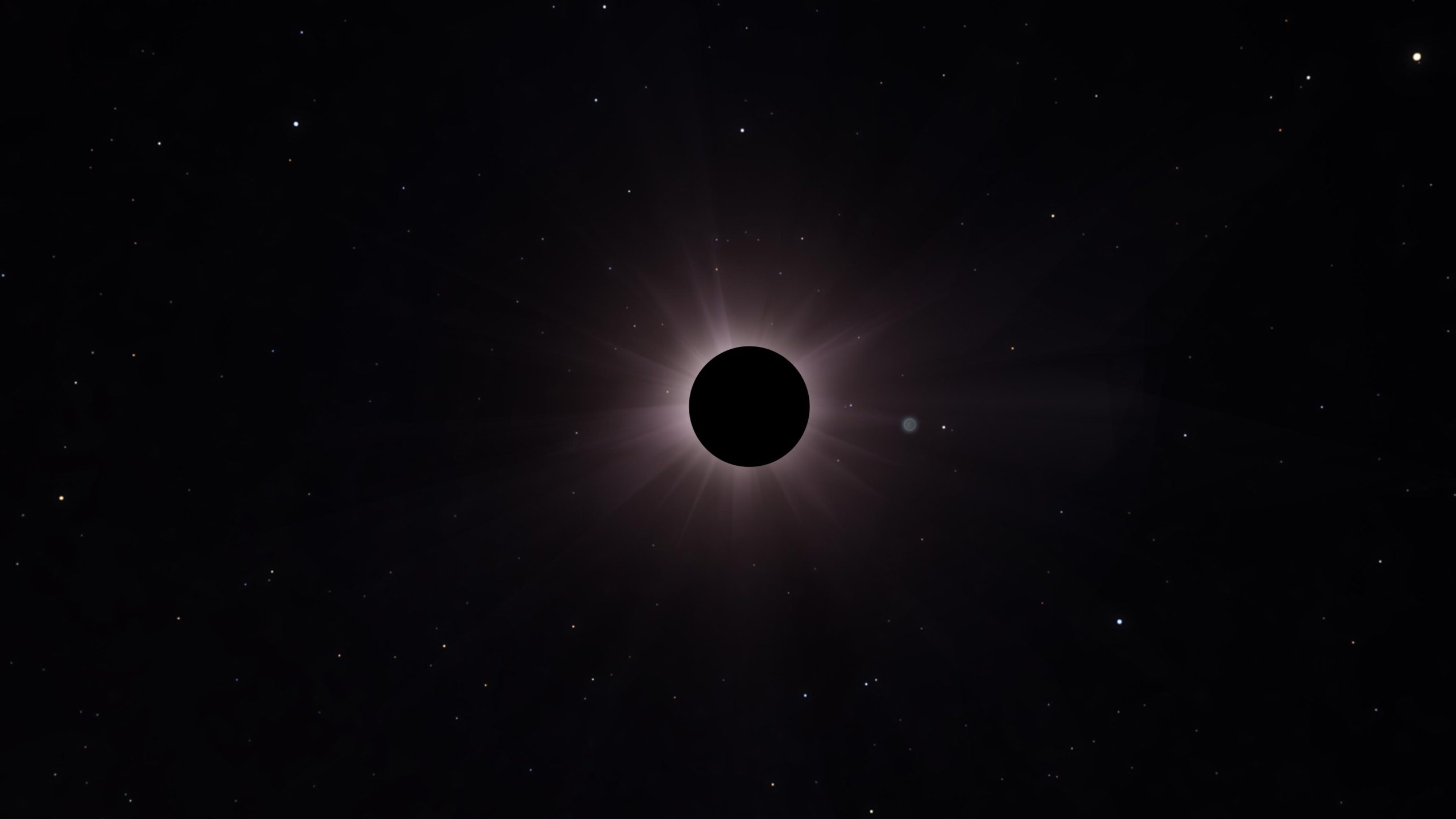
This animation illustrates how a planet can disappear in a star’s bright light, and how a coronagraph can reveal it. Credit: NASA’s Goddard Space Flight Center/CI Labs
If Roman’s Coronagraph Instrument successfully completes its technology demonstration phase, its polarimetry mode will allow astronomers to image the disks around stars in polarized light, familiar to many as the reflected glare blocked by polarized sunglasses. Astronomers will use polarized images to study the dust grains that make up the disks around stars, including their sizes, shapes, and possibly mineral properties. Roman may even be able to reveal structures in the disks, such as gaps created by unseen planets. These measurements will complement existing data by probing fainter dust disks orbiting nearer to their host stars than other telescopes can see.
Bridging the Gap
Current direct imaging efforts are limited to enormous, bright planets. These worlds are typically super-Jupiters that are less than 100 million years old – so young that they glow brightly thanks to heat left over from their formation, which makes them detectable in infrared light. They also tend to be very far away from their host stars because it’s easier to block the star’s light and see planets in more distant orbits. The Roman Coronagraph could complement other telescopes’ infrared observations by imaging young super-Jupiters in visible light for the first time, according to a study by a team of scientists.
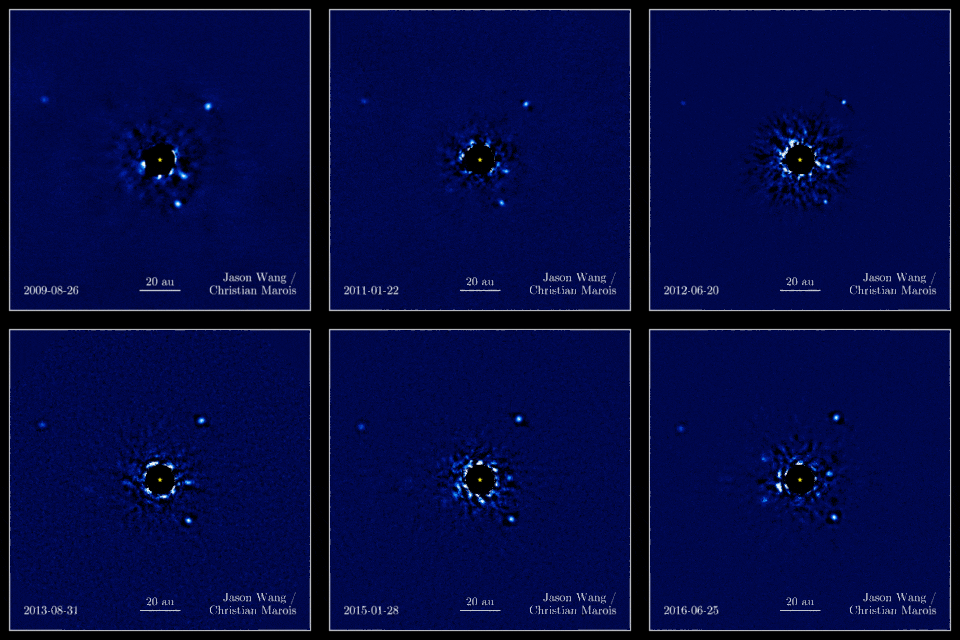
But astronomers would also like to directly image planets that are similar to our own one day – rocky, Earth-sized planets orbiting Sun-like stars within their habitable zones, the range of orbital distances where temperatures allow liquid water to exist on a planet’s surface. To do so, astronomers need to be able to see smaller, cooler, dimmer planets orbiting much closer to their host stars than current telescopes can. By photographing worlds in visible light, Roman will be able to image mature planets spanning ages up to several billion years – something that has never been done before.
“To image Earth-like planets, we’ll need 10,000 times better performance than today’s instruments provide,” said Vanessa Bailey, an astronomer at JPL and the instrument technologist for the Roman Coronagraph. “The Coronagraph Instrument will perform several hundred times better than current instruments, so we will be able to see Jupiter-like planets that are more than 100 million times fainter than their host stars.”
A team of scientists recently simulated a promising target for Roman to image, called Upsilon Andromedae d. “This gas giant exoplanet is slightly larger than Jupiter, orbits within a Sun-like star’s habitable zone, and is relatively close to Earth – just 44 light-years away,” said Prabal Saxena, an assistant research scientist at the University of Maryland, College Park and NASA’s Goddard Space Flight Center in Greenbelt, Maryland, and the lead author of a paper describing the results. “What’s really exciting is that Roman may be able to help us explore hazes and clouds in Upsilon Andromedae d’s atmosphere and may even be able to act as a planetary thermometer by putting constraints on the planet’s internal temperature!”
Opening a New Frontier
The Coronagraph Instrument will contain several state-of-the-art components that have never flown aboard a space-based observatory before. For example, it will use specially designed coronagraph masks to block the glare from host stars but allow the light from dimmer, orbiting planets to filter through. These masks have innovative, complex shapes that block starlight more effectively than traditional masks.
Watch this video to learn more about Roman’s Coronagraph Instrument – a system of masks, prisms, detectors, and even self-flexing mirrors built to block out the glare from distant stars and reveal planets in orbit around them. Credit: NASA’s Goddard Space Flight Center
The Roman Coronagraph will also be equipped with deformable mirrors, which help counteract small imperfections that reduce image quality. These special mirrors will measure and subtract starlight in real time, and technicians on the ground can also send commands to the spacecraft to adjust them. This will help counteract effects like temperature changes, which can slightly alter the shape of the optics.
Using this technology, Roman will observe planets so faint that special detectors will count individual photons of light as they arrive, seconds or even minutes apart. No other observatory has done this kind of imaging in visible light before, providing a vital step toward discovering habitable planets and possibly learning whether we are alone in the universe.
The Nancy Grace Roman Space Telescope is managed at NASA’s Goddard Space Flight Center in Greenbelt, Maryland, with participation by NASA’s Jet Propulsion Laboratory and Caltech/IPAC in Southern California, the Space Telescope Science Institute in Baltimore, and a science team comprising scientists from various research institutions. The primary industrial partners are Ball Aerospace and Technologies Corporation in Boulder, Colorado; L3Harris Technologies in Melbourne, Florida; and Teledyne Scientific & Imaging in Thousand Oaks, California.
Never miss a breakthrough: Join the SciTechDaily newsletter.
Follow us on Google and Google News.