
Weizmann Institute of Science researchers generate, for the first time, a vortex beam of atoms and molecules.
Vortices may conjure a mental image of whirlpools and tornados – spinning bodies of water and air – but they can also exist on much smaller scales. In a new study published in Science, researchers from the Weizmann Institute of Science, together with collaborators from the Technion – Israel Institute of Technology and Tel Aviv University, have created, for the first time, vortices made of a single atom. These vortices could help answer fundamental questions about the inner workings of the subatomic world and be used to enhance a variety of technologies – for example, by providing new capabilities for atomic microscopes.
Scientists have long been striving to produce various types of nano-scale vortices in the lab, with recent focus on creating vortex beams – streams of particles having spinning properties – where even their internal quantum structure can be made to spin. Vortices made up of elementary particles, electrons and photons, have been created experimentally in the past, but until now vortex beams of atoms have existed only as a thought experiment. “During a theoretical debate with Prof. Ido Kaminer from the Technion, we came up with an idea for an experiment that would generate vortices of single atoms,” says Dr. Yair Segev, who has recently completed his PhD studies in the group of Prof. Edvardas Narevicius of Weizmann’s Chemical and Biological Physics Department.
In classical physics, spinning objects are often characterized by a property known as angular momentum. Similar to linear momentum, it describes the effort needed to stop a moving object in its tracks, or rather, to stop it from spinning. Vortices – characterized by the circulation of flux around an axis – embody this property perfectly in their relentless spin.
However, the very basic property of angular momentum, which characterizes naturally occurring vortices both big and small, takes on a different twist on the quantum scale. Unlike their classical physics equivalents, quantum particles cannot take on any value of angular momentum; rather, they can only take on values in discrete portions, or “quanta.” Another difference is the way in which a vortex particle carries its angular momentum – not as a rigid, spinning propeller, but as a wave that flows and twists around its own axis of motion.
Nano-Forks: Engineering Atomic Vortices
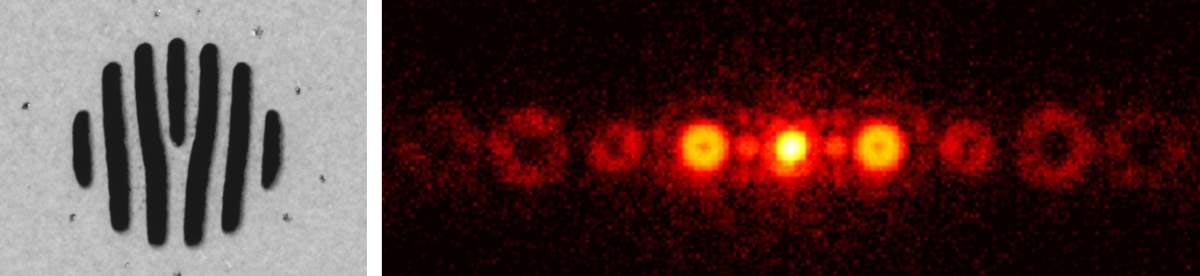
These waves can be shaped and manipulated similarly to how breakwaters are used to direct the flow of seawater close to shore, but on a much smaller scale. “By placing physical obstacles in an atom’s path, we can manipulate the shape of its wave into various forms,” says Alon Luski, a PhD student in Narevicius’s group. Luski and Segev, who led the research along with Rea David from their group, collaborated with colleagues from Tel Aviv University to develop an innovative approach for directing the movement of atoms. They created patterns of nanometric “breakwaters” called gratings – tiny ceramic discs, several hundreds of nanometers in diameter, with specific slit patterns. When the slits are arranged into a fork-like shape, each atom that passes through them behaves like a wave that flows through a physical obstacle, in this way acquiring angular momentum and emerging as a spinning vortex. These “nano-forks” were produced through a nano-fabrication process that was developed specifically for this experiment by Dr. Ora Bitton and Hila Nadler, both of Weizmann’s Chemical Research Support Department.
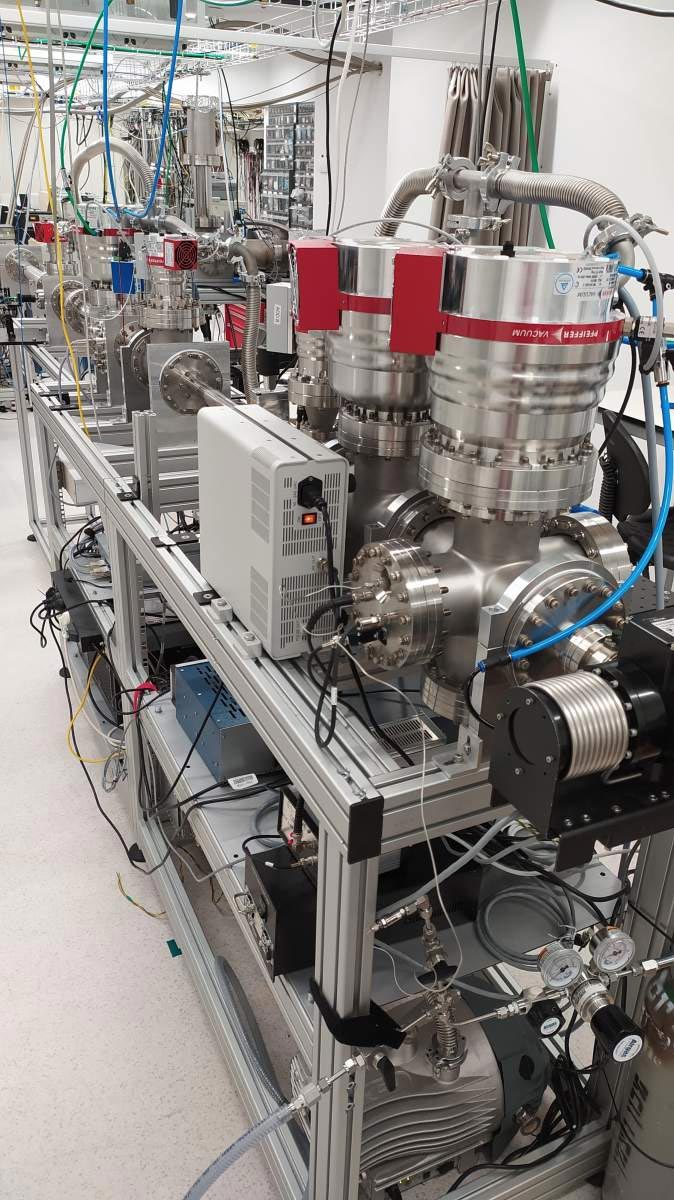
To generate and observe atomic vortices, the researchers aim a supersonic beam of helium atoms at these forked gratings. Before reaching the gratings, the beam passes through a system of narrow slits that blocks some of the atoms, transmitting only the atoms that behave more like large waves – those that are better suited to being shaped by the gratings. When these “wavy” atoms interact with the “forks,” they are shaped into vortices, and their intensity is recorded and photographed by a detector.
Much like the “eye” of the storm, the center of these “donuts” represents the space where each atomic vortex is calmest – the intensity of the waves there is zero, so no atoms are found there.
This results in a donut-shaped image constructed from millions of vortexed helium atoms that collide with the detector. “When we saw the donut-shaped image, we knew we had succeeded in creating vortices of these helium atoms,” says Segev. Much like the “eye” of the storm, the center of these “donuts” represents the space where each atomic vortex is calmest – the intensity of the waves there is zero, so no atoms are found there. “The ‘donuts’ are the fingerprint of a series of different vortex beams,” explains Narevicius.
Unexpected Guests: Vortices of Molecules
During the experiments, the researchers made an odd observation. “We saw that next to the perfectly shaped donuts, there were two small spots of ‘noise’ as well,” says Segev. “At first we thought this was a hardware malfunction, but after extensive investigation we realized that what we’re looking at are actually unusual molecules, each made of two helium atoms, that were joined together in our beams.” In other words, they had generated vortices of not only atoms but also of molecules.
Although the researchers used helium in their experiments, the experimental setup may accommodate studies of other elements and molecules. It could also be used to study hidden subatomic properties, such as the charge distribution of protons or neutrons that may be revealed only when an atom is spinning. Luski gives the example of a mechanical clock: “Mechanical clocks are made of tiny gears and cogs, each moving at a certain frequency, similarly to the internal structure of an atom. Now imagine taking that clock and spinning it – this motion could change the internal frequency of the gears, and the internal structure could be expressed in the properties of the vortex as well.”
Each of the helium atoms in the experiment was shaped into a vortex wave 1 micron across – 10,000 times larger than its original size.
In addition to offering a new way of studying the very basic properties of matter, atomic vortex beams might find use in several technological applications, such as in atomic microscopy. The interaction between spinning atoms and any investigated material could lead to the discovery of novel properties of that material, adding significant, previously inaccessible data to many future experiments.
Reference: “Vortex beams of atoms and molecules” by Alon Luski, Yair Segev, Rea David, Ora Bitton, Hila Nadler, A. Ronny Barnea, Alexey Gorlach, Ori Cheshnovsky, Ido Kaminer and Edvardas Narevicius, 1 September 2021, Science.
DOI: 10.1126/science.abj2451
Never miss a breakthrough: Join the SciTechDaily newsletter.
Follow us on Google and Google News.