
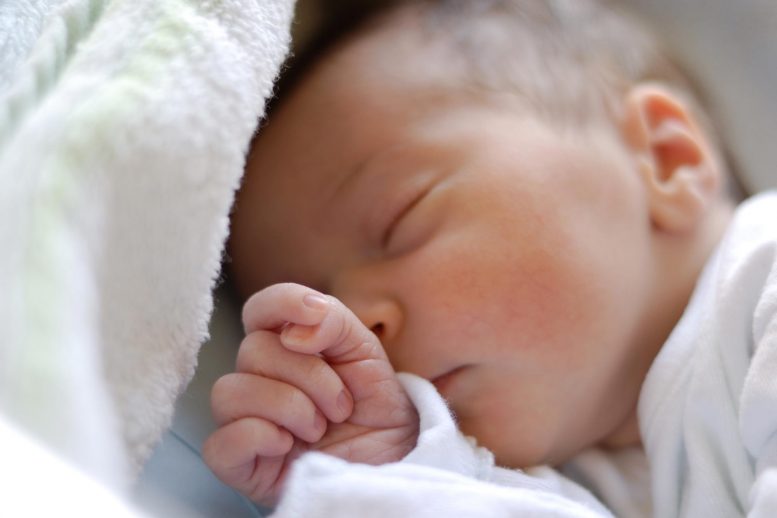
Newborns possess five of the seven functional brain networks seen in adults. Control and limbic networks are absent at birth, indicating development through experience. Genetic variability may play a role in network organization, which could influence future behavior.
Right from birth, human brains are organized into networks that support mental functions such as vision and attention, a new study shows.
Previous studies had shown that adults have seven such functional networks in the brain. This study, the first to take a fine-grained, whole-brain approach in newborns, found five of those networks are operating at birth.
“Our study shows variability in the brain at birth that may be related to some of the behavioral differences we see in adults.” Zeynep Saygin
Individual Variability in Newborn Brain Networks
Crucially, the study also found individual variability in those networks in newborns, which may have implications for how genetics affects behavior in adults.
“For centuries, humans have wondered about what makes them unique and the role of genetic programming versus our lifetime of experience,” said Zeynep Saygin, senior author of the study and assistant professor of psychology at The Ohio State University.
“Our study shows variability in the brain at birth that may be related to some of the behavioral differences we see in adults.”
The study, published recently in the journal NeuroImage, was led by M. Fiona Molloy, a psychology graduate student at Ohio State.
The researchers analyzed fMRI scans of the brains of 267 newborns, most less than a week old, who were part of the Developing Human Connectome Project. All infants were scanned for 15 minutes while they were asleep.
The study involved analysis of the smallest bits of brain possible with MRI – called voxels or volumetric pixels – to see how the signals of each voxel were related to other voxels in the brain.
“Even when we’re sleeping, the brain is active and different parts are communicating with each other,” Saygin said.
“We identify networks by finding which parts of the brain show similar patterns of activity at the same time – for example when one area activates, the other does too. They are talking to each other.”
Findings showed five networks in newborns that resembled those found in adults: the visual, default, sensorimotor, ventral attention, and high-level vision networks.
Brain Networks Missing in Newborns: Control and Limbic Systems
Adults have two additional networks not found in the brains of newborns: the control and limbic networks. These are both involved with higher-level functions, Saygin explained.
The control network allows adults to make plans to meet goals. The limbic network is involved in emotional regulation.
“Babies have little cognitive control and emotional regulation, so it is not surprising that these networks aren’t developed,” Saygin said.
“But one possibility would have been that they are set up at birth and just need to be honed. That’s not what we found, though. Those networks are not there at all yet and must develop through experience.”
The researchers also examined individual differences in the brain networks of the newborns studied. Results showed that the ventral attention network showed the most variability in the newborns. This is the network involved in directing attention to important stimuli encountered in the world, especially something that may be unexpected.
“Our results suggest that the ventral attention network is a stable source of individual variability that exists at birth and perhaps persists through the lifetime,” she said.
In adults, this individual variability in network organization has been linked to behavior and different disorders.
“We see individual differences in network organization as early as birth, and it could be interesting to see if these differences predict behavior or risk of psychological disorders later in life,” Molloy said.
Genetic Basis for Brain Organization in Newborns
In another analysis, the researchers used tissue samples of human brains available through the Allan Human Brain Atlas to explore how differences in the brain networks in the newborns may be tied to differences in gene expression – the process of turning on or activating genes.
They found multiple genes from the brain tissue samples that may have led to the specific brain organizations they found in individual newborns in the study.
“This might uncover a potential genetic basis for why we’re seeing these differences in the networks of newborns in our study,” she said.
Future research will examine how these networks develop over time to get a better understanding of the role of genetic programming and experience in producing variability in these networks.
“We want to further understand the developmental trajectory of these networks to learn how genes and experience relate to future behavior and outcomes,” Saygin said.
Reference: “Individual variability in functional organization of the neonatal brain” by M. Fiona Molloy and Zeynep M. Saygin, 15 March 2022, NeuroImage.
DOI: 10.1016/j.neuroimage.2022.119101
Never miss a breakthrough: Join the SciTechDaily newsletter.
Follow us on Google and Google News.
1 Comment
… in a way, all they need is their parents and later education to train their neural networks… like AI will learn …