
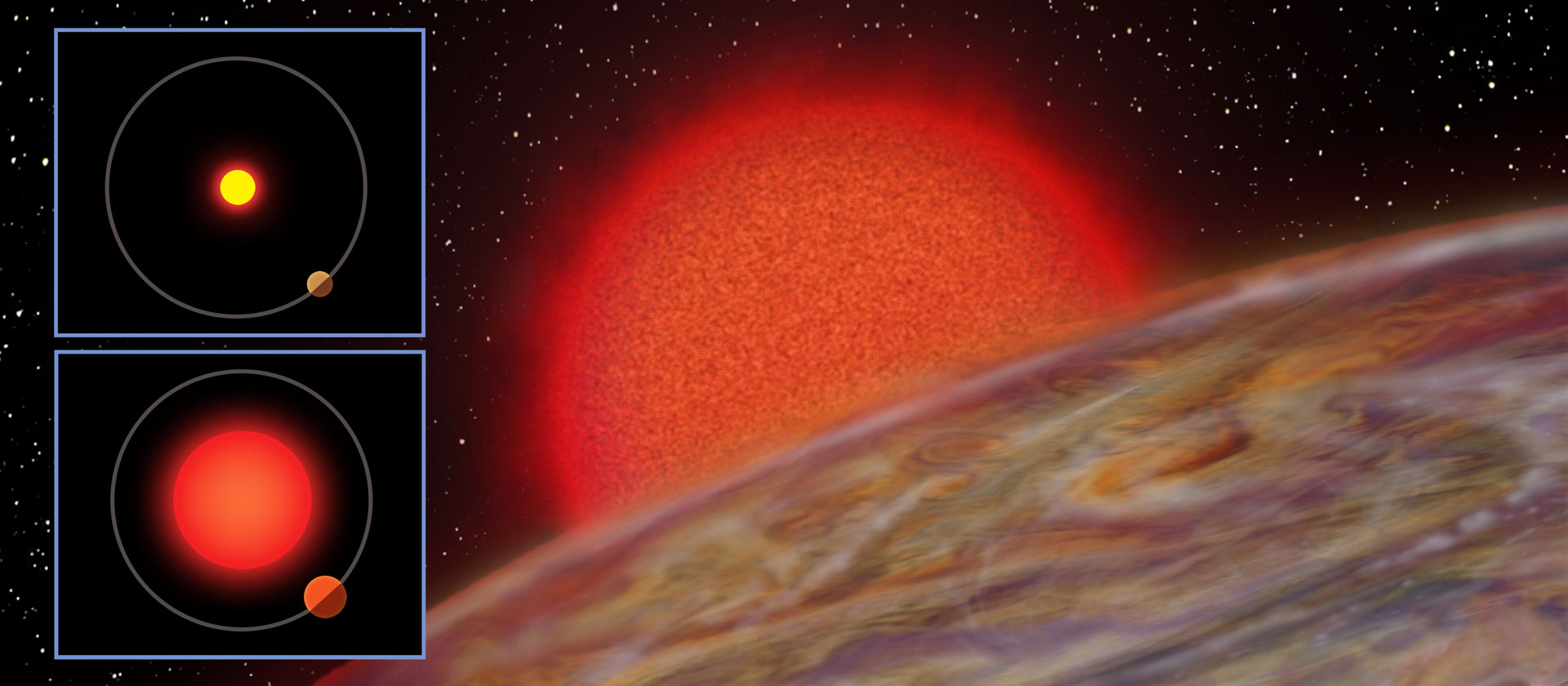
Lower left: Schematic of the K2-132 system now. The host star has become redder and larger, irradiating the planet more and thus causing it to expand. Sizes not to scale.
Main panel: Gas giant planet K2-132b expands as its host star evolves into a red giant. The energy from the host star is transferred from the planet’s surface to its deep interior, causing turbulence and deep mixing in the planetary atmosphere. The planet orbits its star every 9 days and is located about 2000 light years away from us in the constellation Virgo. Credit: Karen Teramura, UH IfA
Since astronomers first measured the size of an extrasolar planet seventeen years ago, they have struggled to answer the question: how did the largest planets get to be so large? Thanks to the recent discovery of twin planets by a University of Hawaii Institute for Astronomy team lead by graduate student Samuel Grunblatt, we are getting closer to an answer.
Gas giant planets are primarily made out of hydrogen and helium, and are at least 4 times the diameter of Earth. Gas giant planets that orbit scorchingly close to their host stars are known as “hot Jupiters.” These planets have masses similar to Jupiter and Saturn, but tend to be much larger – some are puffed up to sizes even larger than the smallest stars.
The unusually large sizes of these planets are likely related to heat flowing in and out of their atmospheres, and several theories have been developed to explain this process. “However, since we don’t have millions of years to see how a particular planetary system evolves, planet inflation theories have been difficult to prove or disprove,” said Grunblatt.
To solve this issue, Grunblatt searched through data collected by NASA’s K2 Mission to hunt for hot Jupiters orbiting red giant stars. These stars, which are in the late stages of their lives, become significantly larger over their companion planet’s lifetime. Following a theory put forth by Eric Lopez of NASA’s Goddard Space Flight Center, hot Jupiters orbiting red giant stars should be highly inflated if direct energy input from the host star is the dominant process inflating planets.
The search has now revealed two planets, each orbiting their host star with a period of approximately 9 days. Using stellar oscillations to precisely calculate the radii of both the stars and planets, the team found that the planets are 30% larger than Jupiter. Observations using the W. M. Keck Observatory on Maunakea also showed that, despite their large sizes, the planets were only half as massive as Jupiter. Remarkably, the two planets are near twins in terms of their orbital periods, radii, and masses.
Using models to track the evolution of the planets and their stars over time, the team calculated the planets’ efficiency at absorbing heat from the star and transferring it to their deep interiors, causing the whole planet to expand in size and decrease in density. Their findings show that these planets likely needed the increased radiation from the red giant star to inflate, but the amount of radiation absorbed was also lower than expected.
It is risky to attempt to reach strong conclusions with only two examples. But these results begin to rule out some explanations of planet inflation, and are consistent with a scenario where planets are directly inflated by the heat from their host stars. The mounting scientific evidence seems to suggest that stellar radiation alone can directly alter the size and density of a planet.
Our own Sun will eventually become a red giant star, so it’s important to quantify the effect its evolution will have on the rest of the Solar System. “Studying how stellar evolution affects planets is a new frontier, both in other solar systems as well as our own,” said Grunblatt. “With a better idea of how planets respond to these changes, we can start to determine how the Sun’s evolution will affect the atmosphere, oceans, and life here on Earth.”
The search for gas giant planets around red giant stars continues since additional systems could conclusively distinguish between planet inflation scenarios. Grunblatt and his team have been awarded time with the NASA Spitzer Space Telescope to measure the sizes of these twin planets more accurately. In addition, the search for planets around red giants with the NASA K2 Mission will continue for at least another year, and NASA’s Transiting Exoplanet Survey Satellite (TESS), launching in 2018, will observe hundreds of thousands of red giants across the entire sky.
PDF Copy of the Paper: Seeing double with K2: Testing re-inflation with two remarkably similar planets around red giant branch stars
Never miss a breakthrough: Join the SciTechDaily newsletter.
Follow us on Google and Google News.