
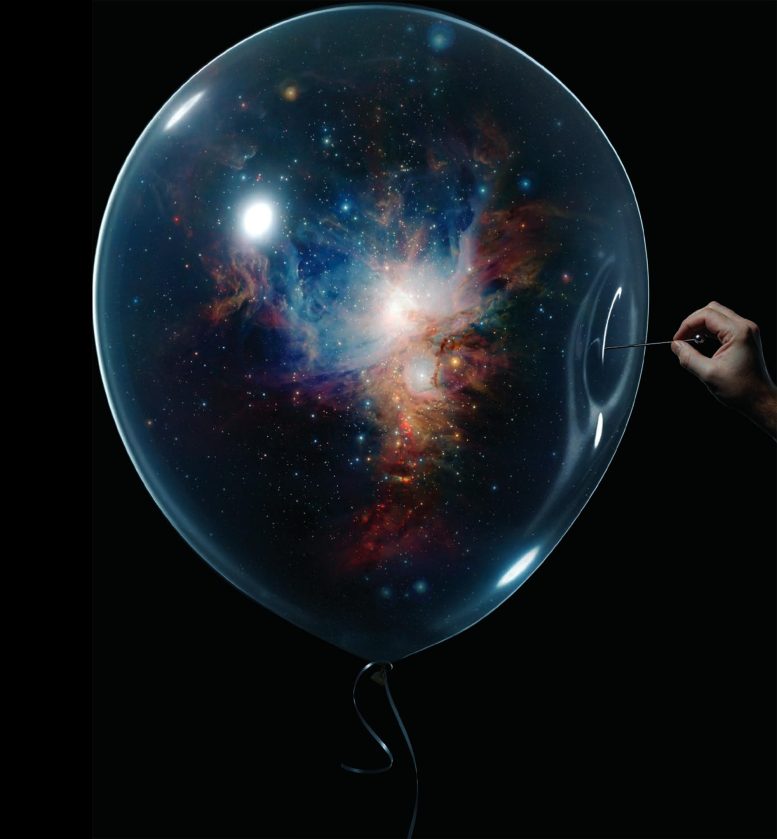
According to astrophysicists, cosmic inflation – a point in the Universe’s infancy when space-time expanded exponentially, and what physicists really refer to when they talk about the ‘Big Bang’ – can in principle be ruled out in an assumption-free way.
“Is it possible in principle to test cosmic inflation in a model-independent way?” Sunny Vagnozzi
There is a clear, unambiguous signal in the cosmos which could eliminate inflation as a possibility says a group of astrophysicists from the University of Cambridge, the University of Trento, and Harvard University. Published on November 3 in The Astrophysical Journal Letters, their paper argues that this signal – known as the cosmic graviton background (CGB) – can feasibly be detected, although it will be a massive technical and scientific challenge.
“Inflation was theorized to explain various fine-tuning challenges of the so-called hot Big Bang model,” said the paper’s first author Dr. Sunny Vagnozzi, from Cambridge’s Kavli Institute for Cosmology, and who is now based at the University of Trento. “It also explains the origin of structure in our Universe as a result of quantum fluctuations.
“However, the large flexibility displayed by possible models for cosmic inflation which span an unlimited landscape of cosmological outcomes raises concerns that cosmic inflation is not falsifiable, even if individual inflationary models can be ruled out. Is it possible in principle to test cosmic inflation in a model-independent way?”
Cosmic Microwave Background and Early Critiques of Inflation
In 2013, some scientists raised concerns about cosmic inflation when the Planck satellite released its first measurements of the cosmic microwave background (CMB), the universe’s oldest light.
“When the results from the Planck satellite were announced, they were held up as a confirmation of cosmic inflation,” said Professor Avi Loeb from Harvard University, Vagnozzi’s co-author on the current paper. “However, some of us argued that the results might be showing just the opposite.”
Along with Anna Ijjas and Paul Steinhardt, Loeb was one of those who argued that results from Planck showed that inflation posed more puzzles than it solved. They also made the case that it was time to consider new ideas about the beginnings of the universe, which, for example, may have begun not with a bang but with a bounce from a previously contracting cosmos.
The maps of the CMB released by Planck represent the earliest time in the universe we can ‘see’, 100 million years before the first stars formed. We cannot see farther.
“The actual edge of the observable universe is at the distance that any signal could have traveled at the speed-of-light limit over the 13.8 billion years that elapsed since the birth of the Universe,” said Loeb. “As a result of the expansion of the universe, this edge is currently located 46.5 billion light years away. The spherical volume within this boundary is like an archaeological dig centered on us: the deeper we probe into it, the earlier is the layer of cosmic history that we uncover, all the way back to the Big Bang which represents our ultimate horizon. What lies beyond the horizon is unknown.”
The Role of Neutrinos in Understanding the Universe’s Beginnings
By studying near-weightless particles known as neutrinos, which are the most abundant particles that have mass in the universe, it could be possible to dig even further into the universe’s beginnings. The Universe allows neutrinos to travel freely without scattering from approximately a second after the Big Bang, when the temperature was ten billion degrees. “The present-day universe must be filled with relic neutrinos from that time,” said Vagnozzi.
Vagnozzi and Loeb say we can go even further back, however, by tracing gravitons, particles that mediate the force of gravity.
“The Universe was transparent to gravitons all the way back to the earliest instant traced by known physics, the Planck time: 10 to the power of -43 seconds, when the temperature was the highest conceivable: 10 to the power of 32 degrees,” said Loeb. “A proper understanding of what came before that requires a predictive theory of quantum gravity, which we do not possess.”
Cosmic Graviton Background: A Test of Cosmic Inflation
Vagnozzi and Loeb say that once the Universe allowed gravitons to travel freely without scattering, a relic background of thermal gravitational radiation with a temperature of slightly less than one degree above absolute zero should have been generated: the cosmic graviton background (CGB).
However, the Big Bang theory does not allow for the existence of the CGB, as it suggests that the exponential inflation of the newborn universe diluted relics such as the CGB to a point that they are undetectable. This can be turned into a test: if the CGB were detected, clearly this would rule out cosmic inflation, which does not allow for its existence.
Vagnozzi and Loeb argue that such a test is possible, and the CGB could in principle be detected in the future. The CGB adds to the cosmic radiation budget, which otherwise includes microwave and neutrino backgrounds. It, therefore, affects the cosmic expansion rate of the early Universe at a level that is detectable by next-generation cosmological probes, which could provide the first indirect detection of the CGB.
However, to claim a definitive detection of the CGB, the ‘smoking gun’ would be the detection of a background of high-frequency gravitational waves peaking at frequencies around 100 GHz. This would be very hard to detect and would require tremendous technological advances in gyrotron and superconducting magnets technology. Nevertheless, say the researchers, this signal may be within our reach in the future.
Reference: “The Challenge of Ruling Out Inflation via the Primordial Graviton Background” by Sunny Vagnozzi and Abraham Loeb, 3 November 2022, The Astrophysical Journal Letters.
DOI: 10.3847/2041-8213/ac9b0e
Never miss a breakthrough: Join the SciTechDaily newsletter.
Follow us on Google and Google News.
4 Comments
Big Bang or Bounce, whichever occurred then it must have originally came from an existing multiverse. That is the only sensible explanation for how a grandiose explosion could also create all the multitude of atomic particles and laws of the universe that currently exist. Explosions destroy things, not create them.
Contending that an explosion of some dense matter also created all the myriad atomic particles at the same time, codified how they operate and imparted all the physical laws they operate under is equivalent to imagining that an atomic bomb explosion is going to produce a fully operational city with fully working nice and shiny infrastructure, including properly synchronized street lights and working elevators, among many other things. That’s just delusional.
Which still leaves the question as to who/what/how the particles and laws imparted to our universe came to exist in the origin multiverse? And if your answer is some god being, then where did the god being come from?
A Big Bounce view of the universe is possible but has its own troubles. Another view, from concepts in String Theory, describes how inflation started and stopped, where the matter and energy came from in the first place, and how everything will continue with a different kind of bounce.
Surely you didn’t think all of the matter and energy we see now was stuffed in a single Big Bang! As you may know, quantum mechanics proposes a roiling quantum foam energy field everywhere in the universe, and the right kind of energy spikes creates string/anti-string pairs. These pairs immediately annihilate each other, but I suggest a process similar to Hawking radiation that form permanent strings that are the basis of all the matter and energy we have. This is a Big Bang/Big Crunch cycle, over and over, that also describes how inflation started and stopped. Interestingly, this same process can be used to form the galaxies we see. Gravity is far too weak to cause anything to combine rather than flying apart from the enormous force of the Big Bang. Specifics for the physical creation of the universe and the galaxies can be found by searching YouTube for “Creating Universes – A String Theory Way”
The ‘Big Bang’ is the result of a black hole. Physicists and Astronomers are constantly looking for the beginning, but it’ll never be found. Until we can observe the backside of a black hole, we can just offer up conjectures about the origins of the observable universe. Black holes are the creators of multiple universes. We live in just one of probably dozens of multiverses. I was once told during an astronomy class at Arizona State University, that the universe has a central starting point and it’s expanding equally in all directions. If that’s true, we should be able to see, simultaneously, both the future and past through the cosmos. But we can only look backwards in time.
AFAIK the graviton remains theoretical.