
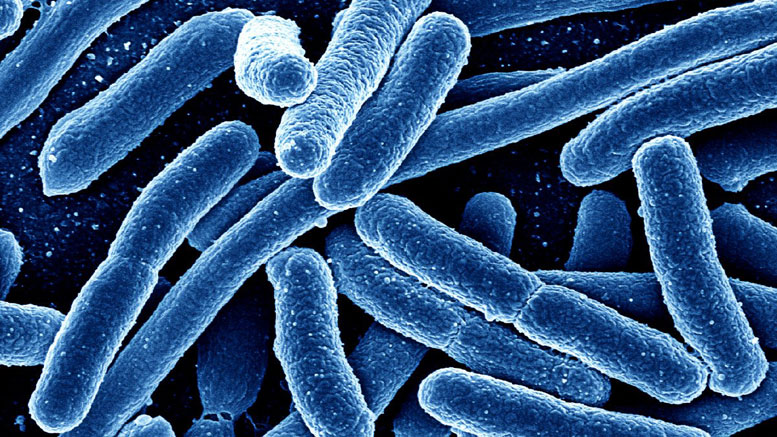
Three new studies by University of Maryland School of Medicine (UMSOM) scientists have identified key factors that help microbes survive in harsh environments.
The results, which have implications for biotechnology and understanding life in extreme conditions, were in the Proceedings of the National Academy Of Sciences (PNAS), Astrobiology, and the International Journal of Astrobiology.
“Our work capitalizes on the abundance of genomic and transcriptomic data. Genomic data represent road maps, and genetics, biochemistry, and microbiology are the vehicles for exploring and expanding knowledge,” said the principal author on the studies, Shiladitya DasSarma, professor at the Institute of Marine and Environmental Technology in the UMSOM Department of Microbiology and Immunology “Using this interdisciplinary approach in our series of recent papers, we have better defined the limits to life and the mechanisms that these hardy microbes and their proteins use to survive and function in cold, salty, and water-limited environments, such as exist on Mars. Our studies also have applications in green biotechnology here on Earth.”
The recent PNAS article builds on a previous analysis by Prof. DasSarma and several colleagues, which identified key proteins in microbes found in extremely salty environments. They examined the amino acid composition of several of the microbe’s proteins. The protein surfaces are negatively supercharged compared to all other organisms. These proteins use the negative charges to tightly bind water molecules in order to stay in solution and combat the effects of high levels of salt and dryness. They focused on a microbe called H. lacusprofundi (Hla), from Deep Lake, a very salty lake in Antarctica.
They wanted to find out how proteins from the microbe function in the dual extremes of very salty, very cold environments. They found that certain amino acids were more prevalent in the microbe. They focused on one enzyme, beta-galactosidase. They discovered key differences between versions of the enzyme in Hla and versions in microbes that live in temperate environments. Among the key differences: looser packing of atoms and greater flexibility in cold-functioning enzymes.
Another study, published today in the journal Astrobiology, expands the study, by examining the role of enzymes in the microbe’s ability to survive in the presence of toxic salts. This research has implications for decontamination of toxic environments, as well as life on other planets such as Mars, where these toxic salts, particularly one called magnesium perchlorate, have been identified on the surface.
The third study, published last month in the International Journal of Astrobiology, showed that Hla and other similarly hardy microbes can survive trips into the stratosphere, many miles above the Earth’s surface, where conditions are similar to those on Mars. The stratosphere is extremely cold, has little oxygen, and has high levels of damaging ultraviolet radiation.
These studies also have the potential to be useful for biotechnology. The approach in the PNAS study could be used for designing valuable enzymes that function at lower temperatures. For example, modified beta-galactosidase can be used for making lactose-free milk in cold temperatures, and other enzymes can be tailored for other “green” industrial processes at reduced temperatures, thereby reducing the amount of energy required in the manufacturing process. Perchlorate is used in rocket fuel and fireworks and is a common toxic contaminant in some groundwater. The work in Astrobiology could lead to a method for its removal.
Never miss a breakthrough: Join the SciTechDaily newsletter.
Follow us on Google and Google News.
1 Comment
Important points in this article that we should be aware of as to how you could possibly survive on other planets. This would somehow be a big help. Thanks for sharing this one out.