
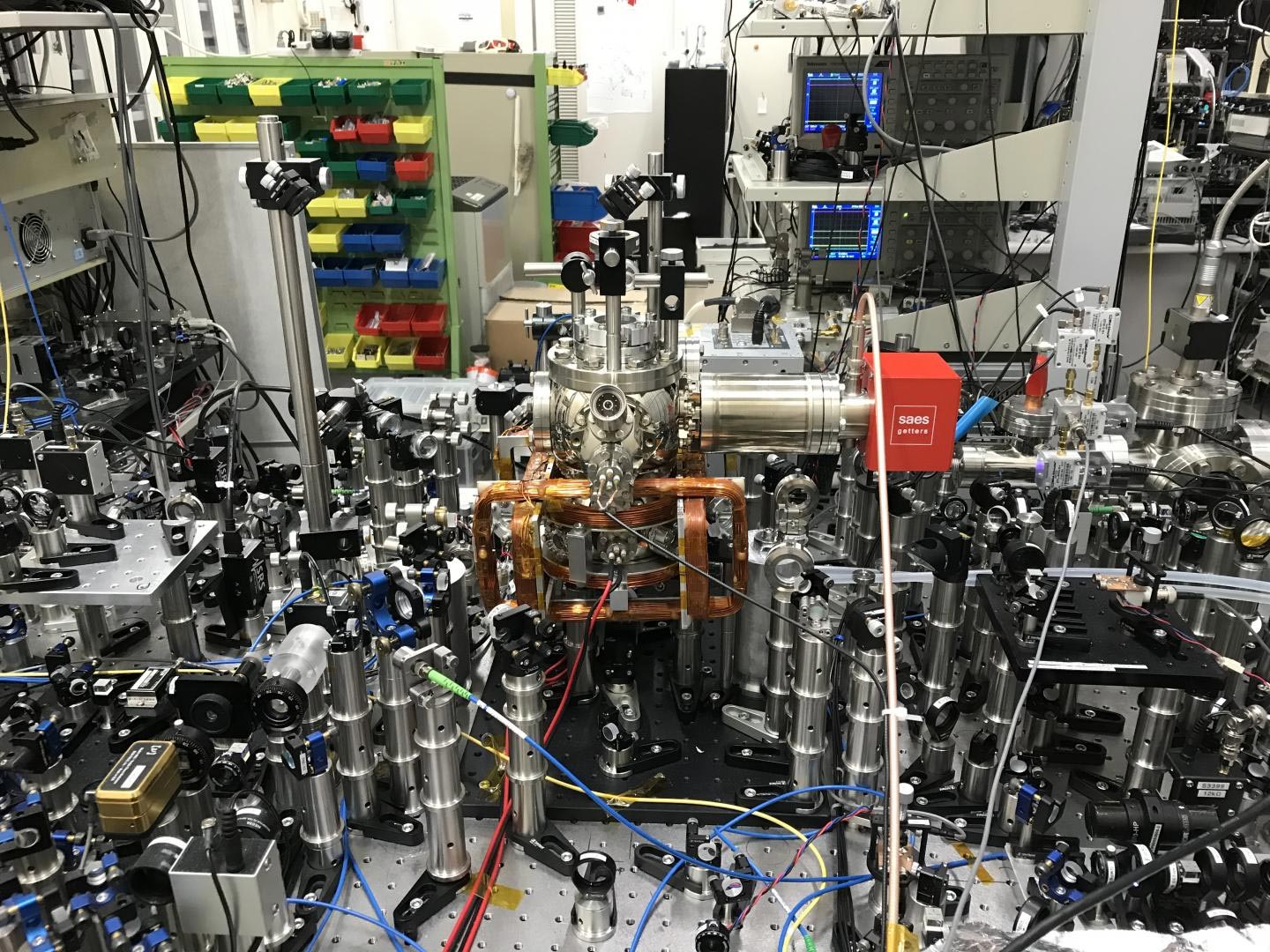
Researchers experimentally determined a property of cadmium called the magic wavelength which is considered essential for the development of the most accurate clocks ever envisaged. The researchers hope this may permit simple and robust atomic clocks so accurate they could be used to improve our understanding of current theories and even test for new physics.
What time do you make it? How about now? Time is constantly changing but it is not changing constantly. It sounds confusing, but since Einstein’s time, we’ve known that time progresses at different rates depending on where you are. This is mainly due to the effect of gravity, the stronger gravity is in your vicinity the slower time progresses relative to where gravity is weaker. To us this difference is imperceptible, but highly accurate atomic clocks can measure it.
These imperceptible differences in the rate of the passage of time are far from trivial, however. Accurate measurements of time can actually help researchers measure other corresponding quantities which relate to how time flows at a specific location. For example given the way increased gravitational strength alters the passage of time, the density of material below your feet could be accurately measured with a sufficiently accurate clock. And this kind of information could be useful to those who study volcanoes, plate tectonics, and earthquakes.
However, measuring time at the accuracies required for such purposes is an immensely complex challenge. State-of-the-art atomic clocks based on the vibration of atoms such as cesium, for example, operate with uncertainty — the opposite of accuracy — in the region of 1×10-16 or to 16 decimal places. This is extremely accurate for the measurement of distance and is thus used in current global positioning system (GPS) technology. But researchers strive for even greater accuracy, and one kind of clock may be able to offer uncertainties as low as 1×10-19 or to 19 decimal places. The optical lattice clock promises to offer such accuracy.
First proposed by Professor Hidetoshi Katori from the Department of Applied Physics in 2001, the idea is to trap a large number of atoms in a lattice of lasers. With many atoms trapped their vibrations can be measured simultaneously, which greatly improves the accuracy of the measurement of time. Isotopes of Cadmium are ideal as they have some properties which help to reduce noise in this kind of quantum system. But in order to create a clock based on this principle, there are several hurdles to overcome, and researchers have just jumped one.
“We experimentally determined the so-called ‘magic wavelength’ for cadmium which is one of the essential parameters to operate the optical lattice clock,” said research scientist Atsushi Yamaguchi from RIKEN. “In a lattice clock, the optical lattice is created by interference patterns of laser light, the wavelength of which is related to the atoms the lattice needs to hold. The optimal or ‘magic’ wavelength to construct a lattice around Cadmium isotopes is around 419.88 nanometers, which is almost exactly the value of 420.10 nanometers we originally predicted.”
One important feature of Cadmium isotopes which makes them ideal for lattice clocks is that they are more robust to changes to their environment than many other atoms and isotopes. An application the researchers aim for is the ability to make measurements in different locations with the same device, meaning it must be relatively portable, so it helps to be robust. With the theory in place, researchers now wish to evaluate the performance of such a clock.
“Careful and detailed evaluation is required so scientists in different fields can make use of this high-precision instrument,” explained Katori. “Such a device will afford us the chance to study and maybe one day challenge established ideas in cosmology such as general relativity and perhaps even the fundamental constants of nature.”
###
Reference: “Narrow-line Cooling and Determination of the Magic Wavelength of Cd” by A. Yamaguchi, M. S. Safronova, K. Gibble and H. Katori, 13 September 2019, Physical Review Letters.
DOI: 10.1103/PhysRevLett.123.113201
Never miss a breakthrough: Join the SciTechDaily newsletter.
Follow us on Google and Google News.