

A revolutionary achievement could pave the way for smaller, more efficient nuclear clocks.
Last year, a research team led by UCLA achieved a milestone scientists had pursued for half a century. They succeeded in making radioactive thorium nuclei interact with light by absorbing and emitting photons, similar to how electrons behave inside atoms. First envisioned by the group in 2008, the breakthrough is expected to transform precision timekeeping and could significantly improve navigation systems, while also opening the door to discoveries that challenge some of the most basic constants in physics.
The advance comes with a major limitation. The required isotope, thorium-229, exists only as a byproduct of weapons-grade uranium, making it extremely rare. Researchers estimate that just 40 grams of this material are currently available worldwide for use in nuclear clock research.
A new study now shows a way around this obstacle. An international collaboration led by UCLA physicist Eric Hudson has developed an approach that uses only a small fraction of the thorium needed in earlier experiments, while delivering the same results previously achieved with specialized crystals. Described in Nature, the technique is both straightforward and low cost, raising the possibility that nuclear clocks could one day be small and affordable enough to fit into everyday devices like phones or wristwatches. Beyond consumer electronics, the clocks could replace existing systems used in power grids, cell phone towers, and GPS satellites, and may even support navigation where GPS is unavailable, such as in deep space or underwater.
A simple process improves what originally took 15 years to figure out
Hudson’s team spent 15 years developing the specialized thorium-doped fluoride crystals that enabled last year’s breakthrough. In those early experiments, thorium-229 atoms were bonded with fluorine in a carefully controlled structure that kept the radioactive material stable while allowing laser light to pass through and excite the nucleus. While effective, the crystals were challenging to produce and required relatively large amounts of the scarce thorium isotope.
“We did all the work of making the crystals because we thought the crystal had to be transparent for the laser light to reach the thorium nuclei. The crystals are really challenging to fabricate. It takes forever and the smallest amount of thorium we can use is 1 milligram, which is a lot when there’s only 40 or so grams available,” said first author and UCLA postdoctoral researcher Ricky Elwell, who received the 2025 Deborah Jin Award for Outstanding Doctoral Thesis Research in Atomic, Molecular, or Optical Physics for last year’s breakthrough.
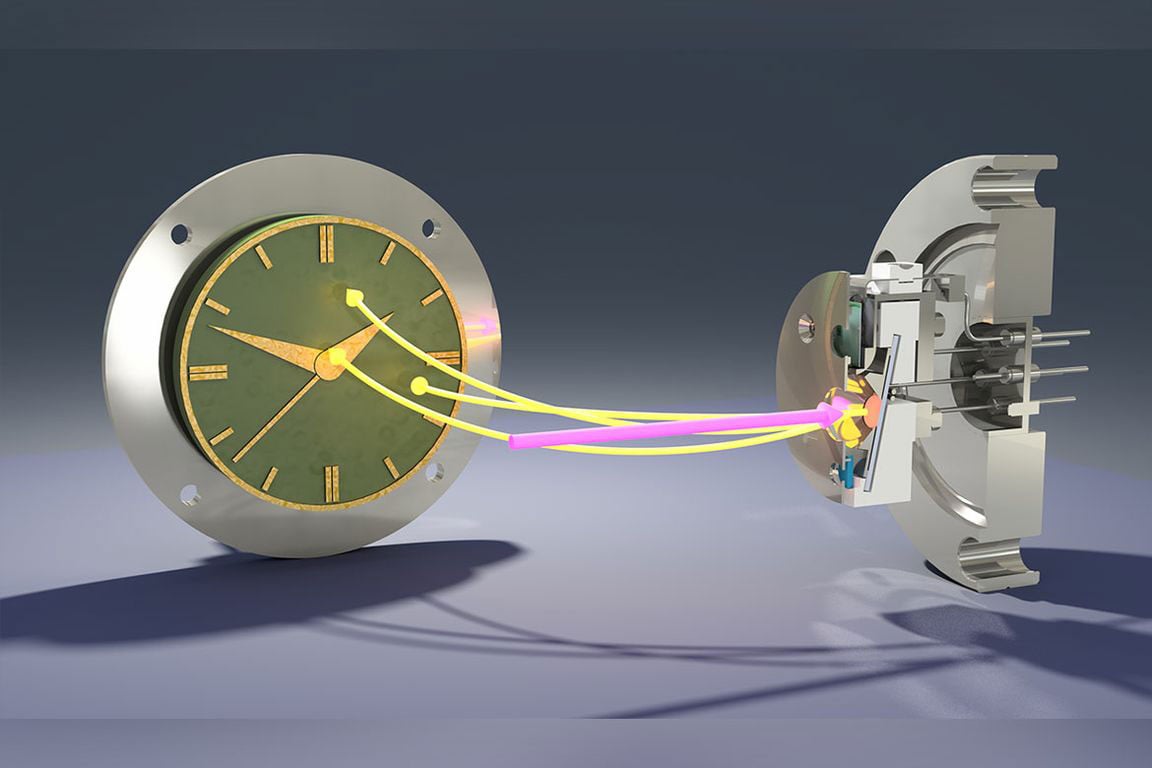
In the new work, Hudson’s group electroplated a minute amount of thorium onto stainless steel by slightly modifying a method used to electroplate jewelry. Electroplating, which was invented in the early 1800s, sends an electric current through an electrically conductive solution to deposit a thin layer of atoms from one metal onto another. In jewelry, for example, silver or gold is electroplated onto a less precious metal base.
“It took us five years to figure out how to grow the fluoride crystals and now we’ve figured out how to get the same results with one of the oldest industrial techniques and using 1,000 times less thorium. Further, the finished product is essentially a small piece of steel and much tougher than the fragile crystals,” said Hudson.
The key to getting this new system working was the realization that one fundamental assumption was wrong. Stimulating the nucleus enough with a laser, or exciting it, to observe its transition to a higher energy state, was easier than anyone thought
“Everyone had always assumed that in order to excite and then observe the nuclear transition, the thorium needed to be embedded in a material that was transparent to the light used to excite the nucleus. In this work, we showed that is simply not true,” said Hudson. “We can still force enough light into these opaque materials to excite nuclei near the surface, and then, instead of emitting photons like they do in transparent material such as the crystals, they emit electrons which can be detected simply by monitoring an electrical current — which is just about the easiest thing you can do in the lab!”
Thorium-based nuclear clocks could unlock satellite-free navigation
In addition to their expected impact on everything from communication technology, power grid synchronization and radar networks, next-generation clocks have long been sought as a solution to a problem with significant national security impact: navigating without GPS. If a bad actor — or even an electromagnetic storm — disabled enough satellites, all of our GPS navigation devices would fail. Similarly, submarines that dive deep in the ocean, where satellite signals cannot reach, already use atomic clocks for navigation, but current clocks are not accurate enough and after a few weeks, the submarines must surface to verify their location. In these demanding environments, the nuclear clock, which is better protected from its environment, excels over current atomic clocks.
“The UCLA team’s approach could help reduce the cost and complexity of future thorium‑based nuclear clocks,” said Makan Mohageg, optical clock lead at Boeing Technology Innovation. “Innovations like these may contribute to more compact, high‑stability timekeeping, relevant to several aerospace applications.”
And, if Earthlings ever want to travel into space, we need even more improved clocks for the same reason.
“The UCLA group led by Eric Hudson has done amazing work in teasing out a viable way to probe the nuclear transition in thorium — work extending over more than a decade. This work opens the way to a viable thorium clock,” said Eric Burt, who leads the High Performance Atomic Clock project at the NASA Jet Propulsion Laboratory and was not involved in the research. “In my opinion, thorium nuclear clocks could also revolutionize fundamental physics measurements that can be performed with clocks, such as tests of Einstein’s theory of relativity. Due to their inherent low sensitivity to environmental perturbations, future thorium clocks may also be useful in setting up a solar-system-wide time scale essential for establishing a permanent human presence on other planets.”
Reference: “Laser-based conversion electron Mössbauer spectroscopy of 229ThO2” by Ricky Elwell, James E. S. Terhune, Christian Schneider, Harry W. T. Morgan, Hoang Bao Tran Tan, Udeshika C. Perera, Daniel A. Rehn, Marisa C. Alfonso, Lars von der Wense, Benedict Seiferle, Kevin Scharl, Peter G. Thirolf, Andrei Derevianko and Eric R. Hudson, 10 December 2025, Nature.
DOI: 10.1038/s41586-025-09776-4
The research was funded by the National Science Foundation and included physicists from the University of Manchester, University of Nevada Reno, Los Alamos National Laboratory, Ziegler Analytics, Johannes Gutenberg-Universität at Mainz, and Ludwig-Maximilians-Universität München.
Never miss a breakthrough: Join the SciTechDaily newsletter.
Follow us on Google and Google News.
7 Comments
One of the unexplored ‘tricks’ in design, are use of thin films.
PS, all time dependent math Constants will be effected by each new clock that cometh. I believe they have already decided that the length of the Meter shall forever now be changed from a thing specified and tied to whatever any new clock becomes acceptable. This little ‘wiggly’ allows all the math people to go right along, humdrum, and not to worry.
In these demanding environments, the nuclear clock, which is better protected from its environment, excels over current atomic clocks.
WHY?
Please ask researchers to think deeply:
Where does the periodicity of nuclear clocks come from?
When we pursue the ultimate truth of all things, the space in which our bodies and all things exist may itself be the final and deepest puzzle we need to explore. This is not only the pursuit of physics, but also the most magnificent exploration of the origin of the universe by human reason.
Based on the Topological Vortex Theory (TVT), space is an uniformly incompressible physical entity. Space-time vortices are the products of topological phase transitions of the tipping points in space, are the point defects in spacetime. Point defects do not only impact the thermodynamic properties, but are also central to kinetic processes. They create all things and shape the world through spin and self-organization.
In today’s physics, some so-called peer-reviewed journals—including Physical Review Letters, Nature, Science, and others—stubbornly insist on and promote the following:
1. Even though θ and τ particles exhibit differences in experiments, physics can claim they are the same particle. This is science.
2. Even though topological vortices and antivortices have identical structures and opposite rotational directions, physics can define their structures and directions as entirely different. This is science.
3. Even though two sets of cobalt-60 rotate in opposite directions and experiments reveal asymmetry, physics can still define them as mirror images of each other. This is science.
4. Even though vortex structures are ubiquitous—from cosmic accretion disks to particle spins—physics must insist that vortex structures do not exist and require verification. Only the particles that like God, Demonic, or Angelic are the most fundamental structures of the universe. This is science.
5. Even though everything occupies space and maintains its existence in time, physics must still debate and insist on whether space exists and whether time is a figment of the human mind. This is science.
6. Even though space, with its non-stick, incompressible, and isotropic characteristics, provides a solid foundation for the development of physics, physics must still insist that the ideal fluid properties of space do not exist. This is science.
and go on.
Is this the counterintuitive science they widely promote? Compromising with pseudo academic publications and peer review by pseudo scholars is an insult to science and public intelligence. Some so-called scholars no longer understand what shame is. The study of Topological Vortex Theory (TVT) reminds us that the most profound problems in physics often lie at the intersection of different theories. By exploring these border regions, we can not only resolve contradictions in existing theories but also discover new physical phenomena and application possibilities.
Under the topological vortex architecture, it is highly challenging for even two hydrogen atoms or two quarks to be perfectly symmetrical, let alone counter-rotating two sets of cobalt-60. Contemporary physics and so-called peer-reviewed publications (including Physical Review Letters, Science, Nature, etc.) stubbornly believe that two sets of counter rotating cobalt-60 are two mirror images of each other, constructing a more shocking pseudoscientific theoretical framework in the history of science than the “geocentric model”. This pseudo scientific framework and system have seriously hindered scientific progress and social development.
For nearly a century, physics has been manipulated by this pseudo scientific theoretical system and the interest groups behind it, wasting a lot of manpower, funds, and time. A large amount of pseudo scientific research has been conducted, and countless pseudo scientific papers have been published, causing serious negative impacts on scientific and social progress, as well as humanistic development.
Complexity does not necessarily mean that there is no logical and architectural framework to follow. Mathematics is the language and tool that reveals the motion of spacetime, rather than the motion itself. Although the physical form of spacetime vortices is extremely simple, their interaction patterns are highly complex, and we must develop more and richer mathematical languages to describe and understand them.
The development of the Topological Vortex Theory (TVT) reflects a progression from concrete physical phenomena to abstract mathematical modeling and, ultimately, to interdisciplinary unification. Its core innovation lies in forging the continuous spacetime geometry of general relativity with the discrete interactions of quantum field theory within the same topological dynamical system.
——Excerpted from https://scitechdaily.com/microscope-spacecrafts-most-precise-test-of-key-component-of-the-theory-of-general-relativity/#comment-909171.
First numbers are applied to some subject – then a constant is applied, which contracts the number product. Not much thought seems offered to the fact that, once applied, a constant contracts every number. Even the distance between 0 and 1. No number is the same size, nor same value.
Kind-a creates a vortex of the scientific mind. Or discipline-wide ring around the rosey.
Bao-hua ZHANG on December 15, 2025 10:17 pm
VERY GOOD.
It is not advisable to be too obsessed with numbers, as the world is geometric and topological. The mathematical formalism of quantum mechanics is highly successful, yet its physical interpretation has long been shrouded in mystification, leading to a series of philosophical dilemmas detached from physical reality. Quantum mechanics is an effective mathematical tool for describing the behavior of low-dimensional spacetime matter, but its mystified interpretation has severely hindered the progress of physics.
Topological Vortex Theory (TVT), through a set of concise yet profound mathematical formulas, provides a promising theoretical framework for unifying spacetime, gravity [1], and quantum phenomena. Its mathematical skeleton not only demonstrates the powerful role of topological methods [4, 6, 8] in fundamental physics but also opens new paths for understanding the fundamental laws of the universe. Although TVT is still under development, its core idea—that the nature of the physical world is topological—has shown unique insight and explanatory potential. With the refinement of mathematical tools and deeper physical applications, TVT is expected to make substantive contributions to solving quantum gravity [5] puzzles and exploring the origin of matter.
VERY GOOD.
It is not advisable to be too obsessed with numbers, as the world is geometric and topological. The mathematical formalism of quantum mechanics is highly successful, yet its physical interpretation has long been shrouded in mystification, leading to a series of philosophical dilemmas detached from physical reality. Quantum mechanics is an effective mathematical tool for describing the behavior of low-dimensional spacetime matter, but its mystified interpretation has severely hindered the progress of physics.
Topological Vortex Theory (TVT), through a set of concise yet profound mathematical formulas, provides a promising theoretical framework for unifying spacetime, gravity [1], and quantum phenomena. Its mathematical skeleton not only demonstrates the powerful role of topological methods [4, 6, 8] in fundamental physics but also opens new paths for understanding the fundamental laws of the universe. Although TVT is still under development, its core idea—that the nature of the physical world is topological—has shown unique insight and explanatory potential. With the refinement of mathematical tools and deeper physical applications, TVT is expected to make substantive contributions to solving quantum gravity [5] puzzles and exploring the origin of matter.