
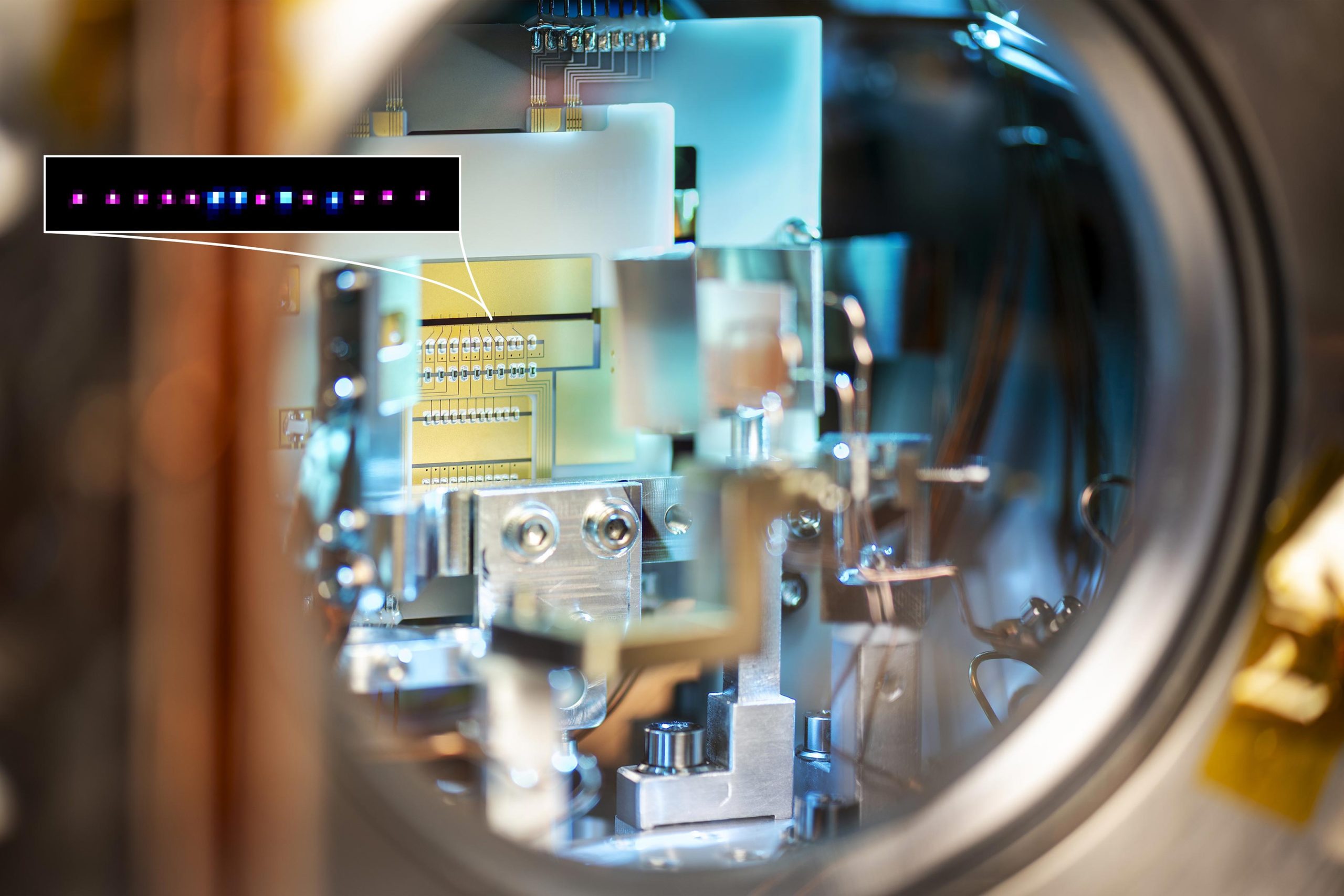
Breakthrough Optical Atomic Clock Sets New Accuracy Record in Quest to Redefine the Second
The next generation of atomic clocks operates using laser frequencies, which “tick” approximately 100,000 times faster than the microwave frequencies used in today’s cesium clocks – the current standard for defining the second. Although optical clocks are still under evaluation, some have already proven to be 100 times more accurate than cesium-based clocks. This remarkable precision positions them as the future foundation for defining the second in the International System of Units (SI).
Before optical clocks can replace cesium clocks, they must undergo rigorous testing and global comparisons to confirm their reliability. The Physikalisch-Technische Bundesanstalt (PTB), a world-leading metrology institute, has played a significant role in advancing this technology by developing various types of optical clocks, including single-ion clocks and optical lattice clocks.
Recently, PTB demonstrated groundbreaking accuracy in a new type of optical clock known as the ion crystal clock. This innovation has the potential to measure time and frequency with 1,000 times greater accuracy than the cesium clocks currently used to define the SI second. The new clock’s precision was validated through comparisons with other optical clocks, setting a new benchmark for accuracy. The findings from these tests have been published in the latest issue of Physical Review Letters.

Harnessing Laser Precision in Optical Atomic Clocks
In an optical atomic clock, atoms are irradiated by laser light. If the laser has the correct frequency, the atoms change their quantum-mechanical state. For this purpose, the atoms have to be shielded from any external influences – and remaining influences must be measured accurately. This works very well for optical clocks with trapped ions. The ions can be trapped by means of electrical fields and kept in place within a few nanometers in vacuum. Thanks to this outstanding control and isolation we can get very close to an ideal, undisturbed quantum system. Ion clocks have therefore already reached relative systematic uncertainties beyond the 18th decimal place. Such a clock, if it had been ticking since the Big Bang, would have lost one second at most.
To date, these clocks have been operated with one individual clock ion. Its weak signal must be measured over long periods of time – up to two weeks – in order to measure the frequency with such a low uncertainty. To exploit the full potential, it would even require measuring times of more than three years.

Revolutionizing Timekeeping with Ion Crystals
The newly developed clock will drastically shorten this measuring time by parallelizing: Multiple ions – often of different kinds – will be simultaneously trapped in one trap. By interacting, they form a new, crystalline structure. “In addition, this concept allows the strengths of different types of ions to be combined”, explains PTB physicist Jonas Keller: “We use indium ions as they have favorable properties to achieve high accuracy. For efficient cooling, ytterbium ions are added to the crystal.”
One of the challenges was the development of an ion trap that provides high-accuracy conditions for such a spatially extended crystal, rather than just a single ion. Another challenge was to develop experimental methods to position the cooling ions within the crystal. Research group leader Tanja Mehlstäubler and her team were able to solve these issues with impressive new ideas: The clock currently reaches an accuracy close to the 18th decimal place.
Comparing Clocks for Unmatched Precision
Two further optical and one microwave clock systems of PTB participated in the comparisons: a single-ion ytterbium clock, a strontium lattice clock, and a cesium fountain clock. The ratio of the indium clock to the ytterbium clock is the first to reach an overall uncertainty lower than the limit required for such comparisons by the roadmap for the redefinition of the second.
The concept promises a new generation of highly stable and accurate optical ion clocks. It is also applicable to other types of ions and opens up new opportunities of entirely new clock concepts such as the use of quantum many-body states or the cascaded interrogation of several ensembles.
Reference: “115In+−172Yb+ Coulomb Crystal Clock with 2.5×10⁻¹⁸ Systematic Uncertainty” by H. N. Hausser, J. Keller, T. Nordmann, N. M. Bhatt, J. Kiethe, H. Liu, I. M. Richter, M. von Boehn, J. Rahm, S. Weyers, E. Benkler, B. Lipphardt, S. Dörscher, K. Stahl, J. Klose, C. Lisdat, M. Filzinger, N. Huntemann, E. Peik and T. E. Mehlstäubler, 16 January 2025, Physical Review Letters.
DOI: 10.1103/PhysRevLett.134.023201
This work was partly funded by the German Research Foundation (DFG) within the framework of the Quantum Frontiers Cluster of Excellence and of the DQ-mat Collaborative Research Center.
Never miss a breakthrough: Join the SciTechDaily newsletter.
Follow us on Google and Google News.
2 Comments
An intresting advance. When we start talking about this kind of accuracy, though, I start to wonder about relativistic effects, e.g. the rate at which the clock “ticks” in Earth’s gravity field. Can we assume the researchers at different locations are taking global gravity variations into account? Could someone give examples of the benefits gained by such an improvement in time accuracy?
Such a clock, if it had been ticking since the Big Bang, would have lost one second at most.
VERY GOOD.
Ask the researchers:
1. How do you understand time?
2. Is this clock in Earth time, solar time, or something else?
3. Is Physical Review Letters a scientific publication?
4. How do you define scientific publications?
Scientific research guided by correct theories can enable researchers to think more.
According to the Topological Vortex Theory (TVT), spins create everything, spins shape the world. There are substantial distinctions between Topological Vortex Theory (TVT) and traditional physical theories. Grounded in the inviscid and absolutely incompressible spaces, TVT introduces the concept of topological phase transitions and employs topological principles to elucidate the formation and evolution of matter in the universe, as well as the impact of interactions between topological vortices and anti-vortices on spacetime dynamics and thermodynamics.
Within TVT, low-dimensional spacetime matter serves as the foundation for high-dimensional spacetime matter, and the hierarchical structure of matter and its interaction mechanisms challenge conventional macroscopic and microscopic interpretations. The conflict between Quantum Physics and Classical Physics can be attributed to their differing focuses: Quantum Physics emphasizes low-dimensional spacetime matter, whereas Classical Physics centers on high-dimensional spacetime matter.
Subatomic particles in the quantum world often defy the familiar rules of the physical world. The fact repeatedly suggests that the familiar rules of the physical world are pseudoscience. In the familiar rules of the physical world, two sets of cobalt-60 can form the mirror image of each other by rotating in opposite directions, and can receive heavy rewards.
Please witness the grand performance of physics today. https://scitechdaily.com/microscope-spacecrafts-most-precise-test-of-key-component-of-the-theory-of-general-relativity/#comment-854286.
If the researchers are truly interested in time, please read: The Challenge of Topological Vortex Theory (TVT) to Traditional Time Concepts (https://scitechdaily.com/microscope-spacecrafts-most-precise-test-of-key-component-of-the-theory-of-general-relativity/#comment-869260).