
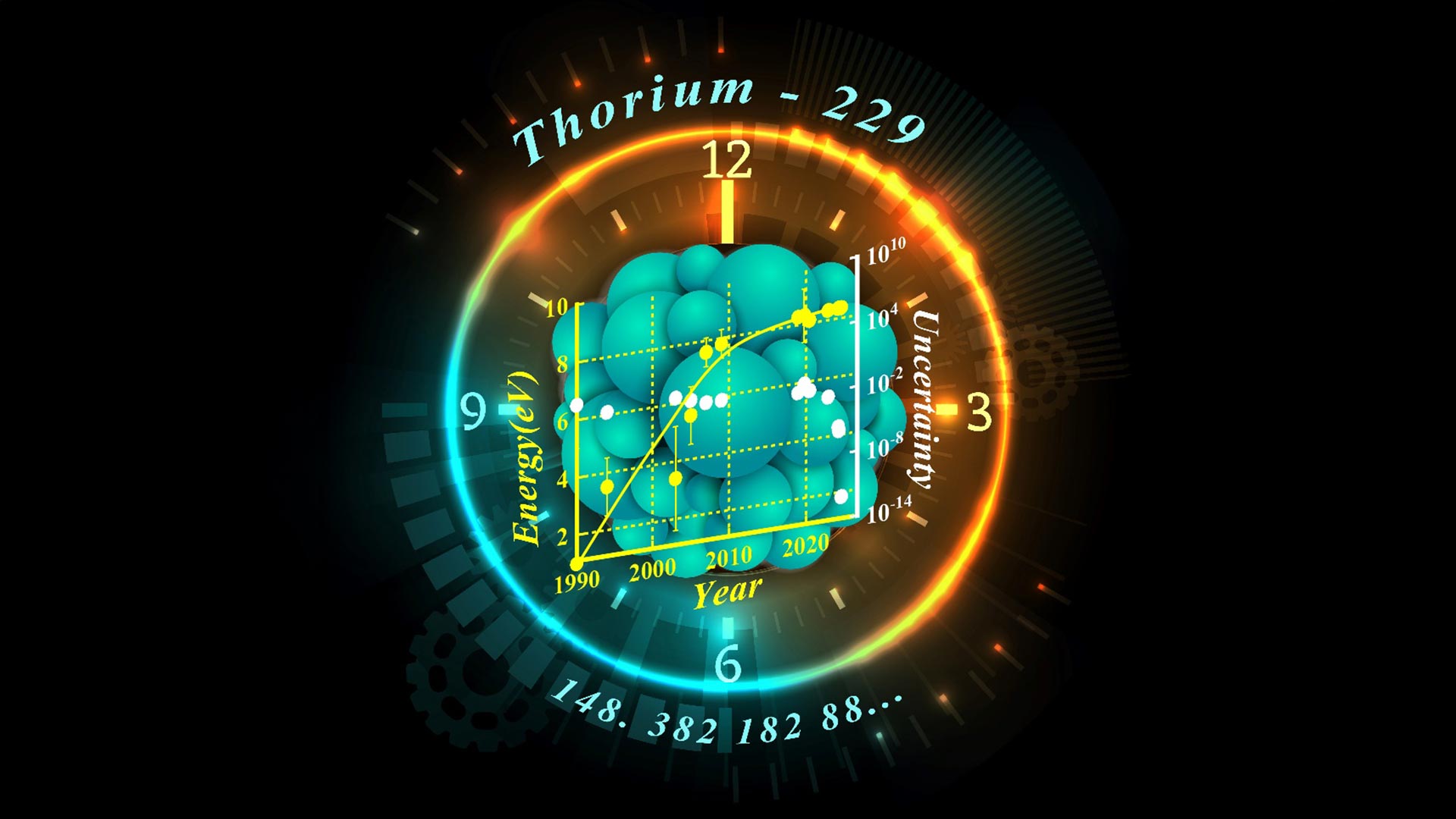
A revolutionary timekeeping breakthrough could be on the horizon as scientists explore the thorium-229 nuclear optical clock, an innovation that may surpass today’s atomic clocks.
By manipulating nuclear quantum states with lasers, researchers are pushing the boundaries of precision and stability in time measurement. Though the journey has spanned decades and major technical hurdles remain, recent experimental milestones have brought this futuristic clock closer to reality. If successful, it could reshape our understanding of time and the universe itself.
Pushing the Limits of Timekeeping
In a recent perspective article in National Science Review, Dr. Xin Tong of the Innovation Academy for Precision Measurement Science and Technology (Chinese Academy of Sciences) and his colleagues explore the exciting potential, and the significant challenges, of developing a nuclear optical clock based on thorium-229 (229Th).
Time and frequency are the most precisely measurable physical quantities in physics. Today, atomic clocks, particularly atomic optical clocks, set the standard for accuracy. But the thorium-229 nuclear optical clock could push this precision even further.
The Quantum Edge of Nuclear Clocks
What makes 229Th remarkable is that it’s the only known nuclide with a nuclear energy level low enough to be accessed with a laser. This enables scientists to manipulate nuclear quantum states directly. Since a nucleus is far smaller than an atom, it is much less affected by external influences. Its quantum states are also well-separated, and surrounding electrons help shield it from electromagnetic disturbances. These features make the 229Th nuclear optical clock a promising candidate for achieving unprecedented timekeeping precision.
The research journey began around half a century ago. Scientists first identified the low-lying excited nuclear state of 229Th, which laid the groundwork for further studies. Since then, there have been significant milestones. In 2024, direct laser excitation of the 229Th nuclear transition was achieved. Different research teams, such as those from Technische Universität (TU) Wien, the University of California at Los Angeles (UCLA), and the Joint Institute for Laboratory Astrophysics (JILA) have conducted experiments using various materials like doped crystals and thin films. These experiments have gradually improved the understanding and measurement capabilities related to nuclear transitions.
Ongoing Challenges in Nuclear Clock Development
Despite these remarkable achievements, numerous challenges remain. Nuclear transitions in solid-state environments are highly sensitive to temperature-related changes. The scarcity of 229Th isotope, the difficulty in developing a specific high-power, narrow-linewidth laser, the incomplete understanding of interaction mechanisms, and the lack of closed-loop manipulation are all major obstacles.
Nevertheless, overcoming these challenges is essential. The successful realization of the thorium nuclear clock would revolutionize timekeeping and open new frontiers in fundamental physics research. It could lead to a paradigm shift in optical clock systems, from relying on electronic to nuclear transitions, and provide deeper insights into the fundamental laws of the universe.
Reference: “The ticking of thorium nuclear optical clocks: a developmental perspective” by Xin Tong, Linqiang Hua, Xia Hua and Xiaojun Liu, 3 March 2025, National Science Review.
DOI: 10.1093/nsr/nwaf083
Never miss a breakthrough: Join the SciTechDaily newsletter.
Follow us on Google and Google News.
1 Comment
I have always thought that the CMB wave would be the most accurate time keeping , harness the movement into a consistent rotation .