
Researchers found that measuring a quantum clock consumes vastly more energy than the clock’s own operation—up to a billion times more.
By tracking single-electron jumps, they discovered that the act of turning quantum events into classical data drives most of the entropy. This makes measurement, not ticking, the true thermodynamic cost of quantum timekeeping.
Quantum Timekeeping’s Hidden Energy Drain
A team from the University of Oxford has uncovered an unexpected contributor to entropy in quantum timekeeping: the measurement process itself. In findings published today (November 14) in Physical Review Letters, the researchers show that the energy needed to read a quantum clock is far greater than the energy required to operate it. This result could shape how future quantum technologies are designed.
Traditional clocks, from swinging pendulums to atomic oscillators, depend on irreversible processes to track time. At the quantum level, these processes become extremely weak or may barely occur at all, making accurate timekeeping much more difficult. Devices that rely on precise timing, such as next-generation sensors and navigation systems, will need clocks that use as little energy as possible. Until now, however, scientists have not fully understood the thermodynamic behavior of clocks that function in the quantum realm.
Probing the True Cost of Measuring Time
The researchers set out to determine the actual thermodynamic expense of keeping time on the quantum scale, along with how much of that expense arises from the act of measurement itself.
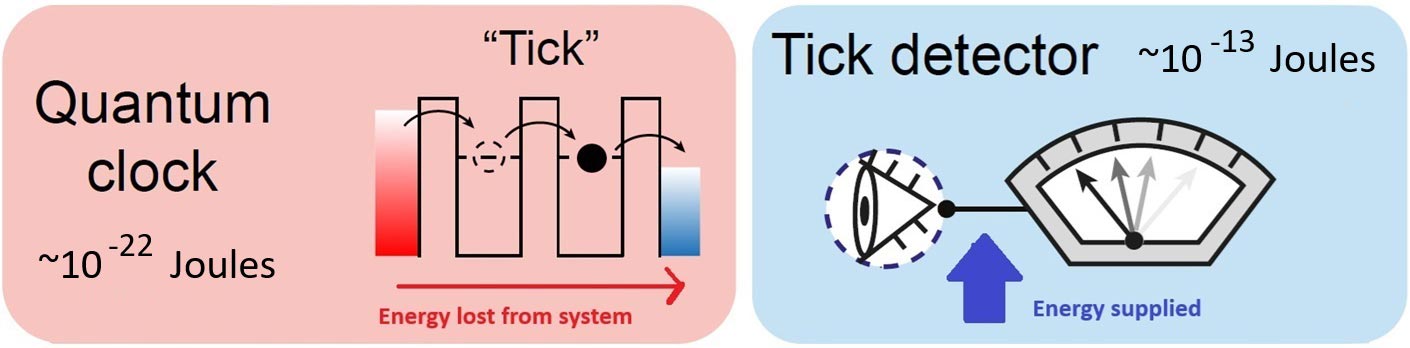
Their experiment involved building a tiny clock that uses single electrons moving between two nanoscale regions (known as a double quantum dot). Each hop serves as a tick of the clock. To observe these ticks, the team relied on two different detection methods; one captured very small electrical currents, and the other used radio waves to detect changes in the system. In each approach, the sensors translated the quantum activity (electron jumps) into classical information that can be recorded, creating a quantum-to-classical transition.
A Billion-Fold Surprise in Measurement Entropy
The team calculated how much entropy (the amount of energy dissipated) was produced by the clockwork itself (i.e., the double quantum dot) and by the measurement hardware. They discovered that reading the clock (i.e., converting its tiny signals into something measurable) can require up to a billion times more energy than the clock consumes while running. This finding overturns the long-standing assumption that measurement costs in quantum physics are negligible. It also reveals a striking idea: observation is what gives time its direction by making the process irreversible.
This result challenges the common belief that improving quantum clocks requires better quantum systems. Instead, the researchers argue that progress will depend on developing more efficient ways to detect and interpret the ticks.
A Paradox That Improves Precision
Lead author Professor Natalia Ares (Department of Engineering Science, University of Oxford) said: “Quantum clocks running at the smallest scales were expected to lower the energy cost of timekeeping, but our new experiment reveals a surprising twist. Instead, in quantum clocks, the quantum ticks far exceed that of the clockwork itself.”
However, according to the researchers this imbalance could be a feature, not a flaw. The extra measurement energy can give more information about the clock’s behaviour: not just a tick count, but a detailed record of every small change. This opens up new ways for achieving highly precise clocks more efficiently.
Co-author Vivek Wadhia (PhD student, Department of Engineering Science) said: “Our results suggest that the entropy produced by the amplification and measurement of a clock’s ticks, which has often been ignored in the literature, is the most important and fundamental thermodynamic cost of timekeeping at the quantum scale. The next step is to understand the principles governing efficiency in nanoscale devices so that we can design autonomous devices that compute and keep time far more efficiently, as nature does.”
Why Time Moves Forward: Measurement’s Deep Role
Co-author Florian Meier (PhD student, Technische Universität Wien) said: “Beyond quantum clocks, the research touches on deep questions in physics, including why time flows in one direction. By showing that it is the act of measuring – not just the ticking itself – that gives time its forward direction, these new findings draw a powerful connection between the physics of energy and the science of information.”
Reference: “Entropic Costs of Extracting Classical Ticks from a Quantum Clock” by Vivek Wadhia, Florian Meier, Federico Fedele, Ralph Silva, Nuriya Nurgalieva, David L. Craig, Daniel Jirovec, Jaime Saez-Mollejo, Andrea Ballabio, Daniel Chrastina, Giovanni Isella, Marcus Huber, Mark T. Mitchison, Paul Erker and Natalia Ares, 14 November 2025, Physical Review Letters.
DOI: 10.1103/5rtj-djfk
The study also involved researchers from TU Wien and Trinity College Dublin.
Never miss a breakthrough: Join the SciTechDaily newsletter.
Follow us on Google and Google News.
6 Comments
Never saw time as in having a tick , and thermodynamics would only be an observation of the expansion of space from hot to the new found knowledge of the deceleration to a cold dark singularity , time is fluid as in the yield will be constant because there is no shape or pressure even when there is an expansion or contraction , time transcends space as we know it the universe maybe a pulsing heart beat but time has no beating tick . Not until science rids itself from the constants of a tick in time will we truly understand why the observation of the quantum changes .
I am an avid gamer and latly I have been streaming. What I have capture is time dialation between my tv wand ps4 witch it braudcasting a time that is less the timer that the streat is on the net how can I be seeing a time before I have even cast it from my playstation
At this point the electron can be studied and usually the pattern of proton neutron and electron would be different on a regular basis. using the dedicated gasses and frozen materials as frozen with nitrogen becasuse there will be regularly similar or the same. use the periodic table and find the adaptable and same and quantum will be at hand
let me reiterate…mixing nitrogen and glasses is not safe as I meant both….gasses….and periodic table frozen with nitrogen
Scientists learned that reading a quantum clock requires orders of magnitude more energy than running it. This surprising imbalance reveals that observation itself shapes the flow and thermodynamics of time.
WHY?
Please ask researchers to think deeply:
What can your observation change? Has your observation changed the imprint of things in your senses (from neural pathways to the brain), or is it the things you observe?
Topological vortex theory (TVT) proposes a new concept of time by combining time and space. This concept emphasizes the relativity, periodicity, quantization, and nonlinearity of time, which not only enriches our scientific understanding of the physical world, but also promotes profound reflection on the essence of the universe, time, space, and matter in the field of philosophy, thereby promoting interdisciplinary dialogue in physics, mathematics, philosophy, and other fields, and deepening human understanding and comprehension of time.
The highest form of AI empowerment is building autonomous scientific discovery systems. In this cycle, the role of the human scientist shifts from direct operator to goal setter and ultimate interpreter. For topological vortex research, such a system could automatically explore vast parameter spaces of material composition, heterostructure, and external fields, discovering optimized topological device prototypes at unprecedented speeds.
Topological Vortex Theory (TVT) posits that the activation patterns of neuronal ensembles can be abstracted as vortex fields with specific geometric structures, whose dynamic evolution directly corresponds to the nonlinear characteristics of the thinking process. This approach coincides with the research direction proposed by the Complex Network Intelligence Research Center, which aims to “transform topology and manifold theory into characterizing many-body interactions in life sciences.”
The brain-like AI models based on TVT jump thinking, significantly outperforming traditional neural networks. As Albert Einstein said, “Imagination is more important than knowledge.” When AI truly masters the “language of dance” of VA pairs, we may for the first time face machine intelligence with primitive creativity. This will not only reshape the technological landscape of AI but also deepen our understanding of the nature of human consciousness.
When we pursue the ultimate truth of all things, the space in which our bodies and all things exist may itself be the final and deepest puzzle we need to explore. This is not only the pursuit of physics, but also the most magnificent exploration of the origin of the universe by human reason.
Based on the Topological Vortex Theory (TVT), space is an uniformly incompressible physical entity. Space-time vortices are the products of topological phase transitions of the tipping points in space, are the point defects in spacetime. Point defects do not only impact the thermodynamic properties, but are also central to kinetic processes. They create all things and shape the world through spin and self-organization.
In today’s physics, some so-called peer-reviewed journals—including Physical Review Letters, Nature, Science, and others—stubbornly insist on and promote the following:
1. Even though θ and τ particles exhibit differences in experiments, physics can claim they are the same particle. This is science.
2. Even though topological vortices and antivortices have identical structures and opposite rotational directions, physics can define their structures and directions as entirely different. This is science.
3. Even though two sets of cobalt-60 rotate in opposite directions and experiments reveal asymmetry, physics can still define them as mirror images of each other. This is science.
4. Even though vortex structures are ubiquitous—from cosmic accretion disks to particle spins—physics must insist that vortex structures do not exist and require verification. Only the particles that like God, Demonic, or Angelic are the most fundamental structures of the universe. This is science.
5. Even though everything occupies space and maintains its existence in time, physics must still debate and insist on whether space exists and whether time is a figment of the human mind. This is science.
6. Even though space, with its non-stick, incompressible, and isotropic characteristics, provides a solid foundation for the development of physics, physics must still insist that the ideal fluid properties of space do not exist. This is science.
and go on.
Is this the counterintuitive science they widely promote? Compromising with pseudo academic publications and peer review by pseudo scholars is an insult to science and public intelligence. Some so-called scholars no longer understand what shame is. The study of Topological Vortex Theory (TVT) reminds us that the most profound problems in physics often lie at the intersection of different theories. By exploring these border regions, we can not only resolve contradictions in existing theories but also discover new physical phenomena and application possibilities.
Under the topological vortex architecture, it is highly challenging for even two hydrogen atoms or two quarks to be perfectly symmetrical, let alone counter-rotating two sets of cobalt-60. Contemporary physics and so-called peer-reviewed publications (including Physical Review Letters, Science, Nature, etc.) stubbornly believe that two sets of counter rotating cobalt-60 are two mirror images of each other, constructing a more shocking pseudoscientific theoretical framework in the history of science than the “geocentric model”. This pseudo scientific framework and system have seriously hindered scientific progress and social development.
For nearly a century, physics has been manipulated by this pseudo scientific theoretical system and the interest groups behind it, wasting a lot of manpower, funds, and time. A large amount of pseudo scientific research has been conducted, and countless pseudo scientific papers have been published, causing serious negative impacts on scientific and social progress, as well as humanistic development.
Complexity does not necessarily mean that there is no logical and architectural framework to follow. Mathematics is the language and tool that reveals the motion of spacetime, rather than the motion itself. Although the physical form of spacetime vortices is extremely simple, their interaction patterns are highly complex, and we must develop more and richer mathematical languages to describe and understand them.
The development of the Topological Vortex Theory (TVT) reflects a progression from concrete physical phenomena to abstract mathematical modeling and, ultimately, to interdisciplinary unification. Its core innovation lies in forging the continuous spacetime geometry of general relativity with the discrete interactions of quantum field theory within the same topological dynamical system.
——Excerpted from https://scitechdaily.com/microscope-spacecrafts-most-precise-test-of-key-component-of-the-theory-of-general-relativity/#comment-909171.