
Close Menu
    Facebook X (Twitter) Instagram
    SciTechDaily
    • Biology
    • Chemistry
    • Earth
    • Health
    • Physics
    • Science
    • Space
    • Technology
    Facebook X (Twitter) Pinterest YouTube RSS
    SciTechDaily
    Home»Space»New Image of Messier 11 – One of the Most Star-Rich Open Clusters
    Space

    New Image of Messier 11 – One of the Most Star-Rich Open Clusters

    By European Southern ObservatoryOctober 2, 20141 Comment4 Mins Read
    Facebook Twitter Pinterest Telegram LinkedIn WhatsApp Email Reddit
    Share
    Facebook Twitter LinkedIn Pinterest Telegram Email Reddit
    New ESO Image of Messier 11
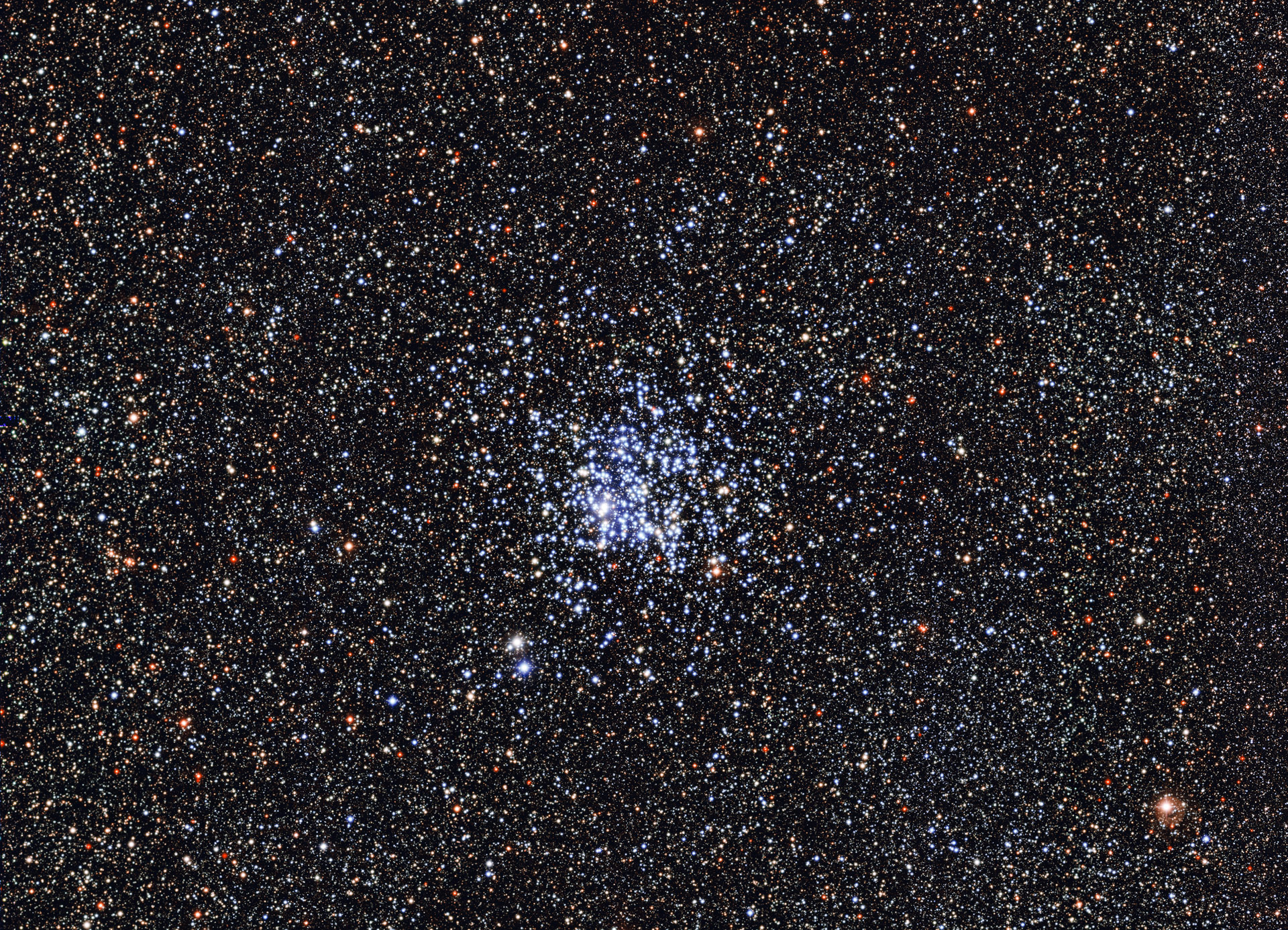
    The Wide Field Imager (WFI) on the MPG/ESO 2.2-meter telescope at the La Silla Observatory in Chile has taken this beautiful image of the open Wild Duck Cluster, Messier 11, or NGC 6705. The blue stars in the center of the image are the young, hot stars of the cluster. The surrounding redder stars are older, cooler background stars. Credit: ESO

    This new image from ESO’s La Silla Observatory shows of one of the most star-rich open clusters currently known — Messier 11, also known as NGC 6705 or the Wild Duck Cluster.

    Messier 11 is an open cluster, sometimes referred to as a galactic cluster, located around 6,000 light-years away in the constellation of Scutum (The Shield). It was first discovered by German astronomer Gottfried Kirch in 1681 at the Berlin Observatory, appearing as nothing more than a fuzzy blob through the telescope. It wasn’t until 1733 that the blob was first resolved into separate stars by the Reverend William Derham in England, and Charles Messier added it to his famous catalog in 1764.

    Messier was a comet hunter and the catalog came into being as he was frustrated by constantly observing fixed, diffuse objects that looked like comets (for example, objects that we now know to be clusters, galaxies, and nebulae). He wanted a record in order to avoid accidentally observing them again and confusing them with possible new comets. This particular stellar cluster was noted down as the eleventh such object — hence the name of Messier 11.

    Open clusters are typically found lying in the arms of spiral galaxies or in the denser regions of irregular galaxies, where star formation is still common. Messier 11 is one of the most star-rich and compact of the open clusters, being almost 20 light-years across and home to close to 3,000 stars. Open clusters are different from globular clusters, which tend to be very dense, tightly bound by gravity, and contain hundreds of thousands of very old stars — some of which are nearly as old as the Universe itself.

    Studying open clusters is a great way to test theories of stellar evolution, as the stars form from the same initial cloud of gas and dust and are therefore very similar to one another — they all have roughly the same age, chemical composition, and are all the same distance away from Earth. However, each star in the cluster has a different mass, with the more massive stars evolving much faster than their lower-mass counterparts as they use up all of their hydrogen much sooner.

    In this way, direct comparisons between the different evolutionary stages can be made within the same cluster: for example, does a 10-million-year-old star with the same mass as the Sun evolve in a different way to another star that is the same age, but half as massive? In this sense, open clusters are the closest thing astronomers have to “laboratory conditions”.

    Because the stars within open clusters are very loosely bound to one another, individuals are very susceptible to being ejected from the main group due to the effect of gravity from neighboring celestial objects. NGC 6705 is already at least 250 million years old, so in a few more million years it is likely that this Wild Duck formation will disperse, and the cluster will break up and merge into its surroundings.[1]

    This image was taken by the Wide Field Imager on the MPG/ESO 2.2-meter (8.2-foot) telescope at ESO’s La Silla Observatory in northern Chile.

    Notes

    1. The alternative and evocative name for NGC 6705, the Wild Duck Cluster, came about in the 19th century. When the cluster was seen through a small telescope it was noticed that the brightest stars formed an open triangle pattern on the sky that resembled ducks flying in formation.

    Never miss a breakthrough: Join the SciTechDaily newsletter.
    Follow us on Google and Google News.

    Astronomy European Southern Observatory
    Share. Facebook Twitter Pinterest LinkedIn Email Reddit

    Related Articles

    Supermassive Black Holes on a Collision Course: Closest Pair of Supermassive Black Holes to Earth Ever Discovered

    Black Hole Discovered Lurking in Star Cluster Outside Our Galaxy

    Discovery in a Galaxy Over 12 Billion Light-Years Away – Reveals How Element Found in Our Bones Is Forged in the Universe

    Strange 160 Mile-Long “Dog-Bone” Asteroid Kleopatra Captured in Detailed Images

    Astronomers Find Small Rocky Planet – Just Half the Mass of Venus

    First Clear Detection of a Moon-Forming Disc Around a Planet Outside Our Solar System

    Mystery Solved: Astronomers Unravel the Puzzle of Betelgeuse’s “Great Dimming”

    Stunning Galactic Fireworks: New ESO Images Reveal Spectacular Features of Nearby Galaxies

    Astronomers Were Puzzled by “Great Dimming” of Betelgeuse – Now the Mystery Is Solved

    1 Comment

    1. Juan Emilio on February 15, 2016 2:22 pm

      Awesome! Just magnificent!

      Reply
    Leave A Reply Cancel Reply

    • Facebook
    • Twitter
    • Pinterest
    • YouTube

    Don't Miss a Discovery

    Subscribe for the Latest in Science & Tech!

    Trending News

    Monster Storms on Jupiter Unleash Lightning Beyond Anything on Earth

    Scientists Create “Liquid Gears” That Spin Without Touching

    The Simple Habit That Could Help Prevent Cancer

    Millions Take These IBS Drugs, But a New Study Finds Serious Risks

    Scientists Unlock Hidden Secrets of 2,300-Year-Old Mummies Using Cutting-Edge CT Scanner

    Bread Might Be Making You Gain Weight Even Without Eating More Calories

    Scientists Discover Massive Magma Reservoir Beneath Tuscany

    Europe’s Most Active Volcano Just Got Stranger – Here’s Why Scientists Are Rethinking It

    Follow SciTechDaily
    • Facebook
    • Twitter
    • YouTube
    • Pinterest
    • Newsletter
    • RSS
    SciTech News
    • Biology News
    • Chemistry News
    • Earth News
    • Health News
    • Physics News
    • Science News
    • Space News
    • Technology News
    Recent Posts
    • Scientists Discover a New Meteor Shower From a Mysterious Crumbling Asteroid
    • This Simple Fruit Wash Could Make Produce Safer and Last Days Longer
    • These Tiny Robots 50x Smaller Than a Hair Can Hunt and Move Bacteria
    • Simple Blood Test May Predict Alzheimer’s Years Before Brain Scans Show Signs
    • Scientists Say Adding This Unusual Seafood to Your Diet Could Reverse Signs of Aging
    Copyright © 1998 - 2026 SciTechDaily. All Rights Reserved.
    • Science News
    • About
    • Contact
    • Editorial Board
    • Privacy Policy
    • Terms of Use

    Type above and press Enter to search. Press Esc to cancel.