
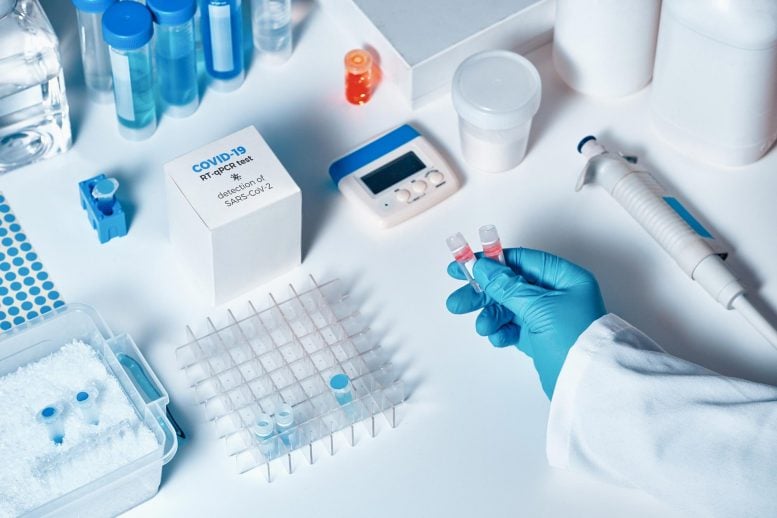
A novel NIH technique uses Chelex resin to detect COVID-19 without RNA extraction, improving test speed, safety, and sensitivity.
Scientists at the National Institutes of Health (NIH) have developed a new sample preparation method to detect SARS-Cov-2, the virus that causes COVID-19. The method bypasses extraction of the virus’ genetic RNA material, simplifying sample purification and potentially reducing test time and cost. The method is the result of a collaboration among researchers at the National Eye Institute (NEI), the NIH Clinical Center (CC), and the National Institute of Dental and Craniofacial Research (NIDCR).
Diagnostic testing remains a crucial tool in the fight against the COVID-19 pandemic. Standard tests for detection of SARS-CoV-2 involve amplifying viral RNA to detectable levels using a technique called quantitative reverse transcription PCR (RT-qPCR). But first, the RNA must be extracted from the sample. Manufacturers of RNA extraction kits have had difficulty keeping up with demand during the COVID-19 pandemic, hindering testing capacity worldwide. With new virus variants emerging, the need for better, faster tests is greater than ever.
Using Chelex Resin to Preserve Viral RNA
A team led by Robert B. Hufnagel, M.D., Ph.D., chief of the NEI Medical Genetics and Ophthalmic Genomic Unit, and Bin Guan, Ph.D., a fellow at the Ophthalmic Genomics Laboratory at NEI, used a chelating agent made by the lab supply company Bio-Rad called Chelex 100 resin to preserve SARS-CoV-2 RNA in samples for detection by RT-qPCR.
“We used nasopharyngeal and saliva samples with various virion concentrations to evaluate whether they could be used for direct RNA detection,” said Guan, the lead author of a report on the technique, which published this week in iScience. “The answer was yes, with markedly high sensitivity. Also, this preparation inactivated the virus, making it safer for lab personnel to handle positive samples.”
Hufnagel’s team made their discovery by testing a variety of chemicals using synthetic and human samples to identify those that could preserve the RNA in samples with minimal degradation while allowing direct detection of the virus by RT-qPCR.
To validate the test, NIDCR’s Blake M. Warner, D.D.S., Ph.D., M.P.H., and his team collected patient samples (on Research Protocol NIH IRB 20-D-0094) and stored them in either viral transport media, or the newly developed chelating-resin-buffer at the NIH Symptomatic Testing Facility.
The samples in viral transport media were tested by the COVID-19 testing team at NIH’s Clinical Center, led by Karen M. Frank, M.D., Ph.D., using conventional RNA extraction and RT-qPCR testing. The samples in the chelating-resin-buffer were heated and the viral RNA was, then, tested by RT-qPCR. The new preparation significantly increased the RNA yield available for testing, compared to the standard method.
“We think this novel methodology has clear benefits of increasing sensitivity, cost and time savings for testing,” said Hufnagel, “The method stabilizes the RNA at room temperature for easier transport, storage, and handling in clinical settings.”
Reference: “Sensitive extraction-free SARS-CoV-2 RNA virus detection using a chelating resin” by Bin Guan, Karen M. Frank, José O. Maldonado, Margaret Beach, Eileen Pelayo, Blake M. Warner and Robert B. Hufnagel, 8 August 2021, iScience.
DOI: 10.1016/j.isci.2021.102960
The work was supported by grant number 1ZIAEY000564-02.
About the National Eye Institute (NEI): NEI leads the federal government’s research on the visual system and eye diseases. NEI supports basic and clinical science programs to develop sight-saving treatments and address special needs of people with vision loss.
About the National Institute of Dental and Craniofacial Research (NIDCR): The mission of the National Institute of Dental and Craniofacial Research (NIDCR) is to improve dental, oral, and craniofacial health. As the largest oral health research funding organization in the world, NIDCR does this by supporting a broad research portfolio, which includes basic, translational and clinical research into areas such as: cancer; the microbiome; immunology; HIV/AIDS; stem cells and regenerative medicine; genetics and rare diseases; and behavioral and social health disparities.
About the NIH Clinical Center: The National Institutes of Health Clinical Center (CC), America’s research hospital, is located on the NIH campus in Bethesda, Md. Through clinical research, clinician-investigators translate laboratory discoveries into better treatments, therapies and interventions to improve the nation’s health.
About the National Institutes of Health (NIH): NIH, the nation’s medical research agency, includes 27 Institutes and Centers and is a component of the U.S. Department of Health and Human Services. NIH is the primary federal agency conducting and supporting basic, clinical, and translational medical research, and is investigating the causes, treatments, and cures for both common and rare diseases.
Never miss a breakthrough: Join the SciTechDaily newsletter.
Follow us on Google and Google News.
1 Comment
Impressive! Thanks for sharing this post.