
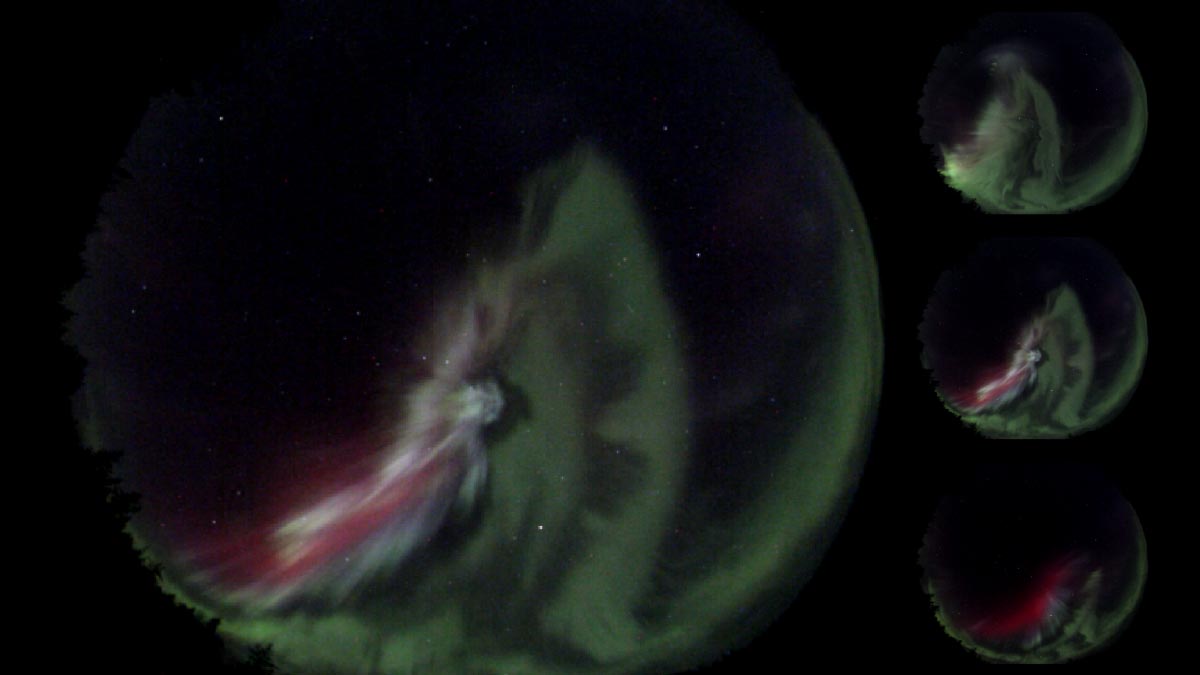
Researchers have uncovered the nature of a mysterious whitish, grey patch that often appears alongside the aurora borealis.
This patch, termed a structured continuum emission, adds a layer of complexity to our understanding of the northern lights. It was identified using advanced camera technology that captures true-color images of celestial phenomena, revealing it to be a heat source intricately linked with the aurora itself.
Mysterious Sky Phenomenon
A mysterious whitish-grey patch that occasionally appears near the northern lights has been explained for the first time by researchers at the University of Calgary.
Published on December 30 in the journal Nature Communications, the study investigates what researchers call a “structured continuum emission” linked to the aurora borealis.
“You’d see this dynamic green aurora, you’d see some of the red aurora in the background and, all of a sudden, you’d see this structured – almost like a patch – grey-toned or white toned-emission connected to the aurora,” explains Dr. Emma Spanswick, PhD, lead author on the paper and an associate professor with the Department of Physics and Astronomy in the Faculty of Science.
Scientific Inquiry and Discovery
“So, the first response of any scientist is, ‘Well, what is that?’”
While this pale patch has been mentioned in scientific literature before, Spanswick notes that it has never been explained — until now.
Spanswick says the white patch has been referenced in scientific papers before, but it has never been explained.
Her team’s paper concludes it’s “most certainly a heat source” and says it suggests that the aurora borealis are more complex than previously thought.
Technological Advances in Observational Astronomy
Spanswick says the discovery was made possible because an advancement in camera technology allows both amateur photographers and scientists to see true color images of the night sky.
“Everyone has noticed the advancement in digital photography. Your cellphone can now take pictures of the aurora,” she says. “That has flowed to the commercial sensor market now.
“Those types of sensors can now be found in more commercial, more robust sensors that we would use in science.”
Linking New Phenomena with Known Events
The team’s research came after there was a renewed interest in continuum emission with the discovery and observations of the long, glowing ribbon of purple light known as STEVE – or Strong Thermal Emission Velocity Enhancement.
“There are similarities between what we’re seeing now and STEVE,” explains Spanswick. “STEVE manifests itself as this mauve or grey-toned structure.
“To be honest, the elevation of the spectrum between the two is very similar but this, because of its association with dynamic aurora, it’s almost embedded in the aurora. It’s harder to pick out if you were to look at it, whereas STEVE is separate from the aurora – a big band crossing the sky.”
Educational Impact and Student Involvement
The latest research is also significant because it includes three UCalgary students, including undergraduate Josh Houghton who was initially hired as an intern on the project.
“I was still learning things at the time,” he says. “I had just started my internship, and I very quickly got involved. It’s just very, very cool.”
Spanswick says Houghton did a lot of the analysis on the research, which led to his participation in the Nature paper as an undergraduate student.
“He’s had one heck of an internship experience,” she says.
Houghton will continue the research as part of his undergrad honours thesis, before taking on his master’s degree at UCalgary next year.
Reference: “Association of structured continuum emission with dynamic aurora” by E. Spanswick, J. Liang, J. Houghton, D. Chaddock, E. Donovan, B. Gallardo-Lacourt, C. Keenan, J. Rosehart, Y. Nishimura, D. Hampton and M. Gillies, 30 December 2024, Nature Communications.
DOI: 10.1038/s41467-024-55081-5
The research was made possible by the Transition Region Explorer (TREx), which is a UCalgary project jointly funded by the Canadian Foundation for Innovation, the Government of Alberta and the Canadian Space Agency.
The TREx RGB and Spectograph instruments are operated and maintained by Space Environment Canada with the support of the Canadian Space Agency through its Geospace Observatory (GO) Canada initiative.
Never miss a breakthrough: Join the SciTechDaily newsletter.
Follow us on Google and Google News.