

Close Menu
    Facebook X (Twitter) Instagram
    SciTechDaily
    • Biology
    • Chemistry
    • Earth
    • Health
    • Physics
    • Science
    • Space
    • Technology
    Facebook X (Twitter) Pinterest YouTube RSS
    SciTechDaily
    Home»Technology»Novel Material Increases Perovskite Solar Cell Efficiency by 15.8%
    Technology

    Novel Material Increases Perovskite Solar Cell Efficiency by 15.8%

    By São Paulo Research FoundationMarch 20, 2024No Comments4 Mins Read
    Facebook Twitter Pinterest Telegram LinkedIn WhatsApp Email Reddit
    Share
    Facebook Twitter LinkedIn Pinterest Telegram Email Reddit
    Advanced Solar Cells Concept
    Brazilian researchers have developed a method to enhance the efficiency and durability of perovskite solar cells by incorporating MXenes into the cells’ structure. This advancement, documented in the Journal of Materials Chemistry C, promises significant improvements in solar cell technology, with potential impacts on industrial production and sustainability efforts.

    A study by researchers at São Paulo State University (UNESP) has yielded results that could significantly benefit the future of the solar power sector.

    In an article published in the Journal of Materials Chemistry C, Brazilian researchers describe a strategy to enhance the efficiency and stability of solar cells made of perovskite, a semiconductor material produced in the laboratory. The results of the project could be highly positive for the future of the solar power sector.

    Developed by researchers at São Paulo State University (UNESP) in Bauru, Brazil, the method involves the use of a class of materials known as MXenes, a family of two-dimensional materials with a graphene-like structure combining transition metals, carbon and/or nitrogen, and surface functional groups such as fluoride, oxygen or hydroxyl. Their properties include high electrical conductivity, good thermal stability, and high transmittance (relating to the amount of light that passes through a substance without being reflected or absorbed).
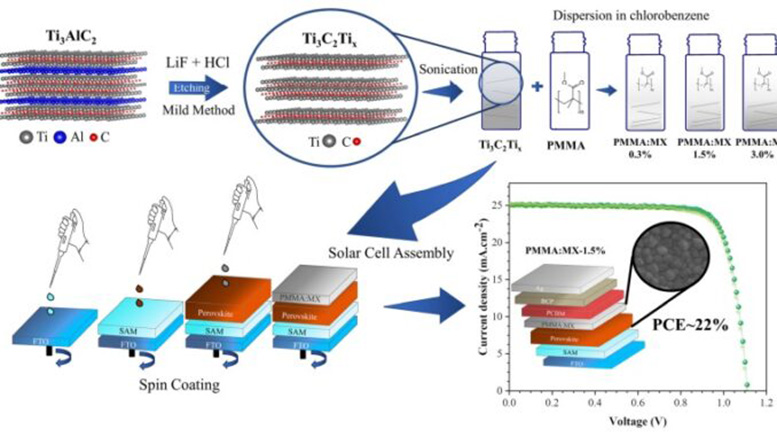
    Novel Material Increases Efficiency and Stability of Perovskite Solar Cells Graphic
    The method developed at UNESP involves the use of a class of materials called MXenes. Credit: CDMF

    In the study, the MXene Ti3C2Tx was added to polymethyl methacrylate (PMMA) to form a passivation coating, which was spin-coated on top of the perovskite layer of inverted solar cells. Passivation coatings are designed to mitigate possible defects in polycrystalline solids (perovskite in this case) due to interaction with the environment or to their internal structure. Perovskite solar cells have a layered structure, and the order of layers (architecture) is crucial to their performance. In an inverted solar cell, the architecture of the device is reversed to assure high optical transparency as sunlight reaches the perovskite layer.

    Improved Efficiency and Stability

    The use of Ti3C2Tx increased the cells’ power conversion efficiency from 19% to 22%. It also increased the stability of the cells, which lasted three times longer with no performance impairment compared to control cells (without the passivation layer).

    For João Pedro Ferreira Assunção, first author of the article and a master’s candidate under UNESP’s program of graduate studies in materials science and technology, the results were surprising because the initial aim of the project was merely to remediate the drop in performance caused by the addition of the insulating passivation layer.

    Research on perovskite solar cells is currently focusing on how to devise large-scale industrial production systems to make stable high-performance cells. “The article shows that the addition of the MXene can be feasible under mass production conditions, and points to a way of achieving this. It also describes several electrical, morphological, and structural characterization techniques that we explored to increase the scientific understanding of how this complex class of devices behaves and functions,” Assunção said.

    The study is a promising step toward the sustainability goals of producing clean energy, mitigating environmental impact, and making Brazil a leading industrial producer of solar cells, he added.

    Reference: “Interface passivation with Ti3C2Tx-MXene doped PMMA film for highly efficient and stable inverted perovskite solar cells” by João Pedro F. Assunção, Hugo G. Lemos, Jéssica H. H. Rossato, Gabriel L. Nogueira, João V. M. Lima, Silvia L. Fernandes, Rafael K. Nishihora, Ricardo V. Fernandes, Sidney A. Lourenço, Diego Bagnis, Sydney F. Santos and Carlos F. O. Graeff, 28 November 2023, Journal of Materials Chemistry C.
    DOI: 10.1039/D3TC03810F

    Some parts of the study, such as characterization of the material by X-ray photoelectron spectroscopy (XPS), were conducted at the Center for Development of Functional Materials (CDMF), a Research, Innovation and Dissemination Center (RIDC) funded by FAPESP and hosted by the Federal University of São Carlos (UFSCar).

    Never miss a breakthrough: Join the SciTechDaily newsletter.
    Follow us on Google and Google News.

    Perovskite Solar Cell São Paulo Research Foundation Solar Cells Solar Energy
    Share. Facebook Twitter Pinterest LinkedIn Email Reddit

    Related Articles

    Innovative Technology Offers Big Performance Boost to Perovskite–Silicon Tandem Solar Cells

    Alternative to Silicon: Why Perovskites Could Take Solar Cells to New Heights

    New Materials Enable Cheaper Solar Cells That Are Easier To Make

    Researchers Set New World Record for Solar Cell Efficiency

    Predicting Semiconductor Solar Cell Performance From Terahertz and Microwave Spectroscopy

    Templating Approach Stabilizes “Ideal” Perovskite Material for Cheap, Efficient Solar Cells

    Solar Energy Breakthrough: Ultrathin Solar Cells Using 2D Perovskites Get a Boost

    A Sunny Outlook for Solar: New Research Demonstrates Great Promise for Improving Solar Cell Efficiency

    Nanoscientists Improve the Stability of Perovskite Solar Cells

    Leave A Reply Cancel Reply

    • Facebook
    • Twitter
    • Pinterest
    • YouTube

    Don't Miss a Discovery

    Subscribe for the Latest in Science & Tech!

    Trending News

    Giant Plasma Waves May Be Stripping Away Mars’ Atmosphere

    Scientists Thought SuperAgers Had Lucky Genes. They Were Wrong

    Astronomers Find Ancient Black Holes Shining With the Power of a Trillion Suns

    Researchers Solve Mystery Behind Contradictory Weight-Loss Drug Paradox

    Long-Lost Megalodon Fossils Found Hiding on a Museum Shelf

    Experimental Eye Drops Restore Sight in Blind Mice

    Scientists Discover the Brain May Enter a New Biological Phase Between 50 and 75

    New Research Reveals Autistic Brains Process Faces Differently

    Follow SciTechDaily
    • Facebook
    • Twitter
    • YouTube
    • Pinterest
    • Newsletter
    • RSS
    SciTech News
    • Biology News
    • Chemistry News
    • Earth News
    • Health News
    • Physics News
    • Science News
    • Space News
    • Technology News
    Recent Posts
    • Spain’s Largest Wildfire on Record Burned an Area the Size of New York City
    • Meet the 30-Million-Year-Old Dog That Climbed Trees Instead of Chasing Sticks
    • Two Mysterious ‘Ghost’ Ancestors Are Hiding in Our DNA
    • Gut Bacteria May Leave a Lasting “Protective Memory” in the Intestine
    • New Antivenom Strategy Is 10 Times More Potent Than a Current Treatment
    Copyright © 1998 - 2026 SciTechDaily. All Rights Reserved.
    • Science News
    • About
    • Contact
    • Editorial Board
    • Privacy Policy
    • Terms of Use

    Type above and press Enter to search. Press Esc to cancel.