
Viruses are non-living creatures, consisting of genetic material encased in a protein coat. Once the virus infects a living organism, it can replicate itself and continue on. But what happens if a virus lacks the proper tools to infect an organism? How can it propagate?
An international collaboration led by scientists at the Tokyo University of Agriculture and Technology (TUAT) in Japan has uncovered a novel virus that may help answer those questions. They published their results online, ahead of print, on July 22, 2019, in Infection, Genetics and Evolution, an Elsevier journal.
Viruses constantly change, combining and recombining into different varieties of themselves. They gain and lose function and either die out or become stronger than ever. This process occurs especially quickly on pig farms, where many pigs interact in filthy environments — it’s the ideal setting for viruses to evolve. The team, led by Professor Tetsuya Mizutani, the corresponding author on the paper and Director at the Research and Education Center for Prevention of Global Infectious Disease of Animal, TUAT, discovered a unique virus in such a location.
“Recombination among different viral families occurs at pig farms all over the world,” Mizutani said. “These recombinant viruses have the potential to connect with a host in a novel way.”
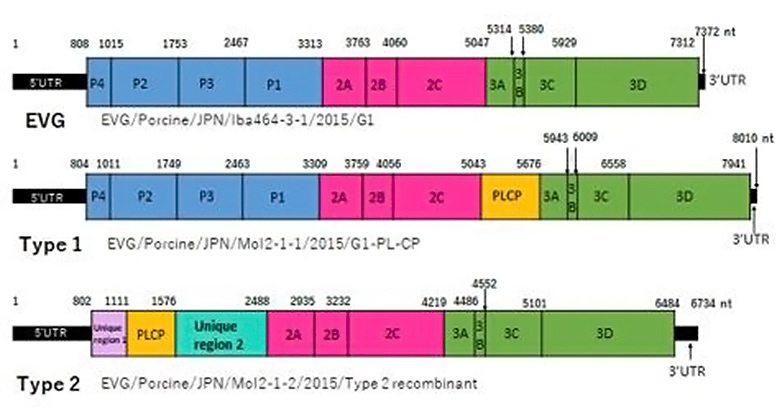
It is known that normal enterovirus G (EV-G) presents as diarrhea in pigs. In this study, the researchers found a new type 2 of EV-G in the pigs’ feces. They also found that this new EV-G type 2 can’t possibly invade a host cell on its own.
“The recombinant virus we found in this study has no structural proteins,” Mizutani said. “This means the recombinant virus cannot make a viral particle.”
Viruses must make a viral particle to invade a living host cell. Without it, they cannot enter a host cell and use its facilities to replicate themselves. According to Mizutani, this particular virus may be partnering up with a “helper virus” to gain access to a host cell, but the mechanism underlying this process is unclear.
“We may be facing an entirely new system of viral evolution,” Mizutani said. “We are wondering how this new virus came to be, how it infects cells, or how it develops a viral particle. Our future work will be on solving this mystery of viral evolution.”
###
Reference: “A novel defective recombinant porcine enterovirus G virus carrying a porcine torovirus papain-like cysteine protease gene and a putative anti-apoptosis gene in place of viral structural protein genes” by Ryo Imai, Makoto Nagai, Mami Oba, Shoichi Sakaguchi, Makoto Ujike, Ruka Kimura, Moeko Kida, Tsuneyuki Masuda, Moegi Kuroda, Rongduo Wen, Kaixin Li, Yukie Katayama, Yuki Naoi, Shinobu Tsuchiaka, Tsutomu Omatsu, Hiroshi Yamazato, Shinji Makino and Tetsuya Mizutani, 22 July 2019, Infection, Genetics and Evolution, Volume 75, 2019, 103975, ISSN 1567-1348.
DOI: 10.1016/j.meegid.2019.103975
Other contributors from the Research and Education Center for Prevention of Global Infectious Disease of Animal at Tokyo University of Agriculture and Technology include Ryo Imai, Mami Oba, Shoichi Sakaguchi, Rongduo Wen, Kaixin Li, Yukie Katayama, Yuki Naoi, Shinobu Tsuchiaka and Tsutomu Omatsu. Sakaguchi is also affiliated with Osaka Medical College. Other contributors include Makoto Nagai of Azabu University; Makoto Ujike, Ruka Kimura, and Moeko Kido of the Laboratory of Veterinary Infectious Diseases at Nippon Veterinary and Life Science University; Tsuneyuki Masuda, Moegi Kuroda, and Hiroshi Yamazato of the Kurayoshi Livestock Hygiene Service Center; and Shinji Makino of the Department of Microbiology and Immunology at The University of Texas Medical Branch at Galveston.
This work was supported by the Japan Society for the Promotion of Science and the Global Innovation Research of the Tokyo University of Agriculture and Technology.
About Tokyo University of Agriculture and Technology (TUAT): TUAT is a distinguished university in Japan dedicated to science and technology. TUAT focuses on agriculture and engineering that form the foundation of industry, and promotes education and research fields that incorporate them. Boasting a history of over 140 years since our founding in 1874, TUAT continues to boldly take on new challenges and steadily promote fields. With high ethics, TUAT fulfills social responsibility in the capacity of transmitting science and technology information towards the construction of a sustainable society where both human beings and nature can thrive in a symbiotic relationship.
About Research and Education Center for Prevention of Global Infectious Disease of Animal at TUAT: The Center was established in April 2011 to aim for the eradication of internationally important livestock infections. Important livestock infectious disease research department, infectious disease epidemiology elucidation department, and is made up of livestock infection economic analysis studies elucidate sector and a total of four departments of planning and coordination.
Never miss a breakthrough: Join the SciTechDaily newsletter.
Follow us on Google and Google News.