
Understanding Proton Structure and Polarizability
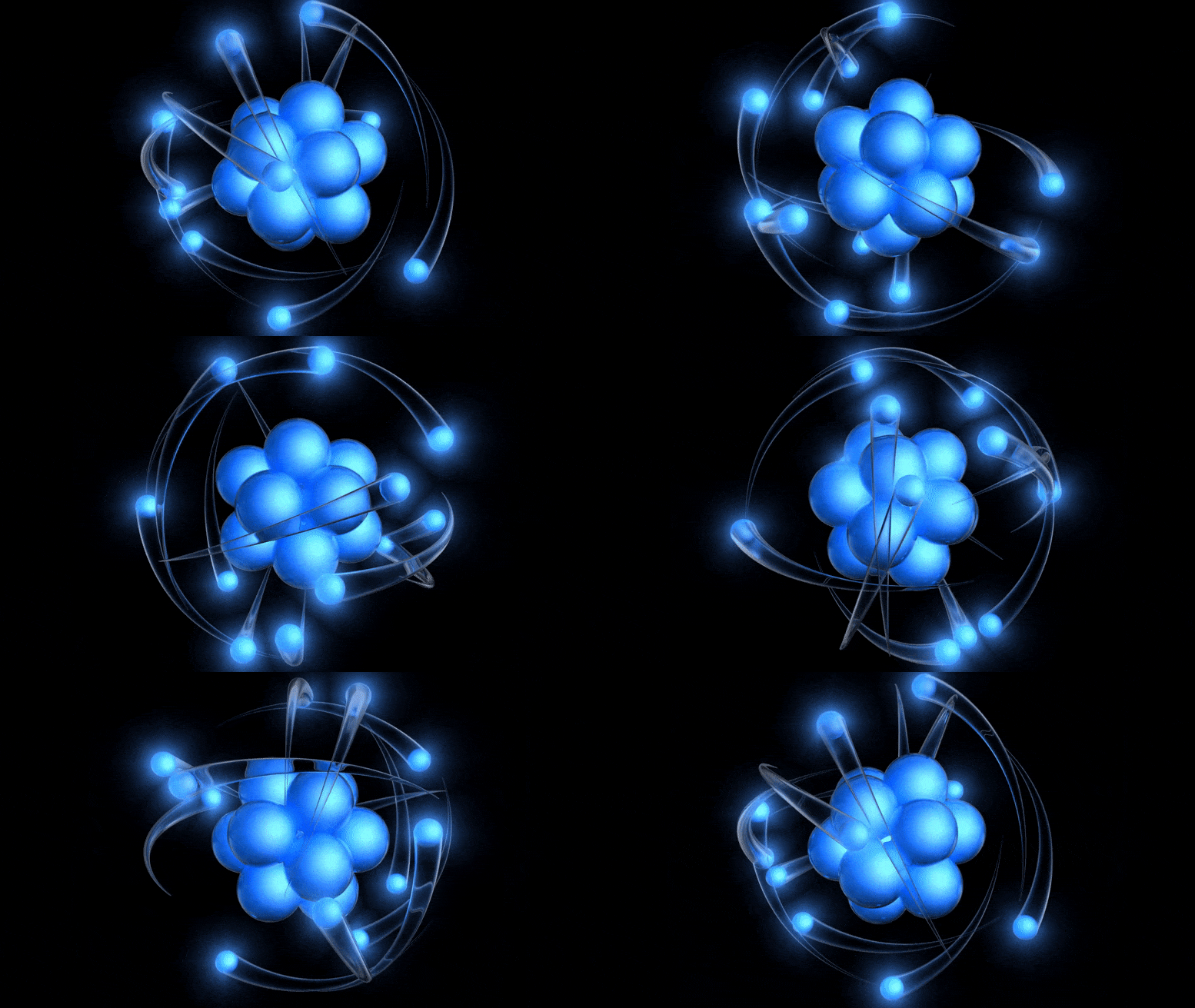
The proton is a nuclear particle with a positive electric charge located in the nucleus of an atom. It is a composite particle made up of fundamental building blocks of quarks and gluons. These components and their interactions determine the proton’s structure, including its electrical charges and currents. When exposed to external electric and magnetic (EM) fields, this structure deforms, a phenomenon known as polarizability. The EM polarizabilities are a measure of the stiffness against the deformation induced by EM fields.
By measuring the EM polarizabilities, researchers can learn about the internal structure of the proton. This knowledge helps to validate the scientific understanding of how nucleons (protons and neutrons) form by comparing the results to theoretical descriptions of gamma-ray scattering from nucleons. Physicists call this scattering process nucleon Compton scattering.
The Impact
When scientists examine the proton at a distance and scale where EM responses dominate, they can determine values of EM polarizabilities with high precision. To do so, they use the theoretical frame of Effective Field Theories (EFTs). The EFTs hold the promise of matching the description of the nucleon structure at low energies to the current theory of the strong nuclear force, called quantum chromodynamics (QCD). In this research, scientists validated EFTs using proton Compton scattering. This approach also validated the framework and methodology that underlie EFTs.
Summary
Proton Compton scattering is the process by which scientists scatter circularly or linearly polarized gamma rays from a hydrogen target (in this case, a liquid target), then measure the angular distribution of the scattered gamma rays. High-energy gamma rays carry strong enough EM fields that the response of the charges and currents in the nucleon becomes significant.
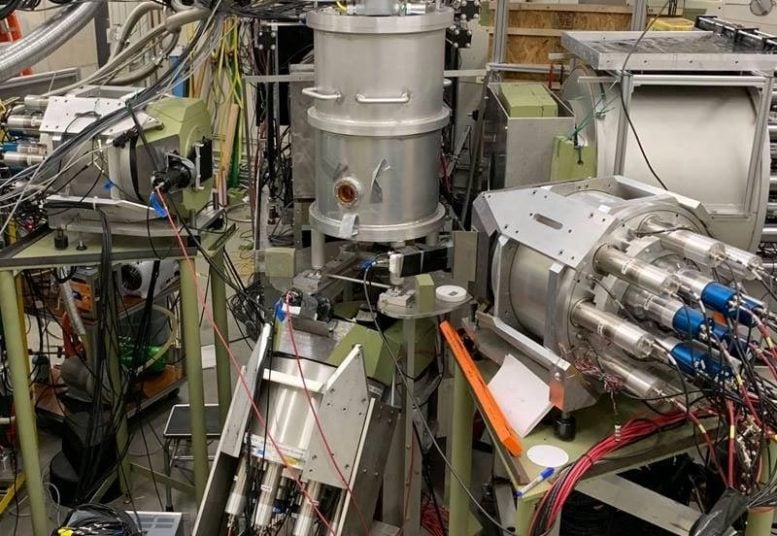
In this study, scientists performed new measurements of Compton scattering from the proton at the High Intensity Gamma Ray Source (HIGS) at the Triangle Universities Nuclear Laboratory. This work provided a novel experimental approach for Compton scattering from the proton at low energies using polarized gamma rays.
The study advances the need for new high-precision measurements at HIGS to improve the accuracy of proton and neutron polarizabilities determinations. These measurements validate the theories which link the low-energy description of nucleons to QCD.
Reference: “Proton Compton Scattering from Linearly Polarized Gamma Rays” by X. Li, M. W. Ahmed, A. Banu, C. Bartram, B. Crowe, E.J. Downie, M. Emamian, G. Feldman, H. Gao, D. Godagama, H.W. Grießhammer, C.R. Howell, H.J. Karwowski, D.P. Kendellen, M.A. Kovash, K.K.H. Leung, D.M. Markoff, J.A. McGovern, S. Mikhailov, R.E. Pywell, M.H. Sikora, J.A. Silano, R.S. Sosa, M.C. Spraker, G. Swift, P. Wallace, H.R. Weller, C.S. Whisnant, Y.K. Wu and Z.W. Zhao, 1 April 2022, Physical Review Letters.
DOI: 10.1103/PhysRevLett.128.132502
This work was funded by the Department of Energy Office of Science, the National Science Foundation, the U.K. Science and Technology Facilities Council Grants, and funds from the Dean of the Columbian College of Arts and Sciences at George Washington University and its Vice-President for Research. The researchers also acknowledge the financial support of the Natural Sciences and Engineering Research Council of Canada and the support of Eugen-Merzbacher Fellowship.
Never miss a breakthrough: Join the SciTechDaily newsletter.
Follow us on Google and Google News.
2 Comments
The Lambda-CDM model is what makes the proton so confusing. This is because this model forces a harmless cloud of gas and dust to become the most powerful objects in the universe with nothing but gravity. Therefore, the normal matter itself must contain the particle that causes the force of gravity. That is where the “gluon” and “bosons” came from. They are “ad-hoc” particles created only to explain a bad theory.
The problem is gravity did not create all the energy we see, a massive collision in space did it all. Gravity is assumed to do something it cannot do. That is specifically why science cannot understand quantum gravity. 13.8 billion years ago, our universe turned itself into a gargantuan particle collider with two objects that contained the mass of the observable galaxies. The only difference is the size of the “particles” in the collision and the size of the “shrapnel” created.
The Big Bang theory was forced to create gluons but the true strong force in our universe is between quarks and the particles that make up space which are sterile electron neutrinos. The Lambda-CDM model is what caused science to create bosons. The reality is that leptons make up our universe.
“Quark-gluon plasma” does not exist. Black holes are absolute minimum entropy energy that only consist of quarks and sterile electron neutrinos. Space is an extremely pressurized, absolute zero field of sterile electron neutrinos and when quarks are separated from a sufficient enough reaction, it is the sheer density and pressure of space itself that is able to overcome the strong force between these two particles and keep the quarks apart indefinitely. As a result, the strong force between the two particles ejects the neutrinos from the mass as gamma rays. Space itself becomes the limitless catalyst that the ultimate energy in our universe must possess that fusion doesn’t have. The Big Bang theory, and its insistence to create the universe, has permanently confused how the true fundamental particles in our universe work.
Black holes create all the other elements all by themselves with only these two particles. A black hole carries out the second law by eventually fusing the quarks and sterile electron neutrinos on the surface to create the first neutrons, and optically visible light, the black hole will possess. These are the “ring stars” scientists don’t understand. Once enough neutrons have congregated on the surface, the beta minus decay reaction begins to turn them into the first hydrogen the mass will see. Then, the constantly forming neutrons fuse with the hydrogen to create the first helium with the beta minus decay reaction. This is the only helium creation in our universe and it doesn’t create energy. Quark plasma is the true, ultimate energy of our universe.
This process continues creating heavier elements making the star darker until the light is extinguished and a surface forms. This is when the atmosphere, and all the water, is formed. The water is created exactly like a catalytic converter in a car creates water with hydrocarbons.
So, an atom is made of quarks and the particles that make up space. Quarks and sterile electron neutrinos are smaller versions of atoms and electrons.
Science has a choice. Either it can continue to believe in a theory that breaks all the laws of physics and continue to be confused about every aspect of our universe forever or it can do what I did and apply the laws to the event that happened 13.8 billion years ago in an already existing, static universe. My theory is testable in particle colliders while the Big Bang theory is completely untestable. The only question that truly exists in physics and astrophysics is when will a theory be considered that actually follows the laws like mine does. The whole world thinks the current theories are facts regardless of the endless problems that they create.
Strongly agree. In the development of human being sciences and humanities, the shameful act of calling a stag as a horse has begun more and more objectionable.