
Close Menu
    Facebook X (Twitter) Instagram
    SciTechDaily
    • Biology
    • Chemistry
    • Earth
    • Health
    • Physics
    • Science
    • Space
    • Technology
    Facebook X (Twitter) Pinterest YouTube RSS
    SciTechDaily
    Home»Space»NuSTAR Reveals the Active Galactic Nucleus of a Quasar
    Space

    NuSTAR Reveals the Active Galactic Nucleus of a Quasar

    By Harvard-Smithsonian Center for AstrophysicsNovember 18, 2015No Comments3 Mins Read
    Facebook Twitter Pinterest Telegram LinkedIn WhatsApp Email Reddit
    Share
    Facebook Twitter LinkedIn Pinterest Telegram Email Reddit
    Astronomers Reveal the Active Galactic Nucleus of a Quasar
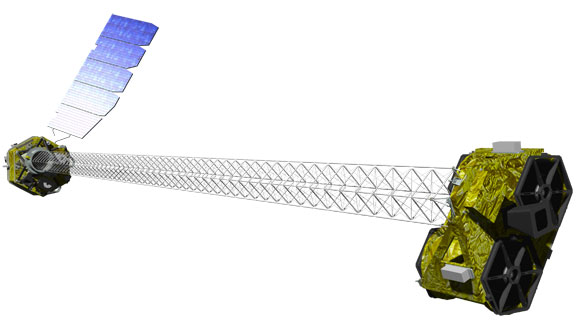
    An artist’s illustration of the NuSTAR X-ray satellite, which studies high-energy X-rays. Credit: NASA, NuSTAR

    Using data from the NuSTAR X-ray satellite, a team of astronomers has found that the emission from quasar 3C 273 most likely arises from two components: an accretion disk around the black hole and very rapidly moving charged particles in a jet.

    3C 273 is the nearest high-luminosity quasar to Earth, about two billion light-years away, and shining with the power of more than about three thousand Milky Way galaxies. Since its discovery in 1963, it has been extensively studied at many wavelengths. It is bright and very variable from the radio wavelengths to the X-ray and gamma-rays, and has rapidly moving jets of charged particles.

    One of the major theoretical challenges for 3C 273 has been explaining the origins of the various kinds of dramatic activities seen. Two generic suggestions have been proposed based on optical variability: emission from an accretion disk around the black hole nucleus, and/or emission from fast-moving charged particles (but unrelated to the radio jet).

    One of the interesting complications is that the X-rays can be produced not only by very hot gas but also by high-velocity particles which add some of their own energy to radiation that they scatter, for example converting radio emission into X-rays. Sorting out the possibilities has been a priority for scientists studying quasars.

    The NuSTAR mission (Nuclear Spectroscopic Telescope Array) is a space-based X-ray telescope that can detect X-rays with wavelengths smaller (energies higher) than those detectable by the Chandra X-ray Observatory by about a factor of eight.

    Launched in 2012, NuSTAR is the first space-based direct-imaging X-ray telescope to be able to observe these energies. CfA astronomer Laura Brenneman joined a team of colleagues to study 3C 273 with NuSTAR, combing the results with observations from other space-based X-ray and gamma-ray missions.

    In 2012, while undertaking a coordinated observing campaign, the team found that the emission was in a relatively weak phase which enabled them to diagnose X-ray emission signatures that are normally overwhelmed by other emissions.

    The scientists conclude that the two-component model is very likely correct, with some emission coming from the accretion disk and higher-energy light coming from a beamed jet of charged particles. With additional, multi-observatory observations of the source, the team hopes to refine their description with more explicit values for the physical conditions present.

    Reference: “3C 273 with NuSTAR: Unveiling the Active Galactic Nucleus” by Kristin K. Madsen, Felix Fürst, Dominic J. Walton, Fiona A. Harrison, Krzysztof Nalewajko, David R. Ballantyne, Steve E. Boggs, Laura W. Brenneman, Finn E. Christensen, William W. Craig, Andrew C. Fabian, Karl Forster, Brian W. Grefenstette, Matteo Guainazzi, Charles J. Hailey, Greg M. Madejski, Giorgio Matt, Daniel Stern, Roland Walter and William W. Zhang, 5 October 2015, The Astrophysical Journal.
    DOI: 10.1088/0004-637X/812/1/14

    Never miss a breakthrough: Join the SciTechDaily newsletter.
    Follow us on Google and Google News.

    Astronomy Astrophysics Harvard-Smithsonian Center for Astrophysics NuSTAR Quasars
    Share. Facebook Twitter Pinterest LinkedIn Email Reddit

    Related Articles

    Unlocking the Universe’s Dark Ages: How a Quasar’s Wild Flicker Could Change Cosmic History

    Massive X-ray Jet – Extending for 160,000 Light-Years – Spied From Supermassive Black Hole in Early Universe

    Puzzling Astrophysics of Quasars in the Early Universe

    Astronomers Detect Time Delays between Flaring Events in a Quasar

    Astronomers Record Detailed Measurements of the Inner Region of a Quasar Nucleus

    Calculations Show the Ideal Time to Study the Cosmos

    Using Infrared Images from Hubble & Spitzer, Scientists Discover 25 Distant Galaxies

    Supernova Shock Wave Breaks Through a Cocoon of Gas

    Origins of Type Ia Supernovae

    Leave A Reply Cancel Reply

    • Facebook
    • Twitter
    • Pinterest
    • YouTube

    Don't Miss a Discovery

    Subscribe for the Latest in Science & Tech!

    Trending News

    New “Nanozyme Hypothesis” Could Rewrite the Story of Life’s Origins

    Anatomy Isn’t Finished: The Human Body Still Holds Secrets

    “Pretty Close to Home”: The Hidden Earthquake Threat Beneath Seattle

    The Surprising Reason You Might Want To Sleep Without a Pillow

    Scientists Say This Natural Hormone Reverses Obesity by Targeting the Brain

    35-Million-Year-Old Mystery: Strange Arachnid Discovered Preserved in Amber

    Is AI Really Just a Tool? It Could Be Altering How You See Reality

    JWST Reveals a “Forbidden” Planet With a Baffling Composition

    Follow SciTechDaily
    • Facebook
    • Twitter
    • YouTube
    • Pinterest
    • Newsletter
    • RSS
    SciTech News
    • Biology News
    • Chemistry News
    • Earth News
    • Health News
    • Physics News
    • Science News
    • Space News
    • Technology News
    Recent Posts
    • The Ocean Current Stronger Than All Rivers Changed Earth Forever
    • NASA Artemis II Splashdown and Astronaut Recovery Operation [Image Gallery]
    • Splashdown! NASA Artemis II Returns From Record-Breaking Moon Mission
    • Scientists Freeze a Spinning Nanoparticle to Its Quantum Limit
    • A 100x Faster Breakthrough Could Fix Quantum Computers’ Biggest Problem
    Copyright © 1998 - 2026 SciTechDaily. All Rights Reserved.
    • Science News
    • About
    • Contact
    • Editorial Board
    • Privacy Policy
    • Terms of Use

    Type above and press Enter to search. Press Esc to cancel.