
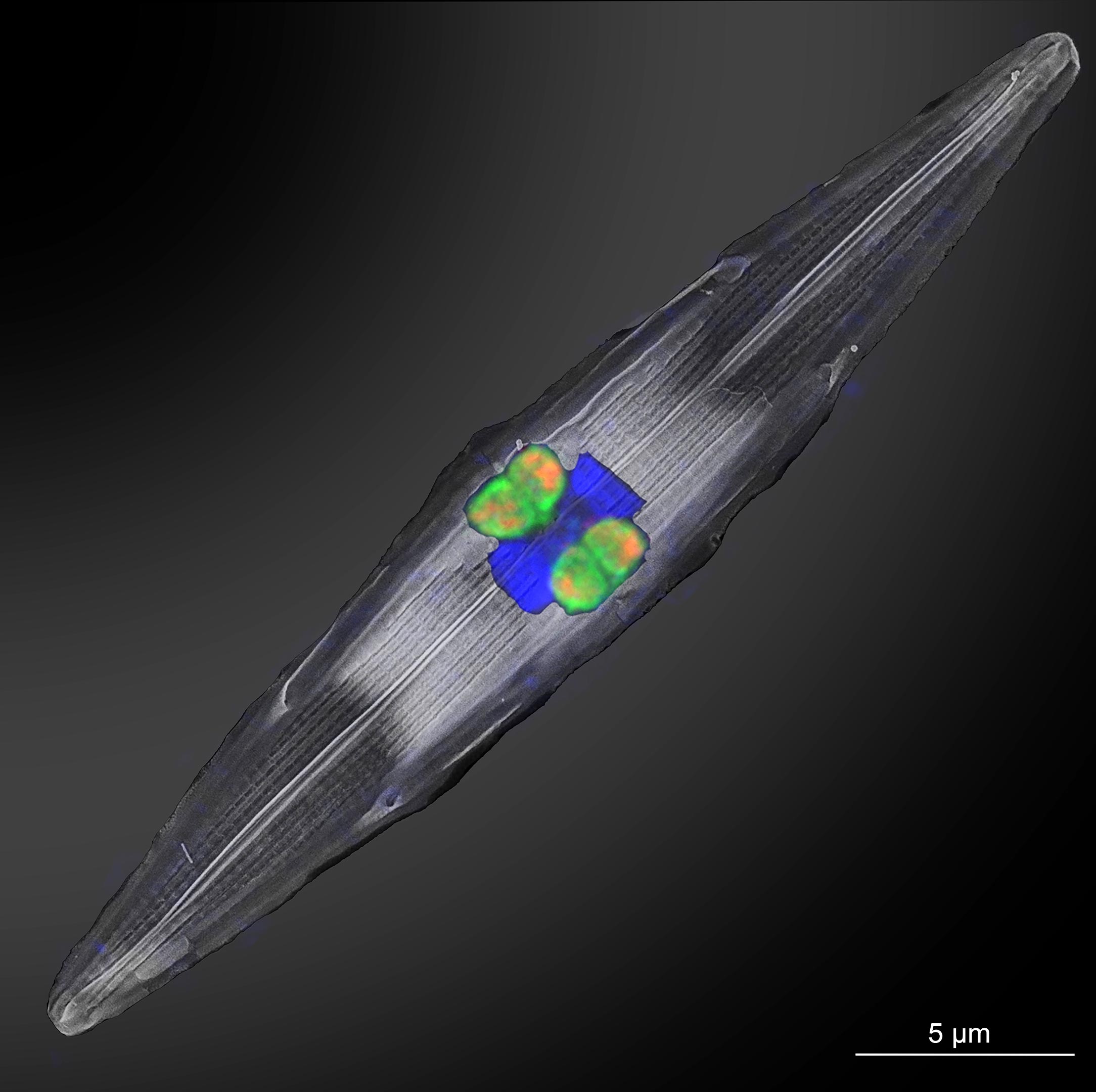
New research reveals a symbiosis between a marine diatom and a Rhizobia-like bacterium, essential for nitrogen fixation in the ocean, which may also impact future agricultural practices by enabling engineered nitrogen-fixing plants.
Scientists have discovered that Rhizobia bacteria, traditionally known for symbiotic nitrogen fixation in legumes, also partner with marine diatoms to fix nitrogen, offering a solution to a long-standing marine mystery. This finding not only enhances understanding of oceanic nitrogen cycles but also suggests potential agricultural and evolutionary applications, highlighting the bacteria’s critical role in marine productivity and carbon dioxide uptake.
Nitrogen is an essential component of all living organisms. It also plays a crucial role in regulating the growth of crops on land as well as microscopic marine plants, which produce half of the world’s oxygen. Although atmospheric nitrogen gas is the largest pool of nitrogen, plants cannot transform it into a usable form. However, certain crops such as soybeans, peas, and alfalfa, collectively known as legumes, have acquired Rhizobial bacterial partners that “fix” atmospheric nitrogen into ammonium, which plants can use. This partnership makes legumes one of the most important sources of proteins in our food supply.
A Groundbreaking Discovery in Marine Biology
It has remained unclear how marine plants obtain the nitrogen they need to grow. Now, researchers from the Max Planck Institute for Marine Microbiology, the Alfred Wegener Institute, and the University of Vienna have discovered that Rhizobia can form similar partnerships with tiny marine plants called diatoms. This finding, detailed in a recent Nature publication, not only solves a longstanding marine mystery but also offers insights that could lead to revolutionary agricultural technologies.
Unveiling a New Marine Nitrogen Fixer
Previously, it was assumed that most nitrogen fixation in the oceans was carried out by photosynthetic organisms called cyanobacteria. However, in vast regions of the ocean, there are not enough cyanobacteria to account for measured nitrogen fixation. Thus, many scientists hypothesized that non-cyanobacterial microorganisms must be responsible for the “missing” nitrogen fixation.
“For years, we have been finding gene fragments encoding the nitrogen-fixing nitrogenase enzyme, which appeared to belong to one particular non-cyanobacterial nitrogen fixer,” says Marcel Kuypers, lead author of the study. “But, we couldn’t work out precisely who the enigmatic organism was and therefore had no idea whether it was important for nitrogen fixation.”

Revealing the Identity of a Mysterious Symbiont
In 2020, the scientists traveled from Bremen to the tropical North Atlantic to join an expedition involving two German research vessels. They collected hundreds of liters of seawater from the region, in which a large part of global marine nitrogen fixation takes place, hoping to both identify and quantify the importance of the mysterious nitrogen fixer. It took them the next three years to finally puzzle together its genome. “It was a long and painstaking piece of detective work but ultimately, the genome solved many mysteries,” says Bernhard Tschitschko, first author of the study and bioinformatician now working at the University of Innsbruck.
Co-author and bioinformatician Daan Speth from the University of Vienna adds: “Based on the nitrogenase gene fragment we had seen in many marine samples before, one would have expected to find this gene in a Vibrio-related organism, but by carefully piecing together the genetic information it turned out that instead, it belonged to a genome closely related to known Rhizobia, which typically live in symbiosis with legume plants.” Together with its surprisingly small genome, this raised the possibility that the marine Rhizobia might be a symbiont.

Uncovering a Unique Symbiotic Relationship
Spurred on by these discoveries, the authors developed a genetic probe that could be used to fluorescently label the Rhizobia. “This allowed us to visualize the Rhizobia directly in their native habitat – the complex environmental samples collected in the Atlantic,” says Katharina Kitzinger, who started contributing to this project at the Max Planck Institute and continued lending her expertise after moving to the University of Vienna.
Their suspicions about it being a symbiont were quickly confirmed. “We were finding sets of four Rhizobia, always sitting in the same spot inside the diatoms,” says Kuypers. “It was very exciting as this is the first known symbiosis between a diatom and a non-cyanobacterial nitrogen fixer.”
The scientists named the newly discovered symbiont Candidatus Tectiglobus diatomicola. Having finally worked out the identity of the missing nitrogen fixer, they focused their attention on working out how the bacteria and diatom live in partnership. Using a technology called nanoSIMS, they could show that the Rhizobia exchanges fixed nitrogen with the diatom in return for carbon. And it puts a lot of effort into it: “In order to support the diatom’s growth, the bacterium fixes 100-fold more nitrogen than it needs for itself,” Wiebke Mohr, one of the scientists on the paper explains.
Implications for Marine Productivity and Carbon Uptake
Next, the team turned back to the oceans to discover how widespread the new symbiosis might be in the environment. It quickly turned out that the newly discovered partnership is found throughout the world’s oceans, especially in regions where cyanobacterial nitrogen fixers are rare. Thus, these tiny organisms are likely major players in total oceanic nitrogen fixation and therefore play a crucial role in sustaining marine productivity and the global oceanic uptake of carbon dioxide.
Potential Agricultural Applications of Marine Symbiosis
Aside from its importance to nitrogen fixation in the oceans, the discovery of this symbiosis hints at other exciting opportunities in the future. Kuypers is particularly excited about what the discovery means from an evolutionary perspective. “The evolutionary adaptations of Ca. T. diatomicola are very similar to the endosymbiotic cyanobacterium UCYN-A, which functions as an early-stage nitrogen-fixing organelle. Therefore, it’s really tempting to speculate that Ca. T. diatomicola and its diatom host might also be in the early stages of becoming a single organism.”
Tschitschko agrees that the identity and organelle-like nature of the symbiont is particularly intriguing. He says, “So far, such organelles have only been shown to originate from the cyanobacteria, but the implications of finding them amongst the Rhizobiales are very exciting, considering that these bacteria are incredibly important for agriculture. The small size and organelle-like nature of the marine Rhizobiales means that it might be a key candidate to engineer nitrogen-fixing plants someday.”
The scientists will now continue to study the newly discovered symbiosis and see if more like it also exists in the oceans.
Reference: “Rhizobia–diatom symbiosis fixes missing nitrogen in the ocean” by Bernhard Tschitschko, Mertcan Esti, Miriam Philippi, Abiel T. Kidane, Sten Littmann, Katharina Kitzinger, Daan R. Speth, Shengjie Li, Alexandra Kraberg, Daniela Tienken, Hannah K. Marchant, Boran Kartal, Jana Milucka, Wiebke Mohr and Marcel M. M. Kuypers, 9 May 2024, Nature.
DOI: 10.1038/s41586-024-07495-w
Never miss a breakthrough: Join the SciTechDaily newsletter.
Follow us on Google and Google News.