
Recent Earthquakes in West Texas Have Been Connected to Oil and Gas Operations
The number of earthquakes has been steadily increasing in the West Texas and New Mexico area known as the Delaware Basin since 2009. The bulk of them may be connected to oil and gas extraction, according to a study conducted by scientists at The University of Texas in Austin.
68% of earthquakes larger than 1.5 on the Richter scale were strongly linked to hydraulic fracturing or the disposal of produced formation water into either shallow or deep geologic formations, according to research that tracked seismicity and oil and gas production in the area from 2017 to 2020. All subterranean reservoirs include formation water, which is produced with oil and gas. Companies get rid of produced water by injecting it into geologic formations that are not part of oil and gas reserves.
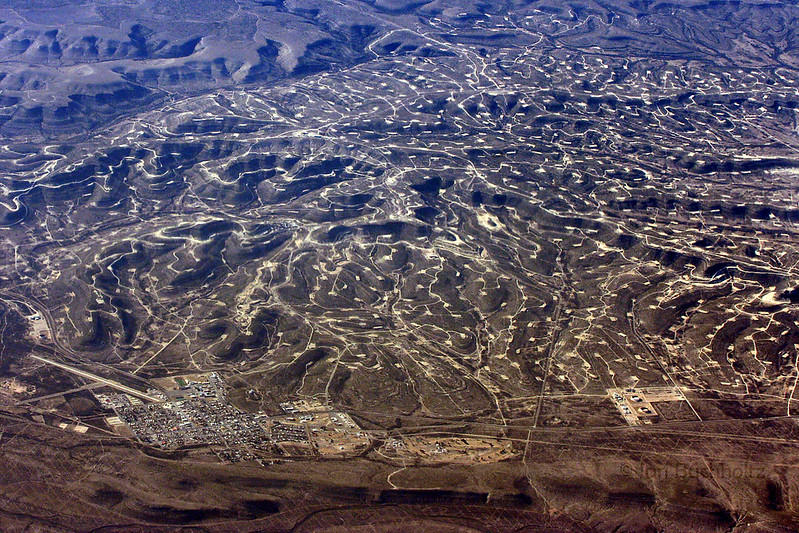
Subsurface Pressure and Seismicity
The study’s co-author, Alexandros Savvaidis, a researcher at the UT Bureau of Economic Geology and the principal investigator of Texas’ state seismic monitoring network and seismicity research TexNet, which is overseen by the bureau, said all of these production activities are known to raise subsurface pore pressure, which is a mechanism for triggering earthquakes. The research was able to determine which activities are related to past earthquakes by combining statistical analysis and physics-based modeling.
“This paper shows that we now know a lot about how oil and gas activities and seismic activity are connected,” Savvaidis said. “The modeling techniques could help oil and gas producers and regulators identify potential risks and adjust production and disposal activity to decrease them.”
The study was published in the journal Seismological Research Letters.
The researchers analyzed about 5,000 earthquakes, selecting the above magnitude 1.5 threshold. Forty-three percent of the earthquakes above magnitude 1.5 were linked with injection into shallow sedimentary formations, above the hydraulic fracturing depth; 12% were linked with injection into deep sedimentary formations above the basement rock and below the hydraulic fracturing depth. The 2020 magnitude 5.0 earthquake that occurred in Mentone, Texas, happened in a region where seismicity was strongly associated with deep produced water injection.
The Role of Hydraulic Fracturing and Deep Water Injection
Hydraulic fracturing – a process that uses highly pressurized fluid to create and enhance fractures in the rock to increase the flow of oil and gas – was linked to only 13% of earthquakes. However, this was higher than previously expected.
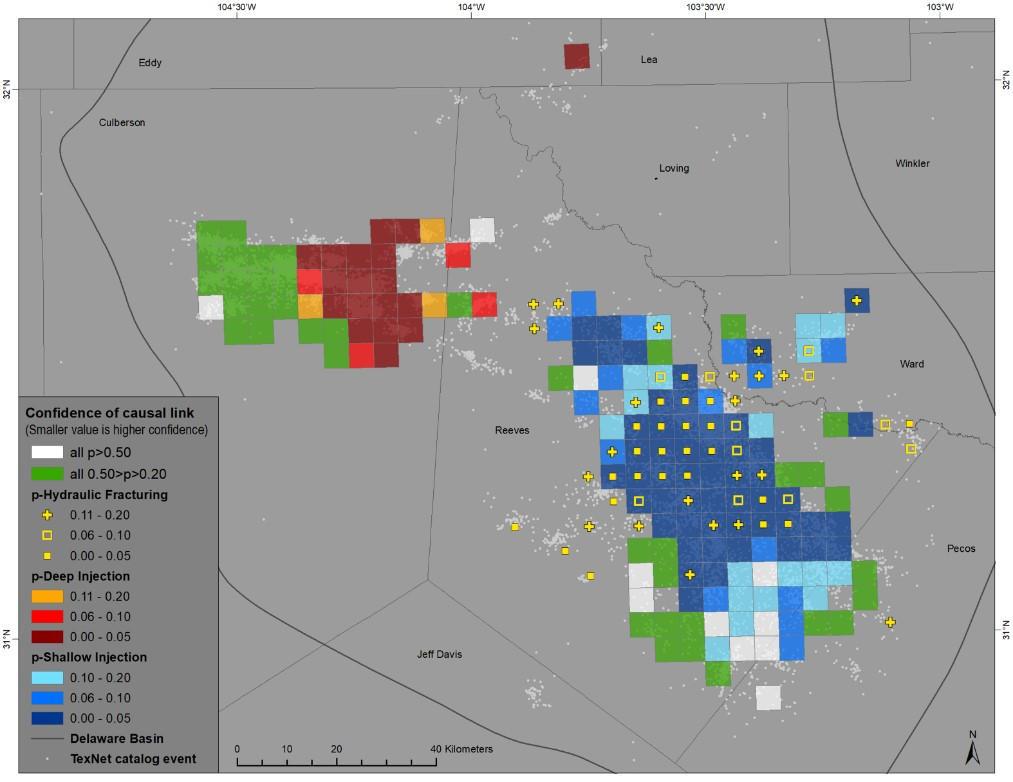
The model divided the Delaware basin region into a grid of five-kilometer squares (about 3 miles), with researchers analyzing connections between seismicity, oil and gas activity, and subsurface pore pressure for each square over time.
Lead author Iason Grigoratos developed the model as a postdoctoral researcher at the UT Jackson School of Geosciences, where the bureau is a research unit. The model was first applied in a 2020 study that found a connection between produced water disposal and seismicity in Oklahoma.
“We believe the framework presented in this study is applicable to other regions around the world that might be experiencing seismicity linked to subsurface fluid injection operations,” said Grigoratos, who is now a postdoctoral researcher at ETH Zurich.
The researchers said TexNet played a key part in the research by providing around-the-clock seismic monitoring across the state and recently launched an online tool so that oil and gas operators can voluntarily report data on produced water injection, improving upon the information that is available in national registries.
Coordinated Efforts to Mitigate Earthquake Risks
“Although there is still much to learn and more work to be done, especially when it comes to mitigating and forecasting, our knowledge of the linkage between water disposal, hydraulic fracturing, and earthquakes continues to improve,” said Scott Tinker, the director of the bureau and a governor-appointed member of the TexNet Advisory Committee. “This knowledge helps academics, regulators, and industry work together to mitigate and minimize risk. It is the type of coordination needed when it comes to many types of industrial operations. I am pleased to see Texas leading.”
Reference: “Distinguishing the Causal Factors of Induced Seismicity in the Delaware Basin: Hydraulic Fracturing or Wastewater Disposal?” by Iason Grigoratos, Alexandros Savvaidis and Ellen Rathje, 22 June 2022, Seismological Research Letters.
DOI: 10.1785/0220210320
The study was funded by the State of Texas through the TexNet program.
Never miss a breakthrough: Join the SciTechDaily newsletter.
Follow us on Google and Google News.
7 Comments
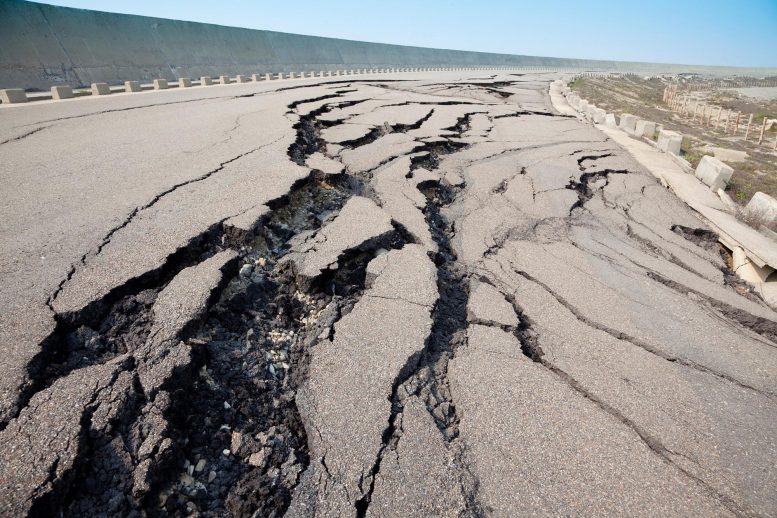
When and where was the lede photograph taken? It certainly isn’t representative of magnitude 1.5 to 5.0 earthquakes, which are characterized as “instrumental” to “mild or moderate.” It appears to show the result of an earthquake much stronger than the 5.0 magnitude earthquake mentioned in the article. It is reminiscent of the devastating 1964 Good Friday Earthquake in Alaska with a magnitude of 9.2!
What was the strongest earthquake recorded by this study?
I missed the part covering the compensation paid to people and governments for the damage. Oh wait, these are fossil fuel companies they walk away scot free, always.
What damages? I seriously doubt that the picture shown with the article represents the typical damage by a sub-5.0 magnitude ‘quake.
Just like the government usually walks away. The government has to agree to be sued for damages. In the case of the Rocky Flats Arsenal in Denver, the deep-well injections were stopped because of damage. If cause can be assigned to a particular company, they can be sued for damages.
You sound like your personal dislike of “fossil fuel” companies affects your objectivity.
Fracking is already wellknown to trigger earthquakes but what is even worse is the fact that its full range of risks/dangers being still unknown!
Could it cause massive sinkholes, ground collapses eventually, after a long time, for example?
Realize that once the fracking fluid is injected deep underground, there is no way to take it back!
So if we findout someday that fracking is extremely dangerous in the long term, then we will absolutely have no solution (other than just keep waiting for all damage to get done)!
The risks/dangers of fracking far outweigh its benefits & so ALL kinds of fracking should/must be banned globally/permanently!!
“Could it cause massive sinkholes, ground collapses eventually, after a long time, for example?”
Only if a void exists for the rock above to collapse into. Voids can be identified by the same seismic techniques used to inform drilling operations. It is good to be concerned about unintended consequences. However, equating an impossibility with a probability is illogical.
Your speculation alone does not support your opinion that “The risks/dangers of fracking far outweigh its benefits, …” Risk/benefit analyses should always be done, even for so-called sustainable energy sources. Are they?
Are you aware of this potential problem from ‘benign’ coastal wind turbines? https://www.theguardian.com/environment/2021/oct/11/underwater-cables-renewables-affect-blood-cells-brown-crabs-study
“Fracking is already wellknown [sic] to trigger earthquakes …”
Note: “Hydraulic fracturing … was linked to only 13% of earthquakes.”
Unfortunately, the article neglected to say if there was a size distribution associated with that 13% of correlated ‘quakes. I’m sure they have that information.
I’ve been in the oilfield since the early nineties. For a fact I know it’s fracking the cause of earthquakes.