
Close Menu
    Facebook X (Twitter) Instagram
    SciTechDaily
    • Biology
    • Chemistry
    • Earth
    • Health
    • Physics
    • Science
    • Space
    • Technology
    Facebook X (Twitter) Pinterest YouTube RSS
    SciTechDaily
    Home»Technology»Old Silicon Learns New Tricks: Atomically Architected Silicon Pyramids With Unusual Magnetic Properties
    Technology

    Old Silicon Learns New Tricks: Atomically Architected Silicon Pyramids With Unusual Magnetic Properties

    By Nara Institute of Science and TechnologyJanuary 6, 20211 Comment3 Mins Read
    Facebook Twitter Pinterest Telegram LinkedIn WhatsApp Email Reddit
    Share
    Facebook Twitter LinkedIn Pinterest Telegram Email Reddit
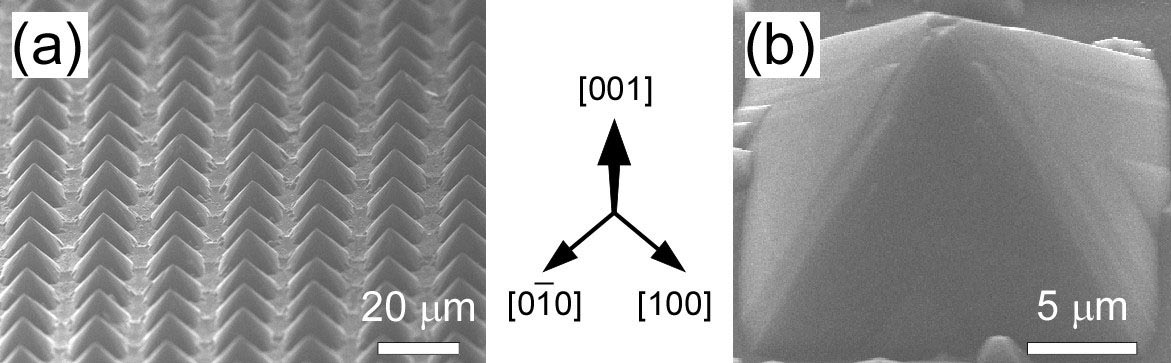
    Fabricated Si Pyramids
    (a) Wide and (b) magnified images of the fabricated Si pyramids. Four slopes correspond to Si{111} facet surfaces. Credit: Ken Hattori

    Researchers from Nara Institute of Science and Technology fabricated arrays of atomically smooth iron-coated silicon pyramids with unusual magnetic properties.

    Ultrasmall integrated circuits have revolutionized mobile phones, home appliances, cars, and other everyday technologies. To further miniaturize electronics and enable advanced functions, circuits must be reliably fabricated in three dimensions. Achieving ultrafine 3D shape control by etching into silicon is difficult because even atomic-scale damage reduces device performance. Researchers at Nara Institute of Science and Technology (NAIST) report, in a new study seen in Crystal Growth and Design, silicon etched to adopt the shape of atomically smooth pyramids. Coating these silicon pyramids with a thin layer of iron imparts magnetic properties that until now were only theoretical.

    NAIST researcher and senior author of the study Ken Hattori is widely published in the field of atomically controlled nanotechnology. One focus of Hattori’s research is in improving the functionality of silicon-based technology.

    “Silicon is the workhorse of modern electronics because it can act as a semiconductor or an insulator, and it’s an abundant element. However, future technological advances require atomically smooth device fabrication in three dimensions,” says Hattori.
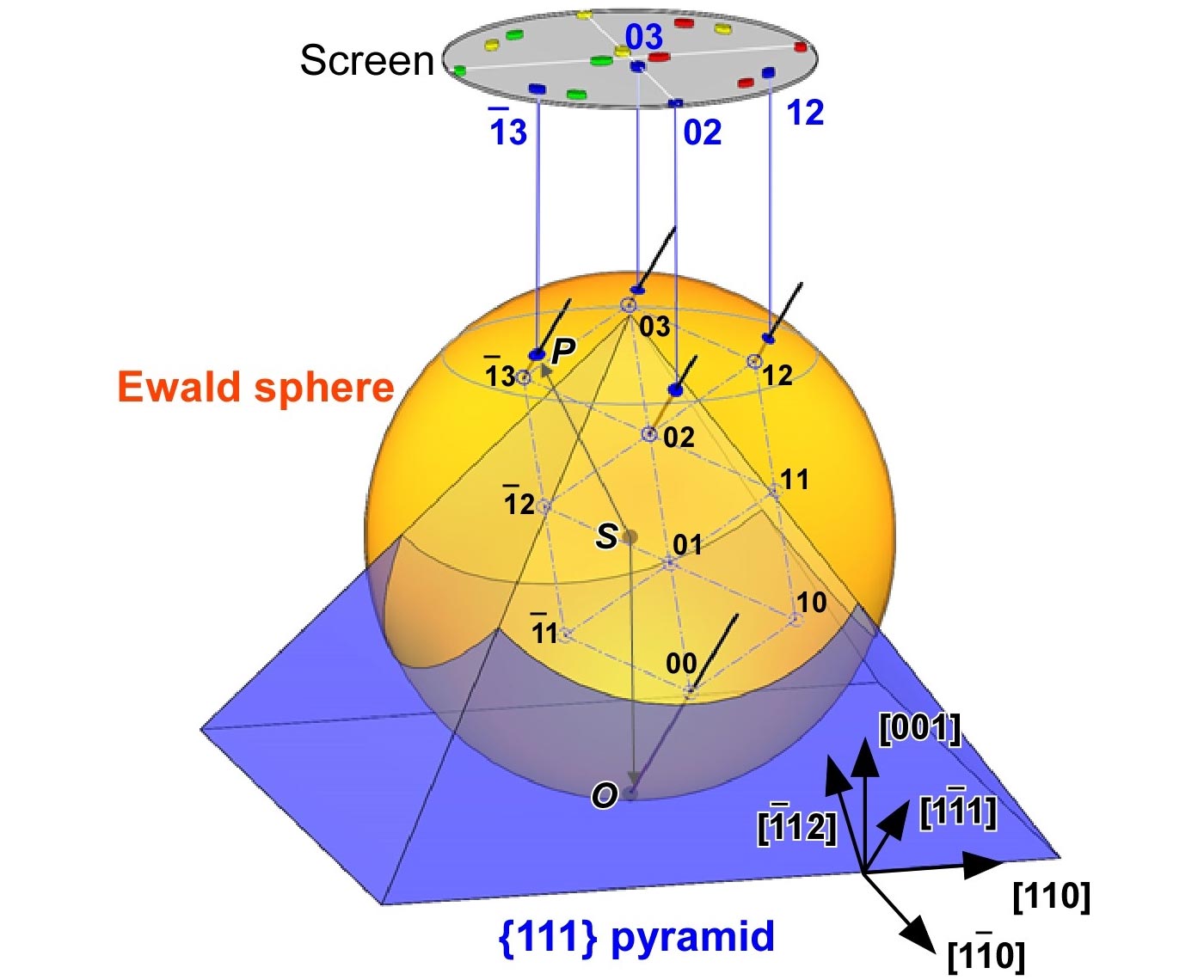
    Ewald Sphere and Reciprocal Lattice Rods
    Schematics representing Ewald sphere and reciprocal lattice rods from a pyramid surface, reflecting diffraction patterns. Credit: Ken Hattori

    Creating Perfect Pyramids with Smooth Atomic Surfaces

    A combination of standard dry etching and chemical etching is necessary to fabricate arrays of pyramid-shaped silicon nanostructures. Until now, atomically smooth surfaces have been extremely challenging to prepare.

    “Our ordered array of isosceles silicon pyramids were all the same size and had flat facet planes. We confirmed these findings by low-energy electron diffraction patterns and electron microscopy,” explains lead author of the study Aydar Irmikimov.

    An ultrathin — 30 nanometer — layer of iron was deposited onto the silicon to impart unusual magnetic properties. The pyramids’ atomic-level orientation defined the orientation-and thus the properties-of the overlaying iron.

    “Epitaxial growth of iron enabled shape anisotropy of the nanofilm. The curve for the magnetization as a function of the magnetic field was rectangular-like shaped but with breaking points which were caused by asymmetric motion of magnetic vortex bound in pyramid apex,” explains Hattori.

    Confirming Theoretical Predictions in Real Nanostructures

    The researchers found that the curve had no breaking points in analogous experiments performed on planar iron-coated silicon. Other researchers have theoretically predicted the anomalous curve for pyramid shapes, but the NAIST researchers are the first to have shown it in a real nanostructure.

    “Our technology will enable fabrication of a circular magnetic array simply by tuning the shape of the substrate,” says Irmikimov. Integration into advanced technologies such as spintronics — which encode information by the spin, rather than electrical charge, of an electron — will considerably accelerate the functionality of 3D electronics.

    Reference: “Atomically architected silicon pyramid single-crystalline structure supporting epitaxial material growth and characteristic magnetism” by Aydar Irmikimov, Liliany N. Pamasi, Azusa N. Hattori, Takaaki Higashi, Shunta Takahashi, Emilia E. Hashamova, Xiaoqian Shi, Fangzhun Guo, Nobuyoshi Hosoito, Ai I. Osaka, Hidekazu Tanaka and Ken Hattori, 5 January 2021, Crystal Growth and Design.
    DOI: 10.1021/acs.cgd.0c01286

    Never miss a breakthrough: Join the SciTechDaily newsletter.
    Follow us on Google and Google News.

    Electrical Engineering Nara Institute of Science and Technology Popular Semiconductors
    Share. Facebook Twitter Pinterest LinkedIn Email Reddit

    Related Articles

    Engineering Breakthrough Paves Way for Chip Components That Could Serve As Both RAM and ROM

    A Laser Breakthrough: First Commercially Scalable Integrated Laser and Microcomb on a Single Chip

    Energy Saving Electronics Breakthrough – Paving Way for a Carbon-Neutral Society

    “Mount Everest” of Electronic Materials: Stretching Diamond for Next-Generation Microelectronics

    Smarter Artificial Intelligence Technology in a New Light-Powered Chip

    Transistor-Integrated Microfluidic Cooling for More Powerful Electronic Chips

    Order From Disorder: Harnessing Turbulence in Light to Create a High-Precision Laser

    Revolutionary Light-Emitting Silicon – “Holy Grail” Breakthrough After 50 Years of Work

    Chance Discovery Results in New Type of Transistor for High-Power Electronic Devices

    1 Comment

    1. Clyde Spencer on January 7, 2021 3:03 pm

      Editor: You might have said something about Miller Indices. I’m sure that the average reader finds the triple numbers in braces and brackets to be quite enigmatic.

      Reply
    Leave A Reply Cancel Reply

    • Facebook
    • Twitter
    • Pinterest
    • YouTube

    Don't Miss a Discovery

    Subscribe for the Latest in Science & Tech!

    Trending News

    Breakthrough Bowel Cancer Trial Leaves Patients Cancer-Free for Nearly 3 Years

    Natural Compound Shows Powerful Potential Against Rheumatoid Arthritis

    100,000-Year-Old Neanderthal Fossils in Poland Reveal Unexpected Genetic Connections

    Simple “Gut Reset” May Prevent Weight Gain After Ozempic or Wegovy

    2.8 Days to Disaster: Scientists Warn Low Earth Orbit Could Suddenly Collapse

    Common Food Compound Shows Surprising Power Against Superbugs

    5 Simple Ways To Remember More and Forget Less

    The Atomic Gap That Could Cost the Semiconductor Industry Billions

    Follow SciTechDaily
    • Facebook
    • Twitter
    • YouTube
    • Pinterest
    • Newsletter
    • RSS
    SciTech News
    • Biology News
    • Chemistry News
    • Earth News
    • Health News
    • Physics News
    • Science News
    • Space News
    • Technology News
    Recent Posts
    • Alzheimer’s May Begin Decades Earlier Than You Think, New Mayo Clinic Study Finds
    • The Hidden Risk of Taking Breaks From Weight-Loss Drugs Like Ozempic
    • Total Solar Eclipse Made Cities Go Eerily Quiet Beneath the Surface
    • This Common Plant Could Be an Unexpected New Source of Protein
    • Birds in Cities Fear Women More Than Men and Scientists Don’t Know Why
    Copyright © 1998 - 2026 SciTechDaily. All Rights Reserved.
    • Science News
    • About
    • Contact
    • Editorial Board
    • Privacy Policy
    • Terms of Use

    Type above and press Enter to search. Press Esc to cancel.