
Close Menu
    Facebook X (Twitter) Instagram
    SciTechDaily
    • Biology
    • Chemistry
    • Earth
    • Health
    • Physics
    • Science
    • Space
    • Technology
    Facebook X (Twitter) Pinterest YouTube RSS
    SciTechDaily
    Home»Space»One of the “Coolest” Places in the World: Astronomers Pinpoint the Best Place on Earth for a Telescope
    Space

    One of the “Coolest” Places in the World: Astronomers Pinpoint the Best Place on Earth for a Telescope

    By University of British ColumbiaAugust 24, 2020No Comments3 Mins Read
    Facebook Twitter Pinterest Telegram LinkedIn WhatsApp Email Reddit
    Share
    Facebook Twitter LinkedIn Pinterest Telegram Email Reddit
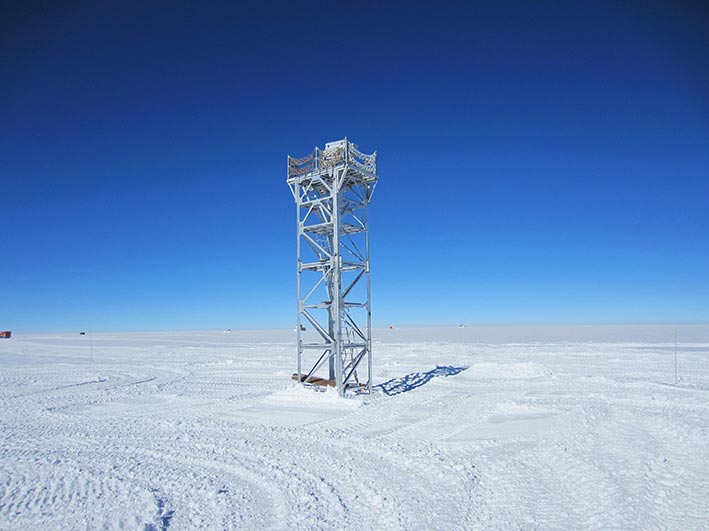
    KunLun Differential Image Motion Monitor
    The KunLun Differential Image Motion Monitors atop the 8-meter high tower at Dome A, Antarctica. Credit: Zhaohui Shang

    Dome A, the highest ice dome on the Antarctic Plateau, could offer the clearest view on Earth of the stars at night, according to new research by an international team from China, Australia, and the University of British Columbia (UBC). The challenge? The location is one of the coldest and most remote places on Earth.

    The findings were published recently in the journal Nature.

    “A telescope located at Dome A could out-perform a similar telescope located at any other astronomical site on the planet,” said UBC astronomer Paul Hickson, a co-author of the study. “The combination of high altitude, low temperature, long periods of continuous darkness, and an exceptionally stable atmosphere, makes Dome A a very attractive location for optical and infrared astronomy. A telescope located there would have sharper images and could detect fainter objects.”

    The combination of high altitude, low temperature, long periods of continuous darkness, and an exceptionally stable atmosphere, makes Dome A a very attractive location for optical and infrared astronomy.

    One of the biggest challenges in Earth-based astronomy is overcoming the effect of atmospheric turbulence on telescope image quality. This turbulence makes stars twinkle, and measurement of its impact is referred to as ‘seeing.’ The less turbulence (the lower the seeing number) the better.

    “The thinner boundary layer at Dome A makes it less challenging to locate a telescope above it, thereby giving greater access to the free atmosphere,” said UBC astronomer Bin Ma, lead author on the paper.

    Currently, the highest performing observatories are located in high-altitude locations along the equator (Chile and Hawaiʻi) and offer seeing in the range of 0.6 to 0.8 arcseconds. In general, the Antarctic has the potential for better seeing, owing to weaker turbulence in the free atmosphere, with an estimated range of 0.23 to 0.36 arcseconds at a location called Dome C.

    Ma, Hickson, and colleagues in China and Australia evaluated a different location, Dome A—also referred to as Dome Argus. Dome A is located near the center of East Antartica, 1,200 kilometers (750 miles) inland.
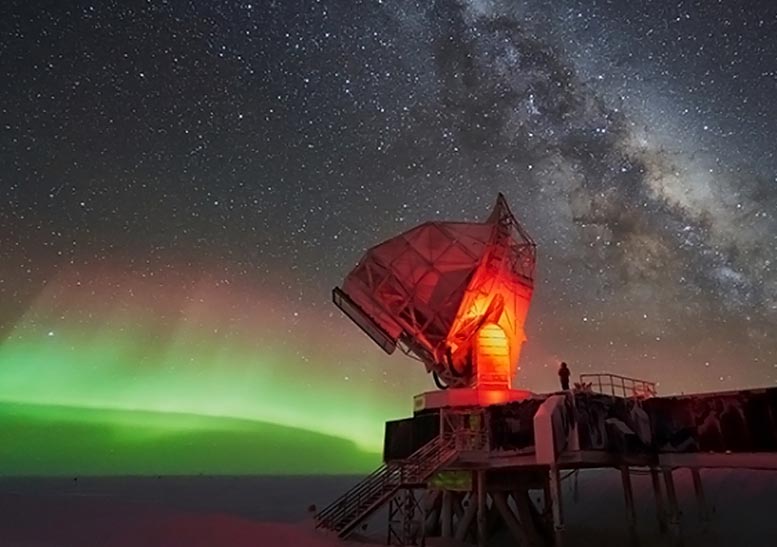
    South Pole Telescope
    The South Pole Telescope at the US Amundsen-Scott South Pole Station, with a bright aurora in July 2020. Credit: Geoff Chen

    The researchers estimated the location has a thinner boundary layer (the lowest part of the atmosphere, which is influenced by friction from the Earth’s surface) than Dome C. Previous measurements from Dome A have been taken in the daytime, but the authors report a median night-time seeing of 0.31 arcseconds, reaching as low as 0.13 arcseconds.

    The measurements from Dome A, taken at a height of eight meters, were much better than those from the same height at Dome C and comparable to those at a height of 20 meters (66 feet) at Dome C.

    Not surprisingly, the viewing capabilities of the researchers’ equipment were also hampered by frost—overcoming this issue could improve seeing by 10 to 12 percent. But the site has promise, according to Ma.

    “Our telescope observed the sky fully automatically at an unmanned station in Antarctica for seven months, with air temperature dropping to -75C at times. In and of itself, that’s a technological breakthrough.”

    For more on this research, read Best Place on Earth to See Stars.

    Reference: “Night-time measurements of astronomical seeing at Dome A in Antarctica” by Bin Ma, Zhaohui Shang, Yi Hu, Keliang Hu, Yongjiang Wang, Xu Yang, Michael C. B. Ashley, Paul Hickson & Peng Jiang, 29 July 2020, Nature.
    DOI: 10.1038/s41586-020-2489-0

    Never miss a breakthrough: Join the SciTechDaily newsletter.

    Antarctica Astronomy Atmospheric Science Stars University of British Columbia
    Share. Facebook Twitter Pinterest LinkedIn Email Reddit

    Related Articles

    Dome A in Antarctica Is the Best Site for Optical Astronomical Observation on Earth

    Best Place on Earth to See Stars – Where They Can Finally Be Seen Without Their Twinkle

    Hubble Reveals Link Between Stars’ Ages and Their Orbits

    WISE Views Aging Star Erupting With Dust

    New Model May Rule Out the Presence of Dark Matter

    Hubble Captures New Image of Messier 9

    Hubble Peers at 10 Billion Year Old Globular Cluster NGC 6752

    Astronomers Combine Hundreds of Images of Carina Nebula to Reveal Thousands of Stars in Stellar Nursery

    Hubble Observes Rare Blue Stars in Andromeda’s Core

    Leave A Reply Cancel Reply

    • Facebook
    • Twitter
    • Pinterest
    • YouTube

    Don't Miss a Discovery

    Subscribe for the Latest in Science & Tech!

    Trending News

    Worse Than We Thought: “Forever Chemicals” Are Far More Acidic Than Previously Believed

    Scientists Find a Way to Stop Breast Cancer From Coming Back

    Inexpensive New Liquid Battery Could Replace $10,000 Lithium Systems

    New Research Reveals Not All Ultra-Processed Foods Are Bad

    Lost for a Century: First-Ever Images Reveal Sunken WWI Submarine’s Final Resting Place

    Astronomers Just Found a “Zombie Star” With a Shocking Backstory

    The Famous “Unhappiness Hump” Has Vanished, and Youth Are Paying the Price

    Weight-Loss Drug Mounjaro Shrinks Breast Cancer Tumors in Mice

    Follow SciTechDaily
    • Facebook
    • Twitter
    • YouTube
    • Pinterest
    • Newsletter
    • RSS
    SciTech News
    • Biology News
    • Chemistry News
    • Earth News
    • Health News
    • Physics News
    • Science News
    • Space News
    • Technology News
    Recent Posts
    • Archaeologists Unearth Europe’s Oldest Naval Artillery on Sunken Royal Ship
    • World’s Oldest Microbial DNA Discovered in Ancient Mammoth Remains
    • The Da Vinci Bloodline: Living Descendants Provide Clues to the Genius’s Genetic Secrets
    • Overworked Brain Cells May Hold the Key to Parkinson’s
    • Breakthrough “Artificial Cartilage” Could Transform Arthritis Treatment
    Copyright © 1998 - 2025 SciTechDaily. All Rights Reserved.
    • Science News
    • About
    • Contact
    • Editorial Board
    • Privacy Policy
    • Terms of Use

    Type above and press Enter to search. Press Esc to cancel.