
Close Menu
    Facebook X (Twitter) Instagram
    SciTechDaily
    • Biology
    • Chemistry
    • Earth
    • Health
    • Physics
    • Science
    • Space
    • Technology
    Facebook X (Twitter) Pinterest YouTube RSS
    SciTechDaily
    Home»Health»Open Source All-Atom Models of Full-Length COVID-19 ‘S’ Protein Produced by Scientists
    Health

    Open Source All-Atom Models of Full-Length COVID-19 ‘S’ Protein Produced by Scientists

    By Lehigh UniversityJune 21, 2020No Comments3 Mins Read
    Facebook Twitter Pinterest Telegram LinkedIn WhatsApp Email Reddit
    Share
    Facebook Twitter LinkedIn Pinterest Telegram Email Reddit
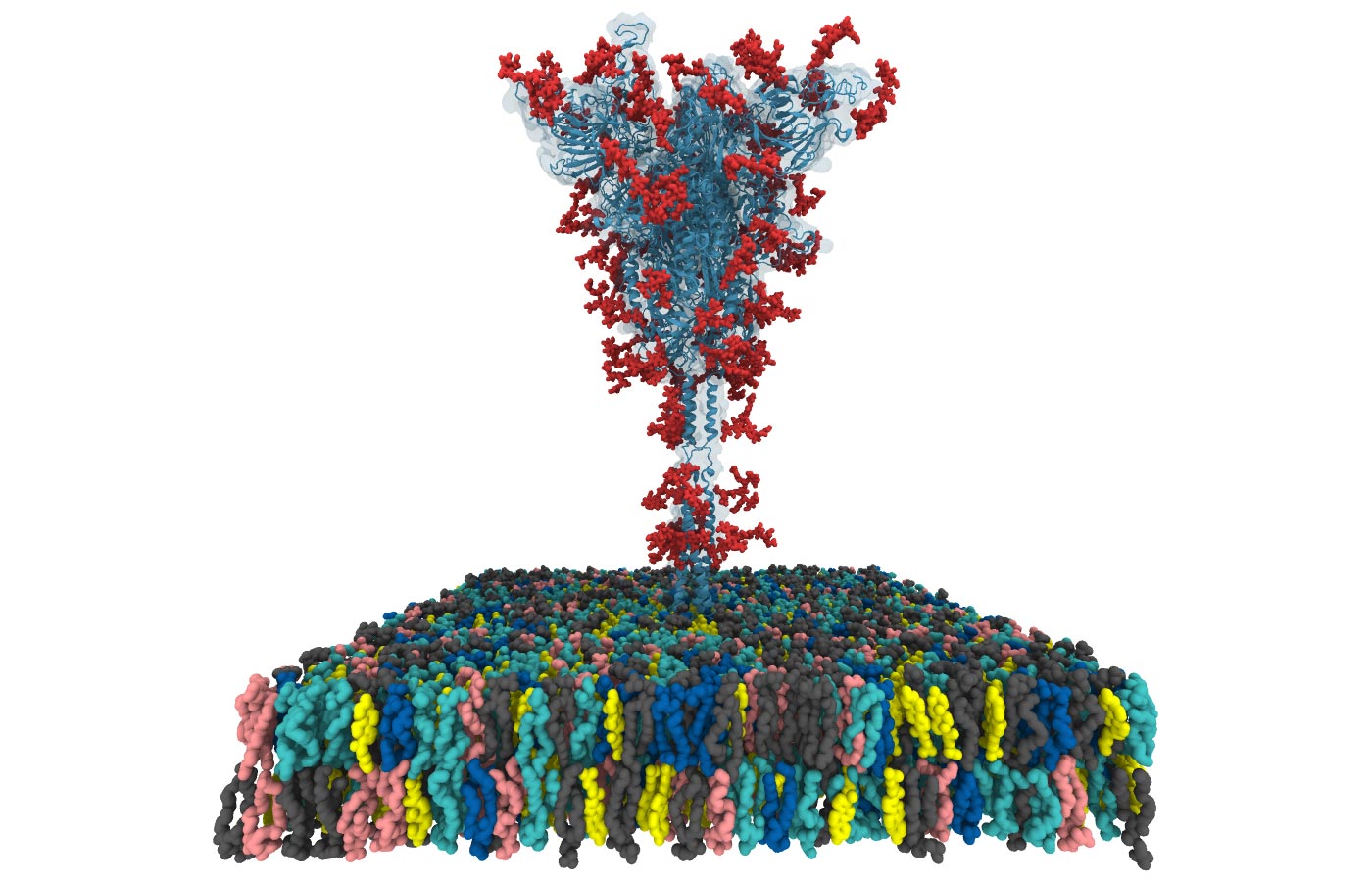
    Fully Glycosylated Full Length S Protein Models

    A model of an S-protein. Illustration: Dr. Yeolkyo Choi/Lehigh

    The virus SARS coronavirus 2 (SARS-CoV-2) is the known cause of coronavirus disease 2019 (COVID-19). The “spike” or S protein facilitates viral entry into host cells.

    Now a group of researchers from Lehigh, Seoul National University in South Korea and the University of Cambridge in the UK has worked together to produce the first open-source all-atom models of a full-length S protein. The researchers say this is of particular importance because the S protein plays a central role in viral entry into cells, making it a main target for vaccine and antiviral drug development.

    This video illustrates how to build the membrane system from their SARS-CoV-2 S protein models. The model-building program is open access and can be found from the home page of CHARMM-GUI by clicking on the COVID-19 Archive link, or by clicking the archive link in the header, then the COVID-19 Proteins link in the left sidebar.

    Developed by Wonpil Im, a professor in Lehigh’s Department of Biological Sciences and Bioengineering Department, CHARMM-GUI (GUI = graphical user interface) is a program that simulates complex biomolecular systems simply, precisely and quickly. Im describes it as a “computational microscope” that enables scientists to understand molecular-level interactions that cannot be observed any other way. More information about CHARMM-GUI can be found in this video.

    “Our models are the first fully-glycosylated full-length SARS-CoV-2 spike (S) protein models that are available to other scientists,” says Im. “I was fortunate to collaborate with Dr. Chaok Seok from Seoul National University in Korea and Dr. Tristan Croll from University of Cambridge in the U.K. Our team spent days and nights building these models very carefully from the known cryo-EM structure portions. Modeling was very challenging because there were many regions where simple modeling failed to provide high-quality models.”

    Scientists can use the models to conduct innovative and novel simulation research for the prevention and treatment of COVID-19, according to Im.

    The S protein structure was determined with cryo-EM with the RBD up (PDB ID: 6VSB), and with the RBD down (PDB ID: 6VXX). But, this model has many missing residues. So, they first modeled the missing amino acid residues, and then other missing domains. In addition, they modeled all potential glycans (or carbohydrates) attached to the S protein. The glycans prevent antibody recognition, which makes it difficult to develop a vaccine. They also built a viral membrane system of an S protein for molecular dynamics simulation.

    The team recommends reading the preprint paper, “Modeling and Simulation of a Fully-glycosylated Full-length SARS-CoV-2 Spike Protein in a Viral Membrane,” before using any of the models.

    Reference: “Modeling and Simulation of a Fully-glycosylated Full-length SARS-CoV-2 Spike Protein in a Viral Membrane” by Hyeonuk Woo, Sang-Jun Park, Yeol Kyo Choi, Taeyong Park, Maham Tanveer, Yiwei Cao, Nathan R. Kern, Jumin Lee, Min Sun Yeom, Tristan Croll, Chaok Seok and Wonpil Im, 17 June 2020, bioRxiv.
    DOI: 10.1101/2020.05.20.103325

    Never miss a breakthrough: Join the SciTechDaily newsletter.
    Follow us on Google and Google News.

    Biochemistry Biotechnology COVID-19 Lehigh University Molecular Biology Virology
    Share. Facebook Twitter Pinterest LinkedIn Email Reddit

    Related Articles

    Newly Discovered Virus-Cell Interaction May Explain COVID-19’s High Infection Rate

    Experimental Therapy For Parasitic Heart Disease – K777 – May Also Help Stop COVID-19

    Promising At-Home Treatment for COVID-19 Discovered: FDA Approved Drug for Leprosy

    New Biosensors Quickly Detect COVID-19 Coronavirus Proteins and Antibodies

    Computer Designed Synthetic Antiviral Proteins Inhibit SARS-CoV-2 / COVID-19 in Human Cells

    COVID-19 Vaccine Innovation Could Massively Speed Up Worldwide Production

    Compounds Identified That Halt COVID-19 Virus Replication by Targeting Key Viral Enzyme

    Coronavirus Fight: Scientists Identify COVID-19 Drug That “Kills” the Virus Within 48 Hours

    Companies Affiliated With MIT Take On COVID-19 Pandemic Using Technology

    Leave A Reply Cancel Reply

    • Facebook
    • Twitter
    • Pinterest
    • YouTube

    Don't Miss a Discovery

    Subscribe for the Latest in Science & Tech!

    Trending News

    1.4-Million-Year-Old Footprints Reveal a Giant Human Relative

    Astronomers May Have Found the First Moon Beyond Our Solar System

    Underwater Cameras Expose the Secret Lives of Whale Sharks

    Why Dreaming Leaves the Brain Running Low on Energy

    CERN Experiments Detect Signs of the Universe’s Primordial Matter

    Study Finds a Surprising Link Between Gut Microbes and Aging

    Frequent Cannabis Users Wake Up With More “Stress Hormone”

    Scientists Reveal Hidden DNA Traces in the Shroud of Turin

    Follow SciTechDaily
    • Facebook
    • Twitter
    • YouTube
    • Pinterest
    • Newsletter
    • RSS
    SciTech News
    • Biology News
    • Chemistry News
    • Earth News
    • Health News
    • Physics News
    • Science News
    • Space News
    • Technology News
    Recent Posts
    • Nearly Invisible Fish-Killing Pathogens Found in Brazil for the First Time
    • A Single Immune Switch Could Help Drive Widespread Aging
    • Scientists Discover a Major Brain Change That Starts Around Age 50
    • Scientists Discover What Makes Hydrogen Go Quantum
    • Scientists Discover Extreme Acceleration Inside a Nuclear Fireball
    Copyright © 1998 - 2026 SciTechDaily. All Rights Reserved.
    • Science News
    • About
    • Contact
    • Editorial Board
    • Privacy Policy
    • Terms of Use

    Type above and press Enter to search. Press Esc to cancel.