
New findings reveal why individuals with Down syndrome have less frequent, but more severe viral infections.
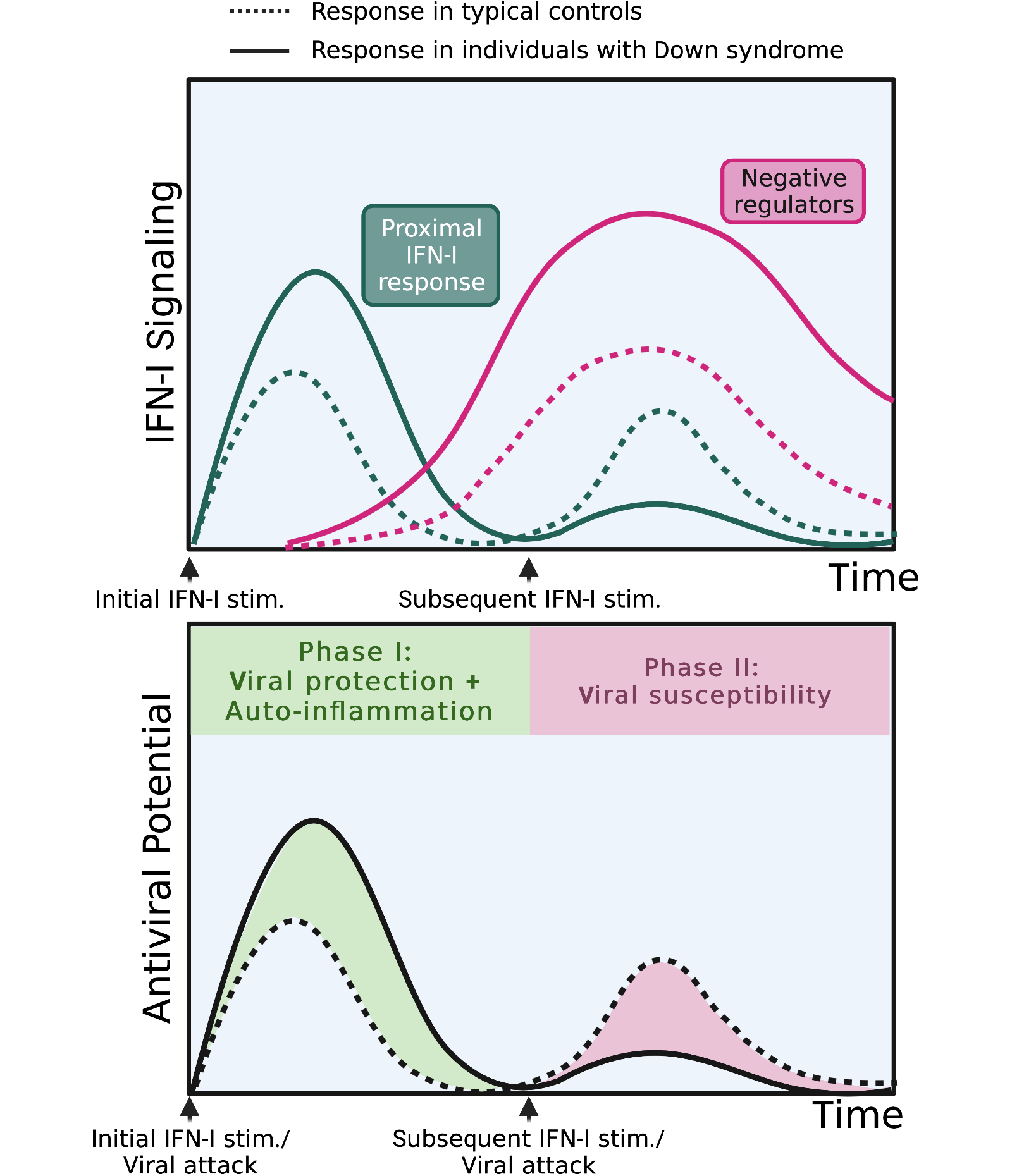
People with Down syndrome have less-frequent viral infections. However, when present, these infections lead to more severe disease. New research findings show that this is caused by increased expression of an antiviral cytokine type I interferon (IFN-I), which is partially coded for by chromosome 21. Elevated IFN-I levels lead to hyperactivity of the immune response initially, but the body overcorrects for this to reduce inflammation, leading to increased vulnerability later in the viral attack. The finding are published today (October 14) in the journal Immunity.
“We have a lot more to do to completely understand the complexities of the immune system in Down syndrome.” Louise Malle
The Immune System Paradox in Down Syndrome
“Usually too much inflammation means autoimmune disease, and immune suppression usually means susceptibility to infections,” says senior study author Dusan Bogunovic of the Icahn School of Medicine at Mount Sinai. “What is unusual is that individuals with Down syndrome are both inflamed and immunosuppressed, a paradox of sorts. Here, we discovered how this is possible.”
Down syndrome is typically caused by the triplication of chromosome 21. This syndrome affects multiple organ systems, causing a mixed clinical presentation that includes intellectual disability, developmental delays, congenital heart and gastrointestinal abnormalities, and Alzheimer’s disease in older individuals.
Down syndrome is the most common chromosomal disorder. According to the CDC, each year, about 6,000 babies are born with Down syndrome in the United States. This is about 1 in every 700 babies born. Between 1979 and 2003, the number of babies born with Down syndrome increased by about 30% in the U.S. Older mothers are more likely to have a baby affected by Down syndrome than younger mothers.
Recently, it has become clear that atypical antiviral responses are another important feature of Down syndrome. Increased rates of hospitalization of people with Down syndrome have been documented for influenza A virus, respiratory syncytial virus, and severe acute respiratory syndrome due to coronavirus (SARS-CoV-2) infections.
While people with Down syndrome show clear signs of immune disturbance, it has yet to be elucidated how a supernumerary chromosome 21 leads to dysregulation of viral defenses. To address this knowledge gap, the researchers compared fibroblasts and white blood cells derived from individuals with and without Down syndrome, at both the mRNA and protein levels. They focused on the potent antiviral cytokine IFN-I receptor subunits IFNAR1 and IFNAR2, which are located on chromosome 21.
Mechanism Behind Immune Oscillations in Down Syndrome
The scientists discovered that increased IFNAR2 expression was sufficient for the hypersensitivity to IFN-I observed in Down syndrome, independent of trisomy 21. But subsequently, the hyper-active IFN-I signaling cascade triggered excessive negative feedback via a protein called USP18, which is a potent IFNAR negative regulator. This process, in turn, suppressed further responses to IFN-I and antiviral responses. Taken together, the findings unveil oscillations of hyper- and hypo-responses to IFN-I in Down syndrome, predisposing to both lower incidence of viral disease and increased infection-related morbidity and mortality.
“We have a lot more to do to completely understand the complexities of the immune system in Down syndrome,” says first author Louise Malle of the Icahn School of Medicine at Mount Sinai. “We have here, in part, explained the susceptibility to severe viral disease, but this is only the tip of the iceberg.”
Reference: “Excessive Negative Regulation of Type I Interferon Disrupts Viral Control in Individuals with Down Syndrome” by Louise Malle, Marta Martin-Fernandez, Sofija Buta, Ashley Richardson, Douglas Bush and Dusan Bogunovic, 14 October 2022, Immunity.
DOI: 10.1016/j.immuni.2022.09.007
Never miss a breakthrough: Join the SciTechDaily newsletter.
Follow us on Google and Google News.