
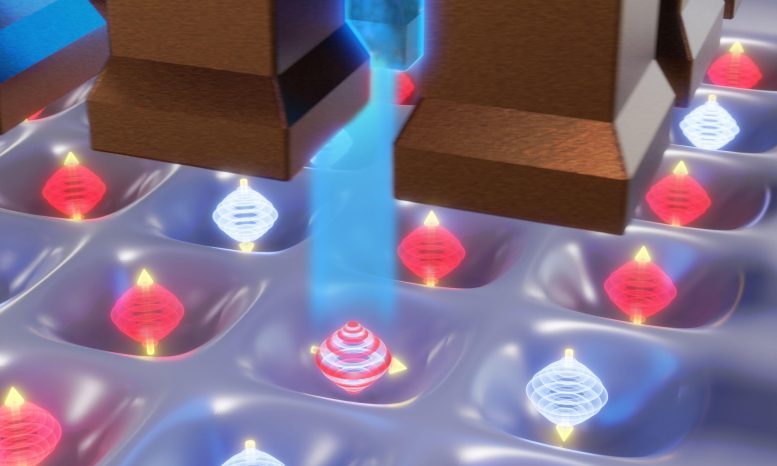
Scientists at the University of Rochester have developed a method that overcomes the limitations of electron spin resonance.
Quantum science holds the potential to transform modern technology through the creation of more efficient computers, communication systems, and sensing devices. Despite these exciting possibilities, challenges remain in realizing these goals, particularly when it comes to precisely manipulating information in quantum systems.
A team of researchers from the University of Rochester, led by John Nichol, an Associate Professor of Physics, has published a paper in Nature Physics outlining a novel approach for manipulating electron spin in silicon quantum dots—tiny, nanoscale semiconductors with remarkable properties—as a way to manipulate information in a quantum system.
“The results of the study provide a promising new mechanism for coherent control of qubits based on electron spin in semiconductor quantum dots, which could pave the way for the development of a practical silicon-based quantum computer,” Nichol says.
Using Quantum Dots As Qubits
A regular computer consists of billions of transistors, called bits. Quantum computers, on the other hand, are based on quantum bits, also known as qubits. Unlike ordinary transistors, which can be either “0” (off) or “1” (on), qubits are governed by the laws of quantum mechanics and can be both “0” and “1” at the same time.
Scientists have long considered using silicon quantum dots as qubits; controlling the spin of electrons in quantum dots would offer a way to manipulate the transfer of quantum information. Every electron in a quantum dot has intrinsic magnetism, like a tiny bar magnet. Scientists call this “electron spin”—the magnetic moment associated with each electron—because each electron is a negatively charged particle that behaves as though it were rapidly spinning, and it is this effective motion that gives rise to the magnetism.
Electron spin is a promising candidate for transferring, storing, and processing information in quantum computing because it offers long coherence times and high gate fidelities and is compatible with advanced semiconductor manufacturing techniques. The coherence time of a qubit is the time before the quantum information is lost due to interactions with a noisy environment; long coherence means a longer time to perform computations. High gate fidelity means that the quantum operation researchers are trying to perform is performed exactly as they want.
One major challenge in using silicon quantum dots as qubits, however, is controlling electron spin.
Controlling Electron Spin
The standard method for controlling electron spin is electron spin resonance (ESR), which involves applying oscillating radiofrequency magnetic fields to the qubits. However, this method has several limitations, including the need to generate and precisely control the oscillating magnetic fields in cryogenic environments, where most electron spin qubits are operated. Typically, to generate oscillating magnetic fields, researchers send a current through a wire, and this generates heat, which can disturb cryogenic environments.
Nichol and his colleagues outline a new method for controlling electron spin in silicon quantum dots that does not rely on oscillating electromagnetic fields. The method is based on a phenomenon called “spin-valley coupling,” which occurs when electrons in silicon quantum dots transition between different spin and valley states. While the spin state of an electron refers to its magnetic properties, the valley state refers to a different property related to the electron’s spatial profile.
The researchers apply a voltage pulse to harness the spin-valley coupling effect and manipulate the spin and valley states, controlling the electron spin.
“This method of coherent control, by spin-valley coupling, allows for universal control over qubits, and can be performed without the need of oscillating magnetic fields, which is a limitation of ESR,” Nichol says. “This allows us a new pathway for using silicon quantum dots to manipulate information in quantum computers.”
Reference: “Coherent spin–valley oscillations in silicon” by Xinxin Cai, Elliot J. Connors, Lisa F. Edge and John M. Nichol, 9 January 2023, Nature Physics.
DOI: 10.1038/s41567-022-01870-y
The study was funded by the National Science Foundation and the Army Research Office.
Never miss a breakthrough: Join the SciTechDaily newsletter.
Follow us on Google and Google News.
1 Comment
Interesting picture. Looks like the applied voltage is focused by four conductive posts. The valleys must be electrostatic effects, if not magnetic. I suppose valleys are strongest between poles. There is likely a larger array of conductive focusing posts not shown. The spacing between posts implies the beam source is switchable to adjacent dots. It looks like it could be a multi-beam electron micro-scanning array but it’s working with photons of charge instead of entire electrons. I guess the electrons forming the beam energies are kept bound to the beam sources and the couplings are AC electrostatic as if squeezing and pulling on the charges on the source electrons with phase controls.