
The Discovery Could Immediately Lead to New Opportunities for Drug Development
Adenosine, a neurotransmitter, has been found to act as a brake on dopamine, another neurotransmitter involved in motor control, by researchers at Oregon Health & Science University. The findings, which were published in the journal Nature, reveal that adenosine and dopamine operate in a push-pull dynamic in the brain.
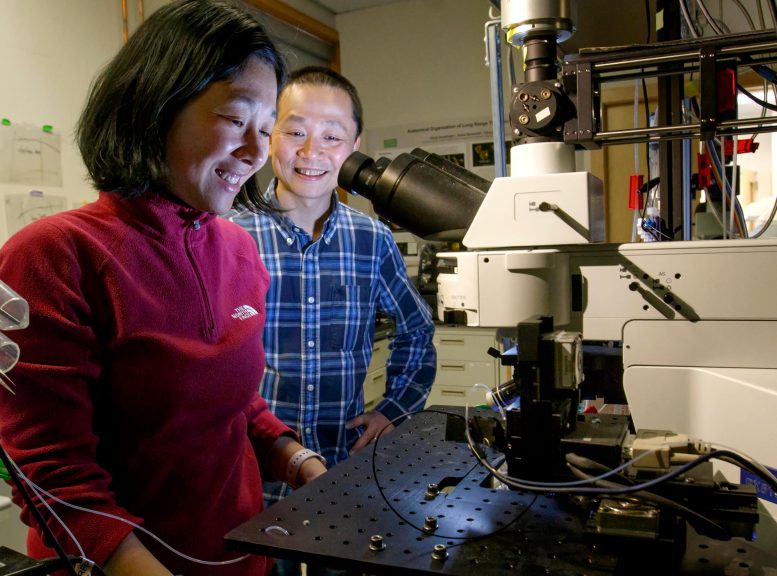
“There are two neuronal circuits: one that helps promote action and the other that inhibits action,” said senior author Haining Zhong, Ph.D., a scientist with the OHSU Vollum Institute. “Dopamine promotes the first circuit to enable movement, and adenosine is the ‘brake’ that promotes the second circuit and brings balance to the system.”
Implications for Parkinson’s Disease Treatment
The discovery has the potential to immediately suggest new avenues for drug development to treat the symptoms of Parkinson’s disease. Parkinson’s disease is a movement disorder that is believed to be caused by the loss of dopamine-producing cells in the brain.
The Role of the Striatum in Movement
Scientists have long suspected that dopamine is influenced by an opposing dynamic of neuronal signaling in the striatum — a critical region of the brain that mediates movement along with reward, motivation, and learning. The striatum is also the primary brain region affected in Parkinson’s disease by the loss of dopamine-producing cells.
“People for a long time suspected there has to be this push-pull system,” said co-author Tianyi Mao, Ph.D., a scientist at the Vollum who happens to be married to Zhong.
In the new study, researchers for the first time clearly and definitively revealed adenosine as the neurotransmitter that acts in an oppositional sense with dopamine. The study, involving mice, used novel genetically engineered protein probes recently developed in the Zhong and Mao labs. An example of that technology was highlighted last month in a study published in the journal Nature Methods.
Adenosine and Caffeine’s Interaction
Notably, adenosine is also well known as the receptor that caffeine acts upon.
“Coffee acts in our brain through the same receptors,” Mao said. “Drinking coffee lifts the brake imposed by adenosine.”
References:
“Locomotion activates PKA through dopamine and adenosine in striatal neurons” by Lei Ma, Julian Day-Cooney, Omar Jáidar Benavides, Michael A. Muniak, Maozhen Qin, Jun B. Ding, Tianyi Mao and Haining Zhong, 9 November 2022, Nature.
DOI: 10.1038/s41586-022-05407-4
“Sensitive genetically encoded sensors for population and subcellular imaging of cAMP in vivo” by Crystian I. Massengill, Landon Bayless-Edwards, Cesar C. Ceballos, Elizabeth R. Cebul, James Cahill, Arpita Bharadwaj, Evan Wilson, Maozhen Qin, Matthew R. Whorton, Isabelle Baconguis, Bing Ye, Tianyi Mao and Haining Zhong, 27 October 2022, Nature Methods.
DOI: 10.1038/s41592-022-01646-5
The study was funded by two BRAIN Initiative awards to Zhong and Mao through the National Institutes of Health, as well as three awards through the National Institute of Neurological Disorders and Stroke of the NIH, to Zhong.
Never miss a breakthrough: Join the SciTechDaily newsletter.
Follow us on Google and Google News.
12 Comments
Parkinsons is a toxicity pathway disease. Clean up those pathways with epigenetics and a squeacky clean zero processed foods diet… buh bye parkinsons, leaky gut, hashimotos, and all your other autoimmunes Takes years to destroy your gutbiome but is reversable by rebuilding it overa few years too. I’ve done it.
Too little, too late
A lot of parkinson troubles could be related to methyl bromide which is in our recycled drinking waters designed as a uniform water supply to add volatility to hydrogen infusion .its responsible for a lot of neurological problems .
I’ve also had preasure on side of skull for months antibiotics and pain relief moderated it but the other day I took liver detox caps and the pain is gone. Just saying. But a lot of troubles building up to this was from long covid and as I reasearch it the methyl bromide toxins seem to be responsible for a massive metabolism change
I am thankful for all the work being done to try and eradicate Parkinson’s. Over the years I have seen millions of dollars poured into research and so far other than swallowing pills for .dopamine, nothing has changed. We are always told of a breakthrough just about to happen but nothing happens. I’m not suggesting that we stop research but I think we could be a bit more honest and say we haven’t got ready far. If we had a breakthrough Michael Fox would be probably be the first 1 to receive it and advertise the breakthrough. Thanks so much for trying to keep our spirits and hope up but practically there doesn’t seem to be much progress in this research ..
Coffee… and chocolate (and any sugary product) lifts my brake to adenosine.
Maybe I’ll try that too.wouldnt have to change anything 🤣
Please hurry up and save Michael J. Fox
A rough road
I was diagnosed with Parkinson’s late in 2021. It seems like the disease has been progressing more intensely just lately. I appreciate all research to help, but as mentioned earlier, not much positive outcome, yet.
My husband has had Parkinson’s Disease for over five years now. It is progressive and the meds are no longer working to help his disease. He is going to have DBS surgery (Deep Brain Stimulation Surgery). The doctors say it will help with his tremors. I feel it is so very important to keep going to find a cure very soon because it is such a horrible disease and effects so many people. I belong to a PD support group which helps us cope with the challenges of Parkinson’s disease.
My father has had Parkinson now for over 10 years if we can find something to help him I would greatly appreciate it