
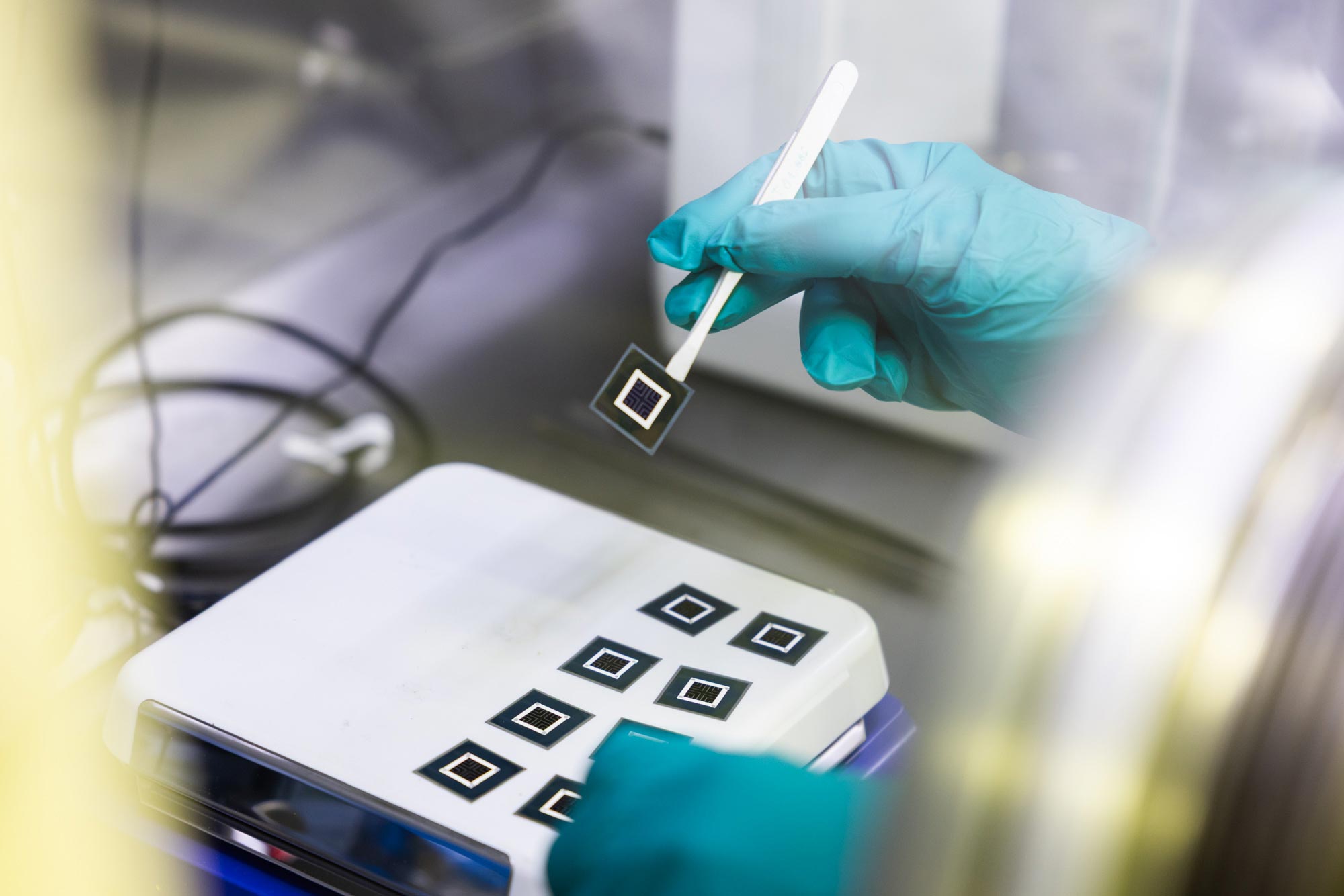
Researchers have unlocked a new method of passivating perovskite-silicon tandem solar cells, achieving record efficiencies and laying the groundwork for more powerful solar technology.
A group of international photovoltaics researchers has made an important advance toward bringing perovskite silicon tandem solar cells closer to large-scale industrial use. The team showed that the perovskite top cell can be successfully passivated when paired with textured silicon bottom cells that have large pyramidal structures, the standard design used in today’s solar industry.
Their work also revealed that passivation influences the entire perovskite layer, unlike silicon cells, where surface treatments only impact the uppermost layers. This distinction leads to additional efficiency gains. Scientists from King Abdullah University of Science and Technology (KAUST), the University of Freiburg, and the Fraunhofer Institute for Solar Energy Systems ISE detailed their technological and scientific progress in developing passivated perovskite top cells.
Perovskite silicon tandem solar cells combine a perovskite top cell with a silicon bottom cell. This pairing represents the next major step forward in photovoltaic technology, particularly as silicon-based solar cells near their theoretical efficiency ceiling of 29.4 percent for sunlight-to-electricity conversion.
For large-scale production of these tandem solar cells, using a standard silicon solar cell for the bottom cell would be advantageous, as their manufacturing processes are already well established. These solar cells are textured to increase their surface area, enhancing efficiency, but this texturization also complicates the deposition of the perovskite layer. Achieving high-quality surface passivation of the perovskite top cell on the pyramid-like surface had not yet been accomplished.
The Key Innovation
“So far, effective passivation has not been fully harnessed on textured perovskite silicon tandem solar cells, with prior success largely confined to flat-front architectures. But we have now managed excellent passivation by depositing 1,3-diaminopropane dihydroiodide on the uneven perovskite surface,” said Dr. Oussama Er-Raji, the lead author of the paper and a scientist at Fraunhofer ISE. The passivated tandem solar cells achieved a conversion efficiency of up to 33.1 percent, with an open-circuit voltage of 2.01 volts.
The scientists also observed that the passivation of the perovskite top cell improved the conductivity and thus the fill factor of the cell. They proved that this improvement is due to a deep field effect resulting from the passivation. In silicon solar cells, the passivation acts only close to the surface, whereas in perovskite solar cells, the surface treatment impacts the entire absorber, enhancing its bulk properties.
A Foundation for Future Research
“This realization provides a solid foundation for all future research in this area,” said Prof. Stefaan De Wolf, Professor of Materials Science and Engineering and Applied Physics at KAUST. “It enhances our understanding of the processes occurring in the top cell while converting light into electricity, enabling scientists to leverage this knowledge to develop better tandem solar cells.”
“Surface passivation of solar cells is not just a nice-to-have feature; it is an essential booster for their efficiency and stability,” adds Prof. Stefan Glunz, Professor of Photovoltaic Energy Conversion at the University of Freiburg and Director of the Photovoltaics Division at Fraunhofer ISE. “For today’s silicon solar cells, surface passivation was the key for high efficiencies in industrial production, and it is encouraging that the photovoltaic industry will benefit from these positive effects for perovskite silicon tandem solar cells as well.”
Reference: “Electron accumulation across the perovskite layer enhances tandem solar cells with textured silicon” by Oussama Er-raji, Christoph Messmer, Rakesh R. Pradhan, Oliver Fischer, Vladyslav Hnapovskyi, Sofiia Kosar, Marco Marengo, Mathias List, Jared Faisst, José P. Jurado, Oleksandr Matiash, Hannu P. Pasanen, Adi Prasetio, Badri Vishal, Shynggys Zhumagali, Anil R. Pininti, Yashika Gupta, Clemens Baretzky, Esma Ugur, Christopher E. Petoukhoff, Martin Bivour, Erkan Aydin, Randi Azmi, Jonas Schön, Florian Schindler, Martin C. Schubert, Udo Schwingenschlögl, Frédéric Laquai, Ahmed A. Said, Juliane Borchert, Patricia S. C. Schulze, Stefaan De Wolf and Stefan W. Glunz, 4 September 2025, Science.
DOI: 10.1126/science.adx1745
The researchers’ findings build on work in the Fraunhofer lighthouse project MaNiTU as well as the projects PrEsto and Perle, both funded by the Federal Ministry for Economic Affairs and Energy.
Never miss a breakthrough: Join the SciTechDaily newsletter.
Follow us on Google and Google News.