

NASA’s Perseverance rover is trying to collect a conglomerate rock sample from Mars to help scientists understand the planet’s geological history and its magnetic field activity.
The rover’s mission has been challenging due to the rocks’ fragile structure. These conglomerate rocks provide insights into a variety of geological events, erosional processes, and environmental changes and are key to conducting the “conglomerate test” that reveals magnetization events. The results of this test could potentially explain the thin Martian atmosphere by indicating the activity period of the Martian magnetic field.
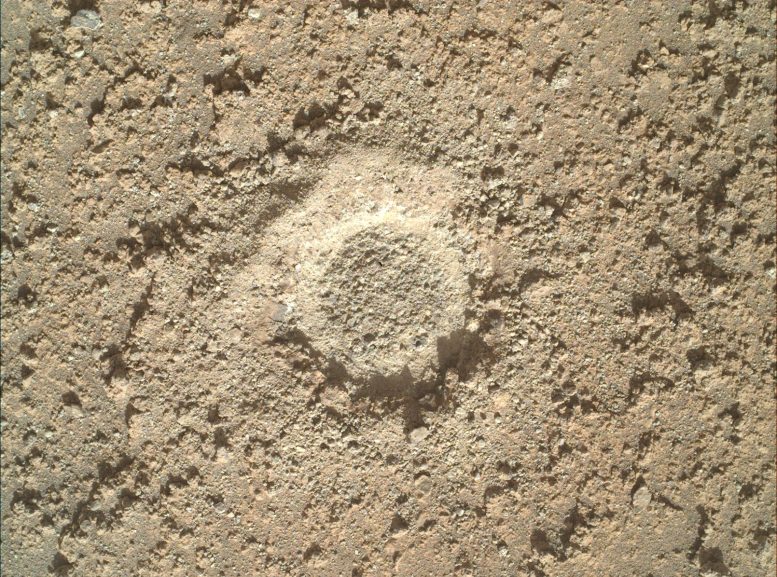
Sampling Martian rocks requires persistence! Right now, Perseverance is on the hunt for a conglomerate rock to sample for return to Earth – a task that is proving to be challenging. Two attempts were made to core at the Onahu outcrop, but the soft rock crumbled during each attempt. The team set sights on a neighboring outcrop called Stone Man Pass, about 40 meters away, to search for a less crumbly conglomerate that could stand up to the coring process.
After nearing Stone Man Pass, rover cameras indicated the rock is not a conglomerate, so instead, Perseverance drove to Emerald Lake, an outcrop a few tens of meters away and within the same layer as Onahu, to attempt sampling here.
What’s the deal with conglomerates and why is the team so interested in collecting one?
Conglomerates are a type of sedimentary rock made up of rounded pebble-sized grains greater than 2 mm across, cemented together in a matrix of finer-grained minerals, mud, or sand. Conglomerates are important because they provide a window into the past, recording information about a variety of geologic events and environmental shifts.
Minerals in each grain are evidence of geology and composition of source terrains, grain size, and roundness bear witness to erosional processes that shaped and transported pebbles, and matrix makeup can provide information about the chemistry, pH, and redox state of fluids that infilled space between clasts after they were deposited.
Mars’ Magnetic Field in Planetary Habitability
Additionally, these types of rocks can help complete the “conglomerate test,” a paleomagnetic tool used by geochronologists to date magnetization events in a planet’s past. Certain types of iron-bearing minerals display magnetic properties, and when a magnetic field is applied to these minerals, the direction of magnetization can shift, serving as a record of the event. The conglomerate test is used to determine whether a rock experienced a “remagnetization” event after it formed.
Why does this matter?
The conglomerate test can help determine when the Martian magnetic field was active. A planet’s magnetosphere, or global magnetic field, is the result of interactions between convection within a molten iron-rich core and the planet’s rotation on its axis. A magnetosphere is important for habitability, because it provides a shield against radiation from the Sun and deep space and can help a planet retain its atmosphere.
In the past, Mars had a molten core and magnetosphere, but at some point in history the core cooled and began to solidify, causing the magnetic field to shut off. Scientists believe that this may be why the Martian atmosphere is thinner today: absent a magnetic field to protect from radiation, solar wind can reach the surface and strip the atmosphere away to space.
Returned samples will help test this hypothesis!
Determining when this process occurred is an important goal for planetary scientists and astrobiologists seeking to understand Mars’ geologic past and changing habitability. With these goals in mind, Perseverance will continue to work towards collecting a conglomerate sample from the upper fan, so back on Earth, scientists can apply the conglomerate test to this special core and better constrain Mars’ paleomagnetic past.
Never miss a breakthrough: Join the SciTechDaily newsletter.
Follow us on Google and Google News.