
Close Menu
    Facebook X (Twitter) Instagram
    SciTechDaily
    • Biology
    • Chemistry
    • Earth
    • Health
    • Physics
    • Science
    • Space
    • Technology
    Facebook X (Twitter) Pinterest YouTube RSS
    SciTechDaily
    Home»Space»PESSTO Survey Views Spiral Galaxy Messier 74
    Space

    PESSTO Survey Views Spiral Galaxy Messier 74

    By European Southern ObservatorySeptember 3, 2013No Comments2 Mins Read
    Facebook Twitter Pinterest Telegram LinkedIn WhatsApp Email Reddit
    Share
    Facebook Twitter LinkedIn Pinterest Telegram Email Reddit
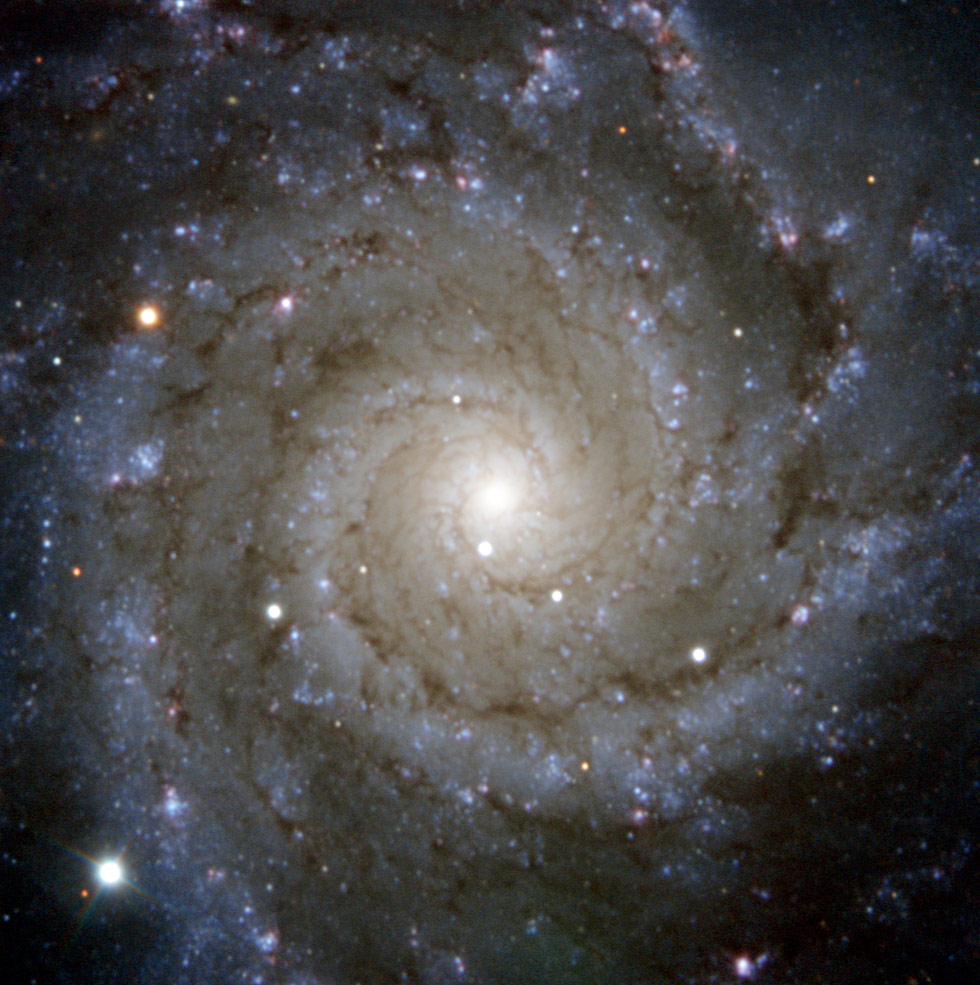
    PESSTO Survey Image of Messier 74
    PESSTO survey image of Messier 74. Credit: ESO/PESSTO/S. Smartt

    This new image from the Public ESO Spectroscopic Survey for Transient Objects (PRESSTO) shows spiral galaxy Messier 74 and its new supernova, SN2013ej.

    ESO’s PESSTO survey has captured this view of Messier 74, a stunning spiral galaxy with well-defined whirling arms. However, the real subject of this image is the galaxy’s brilliant new addition from late July 2013: a Type II supernova named SN2013ej that is visible as the brightest star at the bottom left of the image.

    Such supernovae occur when the core of a massive star collapses due to its own gravity at the end of its life. This collapse results in a massive explosion that ejects material far into space. The resulting detonation can be more brilliant than the entire galaxy that hosts it and can be visible to observers for weeks, or even months.

    PESSTO (Public ESO Spectroscopic Survey for Transient Objects) is designed to study objects that appear briefly in the night sky, such as supernovae. It does this by utilizing a number of instruments on the NTT (New Technology Telescope), located at ESO’s La Silla Observatory in Chile. This new picture of SN2013ej was obtained using the NTT during the course of this survey.

    SN2013ej is the third supernova to have been observed in Messier 74 since the turn of the millennium, the other two being SN 2002ap and SN 2003gd. It was first reported on 25 July 2013 by the KAIT telescope team in California, and the first “precovery image” was taken by amateur astronomer Christina Feliciano, who used the public access SLOOH Space Camera to look at the region in the days and hours immediately before the explosion.

    Messier 74, in the constellation of Pisces (The Fish), is one of the most difficult Messier objects for amateur astronomers to spot due to its low surface brightness, but SN2013ej should still be visible to careful amateur astronomers over the next few weeks as a faint and fading star.

    Links: PESSTO (the “Public ESO Spectroscopic Survey of Transient Objects”)


    Never miss a breakthrough: Join the SciTechDaily newsletter.
    Follow us on Google and Google News.

    Astronomy Astrophysics European Southern Observatory PESSETO Supernova
    Share. Facebook Twitter Pinterest LinkedIn Email Reddit

    Related Articles

    Astronomers Captured a Star’s Final Explosion in Stunning Detail

    Star Explodes Twice: Astronomers Capture Stunning Supernova Remains

    A Spooky Ghost of a Giant Star: What Remains After the Explosive Death of a Massive Star

    New ALMA Observations Show Stellar Explosion in Unprecedented Detail

    A New Class of Magnetar-Powered Supernova

    Two Merging Stars Destined to Ignite a Vast Supernova Explosion

    ALMA Views the Remains of Supernova 1987A

    Lasers Mimic Supernova to Explain Cosmic Magnetic Fields

    SN Primo Is Farthest Type Ia Supernova Discovered

    Leave A Reply Cancel Reply

    • Facebook
    • Twitter
    • Pinterest
    • YouTube

    Don't Miss a Discovery

    Subscribe for the Latest in Science & Tech!

    Trending News

    Scientists Discover Game-Changing New Way To Treat High Cholesterol

    This Small Change to Your Exercise Routine Could Be the Secret to Living Longer

    Scientists Discover 430,000-Year-Old Wooden Tools, Rewriting Human History

    AI Could Detect Early Signs of Alzheimer’s in Under a Minute – Far Before Traditional Tests

    What if Dark Matter Has Two Forms? Bold New Hypothesis Could Explain a Cosmic Mystery

    This Metal Melts in Your Hand – and Scientists Just Discovered Something Strange

    Beef vs. Chicken: Surprising Results From New Prediabetes Study

    Alzheimer’s Breakthrough: Scientists Discover Key Protein May Prevent Toxic Protein Clumps in the Brain

    Follow SciTechDaily
    • Facebook
    • Twitter
    • YouTube
    • Pinterest
    • Newsletter
    • RSS
    SciTech News
    • Biology News
    • Chemistry News
    • Earth News
    • Health News
    • Physics News
    • Science News
    • Space News
    • Technology News
    Recent Posts
    • Revolutionary Imaging Technique Unlocks Secrets of Matter at Extreme Speeds
    • Where Does Mass Come From? Scientists Find Evidence of a New Exotic Nuclear State
    • Quantum Breakthrough: Unhackable Keys Sent Over 120 km Using Quantum Dots
    • Researchers Discover Unknown Beetle Species Just Steps From Their Lab
    • Jellyfish Caught Feasting on Exploding Sea Worms for the First Time
    Copyright © 1998 - 2026 SciTechDaily. All Rights Reserved.
    • Science News
    • About
    • Contact
    • Editorial Board
    • Privacy Policy
    • Terms of Use

    Type above and press Enter to search. Press Esc to cancel.