
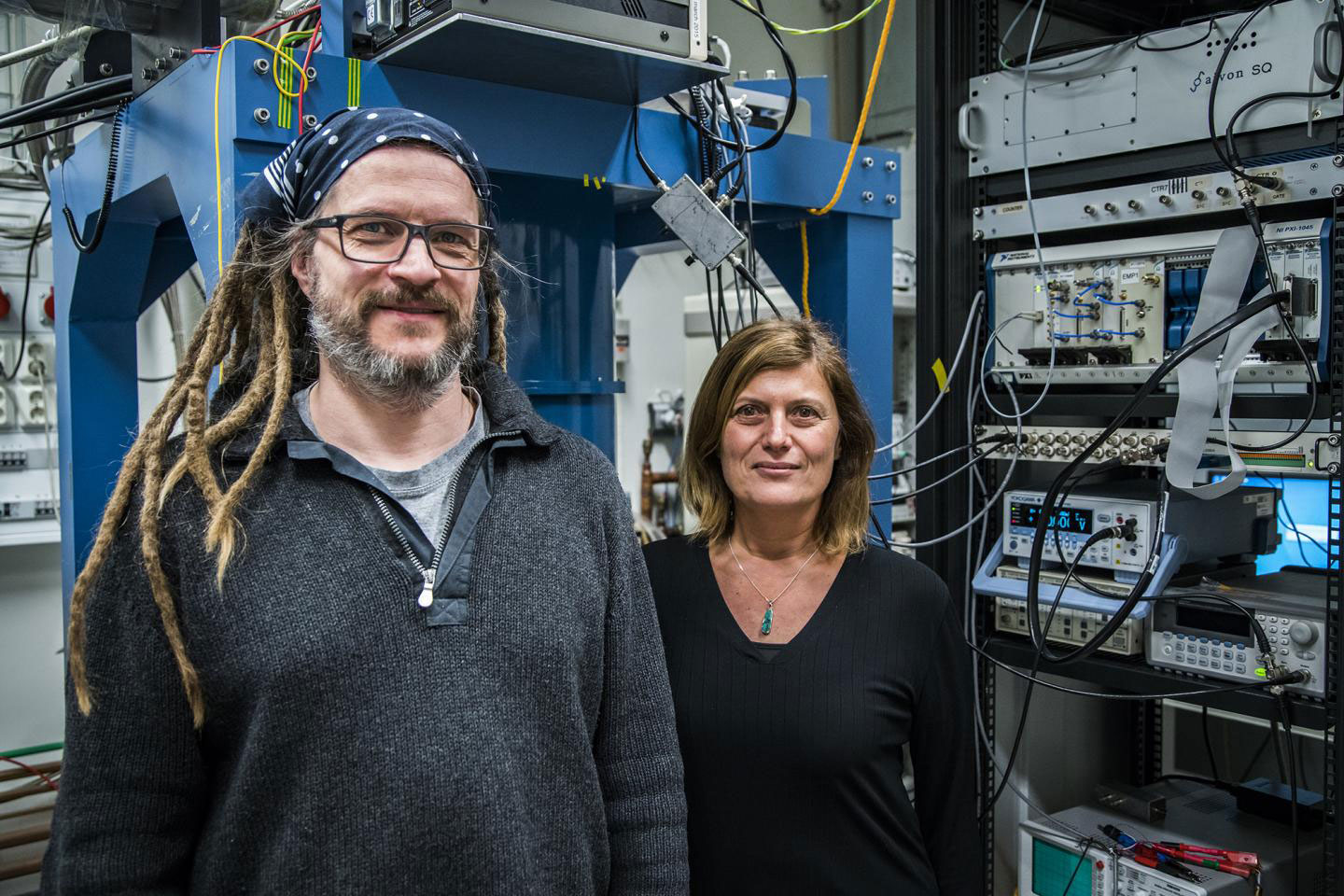
With their insensitivity to decoherence what are known as Majorana particles could become stable building blocks of a quantum computer. The problem is that they only occur under very special circumstances. Now researchers at Chalmers University of Technology have succeeded in manufacturing a component that is able to host the sought-after particles.
Researchers throughout the world are struggling to build a quantum computer. One of the great challenges is to overcome the sensitivity of quantum systems to decoherence, collapse of superpositions. One track within quantum computer research is therefore to make use of what are known as Majorana particles, which are also called Majorana fermions. Microsoft is also committed to the development of this type of quantum computer.
Majorana fermions are highly original particles, quite unlike those that make up the materials around us. In highly simplified terms, they can be seen as half electrons. In a quantum computer, the idea is to encode information in a pair of Majorana fermions which are separated in the material, which should, in principle, make the calculations immune to decoherence.
So where do you find Majorana fermions?
In solid state materials they only appear to occur in what are known as topological superconductors – a new type of superconductor that is so new and special that it is hardly ever found in practice. But a research team at Chalmers University of Technology is now among the first in the world to submit results indicating that they have actually succeeded in manufacturing a topological superconductor.
“Our experimental results are consistent with topological superconductivity,” says Floriana Lombardi, Professor at the Quantum Device Physics Laboratory at Chalmers.
To create their unconventional superconductor they started with what is called a topological insulator made of bismuth telluride, Be2Te3. A topological insulator is mainly just an insulator – in other words, it does not conduct current – but it conducts current in a very special way on the surface. The researchers have placed a layer of a conventional superconductor on top, in this case, aluminum, which conducts current entirely without resistance at really low temperatures.
“The superconducting pair of electrons then leak into the topological insulator which also becomes superconducting,” explains Thilo Bauch, Associate Professor in Quantum Device Physics.
However, the initial measurements all indicated that they only had standard superconductivity induced in the Bi2Te3 topological insulator. But when they cooled the component down again later, to routinely repeat some measurements, the situation suddenly changed – the characteristics of the superconducting pairs of electrons varied in different directions.
“And that isn’t compatible at all with conventional superconductivity. Suddenly unexpected and exciting things occurred,” says Lombardi.
Unlike other research teams, Lombardi’s team used platinum to assemble the topological insulator with the aluminum. Repeated cooling cycles gave rise to stresses in the material, which caused the superconductivity to change its properties.
After an intensive period of analyses the research team was able to establish that they had probably succeeded in creating a topological superconductor.
“For practical applications the material is mainly of interest to those attempting to build a topological quantum computer. We ourselves want to explore the new physics that lies hidden in topological superconductors – this is a new chapter in physics,” Lombardi says.
Reference: “Induced unconventional superconductivity on the surface states of Bi2Te3 topological insulator” by Sophie Charpentier, Luca Galletti, Gunta Kunakova, Riccardo Arpaia, Yuxin Song, Reza Baghdadi, Shu Min Wang, Alexei Kalaboukhov, Eva Olsson, Francesco Tafuri, Dmitry Golubev, Jacob Linder, Thilo Bauch and Floriana Lombardi, 30 January 2018, Nature Communications.
DOI: 10.1038/s41467-017-02069-z
Never miss a breakthrough: Join the SciTechDaily newsletter.
Follow us on Google and Google News.