
An experiment with ultracold atoms reveals that a strongly driven quantum system doesn’t always heat up as expected.
In daily life, doing work on something over and over usually makes it warmer. You can feel it when you rub your hands together, and you can see it when metal heats up under repeated hammer blows.
Even without formal equations, experience teaches the same lesson: if you keep pushing, stirring, pressing, or striking a system, its temperature tends to rise. Physicists generally expect a similar outcome in the quantum world. When a many particle system is repeatedly driven, especially when the particles interact strongly with one another, it should take in energy and gradually heat up.
But does that rule always hold, particularly for quantum matter? A recent experiment from Hanns-Christoph Nägerl’s group at the Department of Experimental Physics of the University of Innsbruck suggests the answer is no.
Localized in momentum space
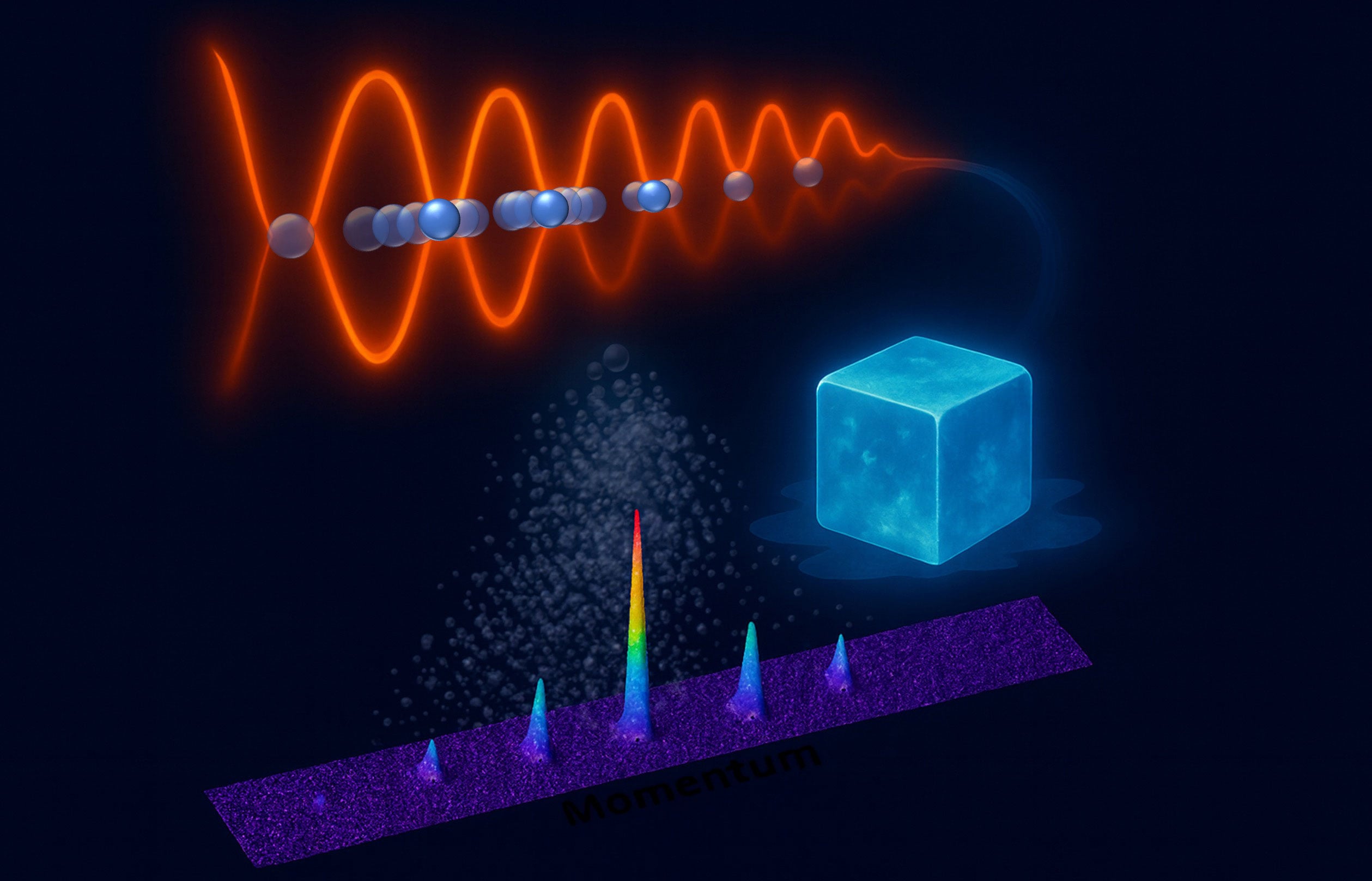
In the study, the team prepared a one dimensional quantum fluid made of strongly interacting atoms, cooled to only a few nanokelvin above absolute zero. They then subjected the atoms to a lattice potential that switched on in rapid, regular bursts, a periodically “kicked” landscape created with laser light. Under this kind of steady driving, the atoms would normally be expected to absorb energy together over time, similar to how two children on a trampoline might be jostled by the repeated jumping of a single child.
Yet the team observed something different. After a brief period of initial evolution, the atoms’ momentum distribution stopped spreading, and the system’s kinetic energy plateaued. Despite being continually kicked and strongly interacting, the system no longer absorbed energy. It had localized in momentum space, a remarkable phenomenon termed many-body dynamical localization (MBDL).
“In this state, quantum coherence and many-body entanglement prevent the system from thermalizing and from showing diffusive behavior, even under sustained external driving,” explains Hanns-Christoph Nägerl. “The momentum distribution essentially freezes and retains whatever structure it has.”
Stability rooted in quantum mechanics
Yanliang Guo, the lead author of the study, is still puzzled: “We had initially expected that the atoms would start flying all around. Instead, they behaved in an amazingly orderly manner.”
Lei Ying, a theory collaborator from Zhejing University in Hangzhou, China, agrees: “This is not to our naïve expectation. What’s striking is the fact that in a strongly driven and strongly interacting system, many-body coherence can evidently halt energy absorption. This goes against our classical intuition and reveals a remarkable stability rooted in quantum mechanics.”
Ying adds that simulating such a seemingly simple system on a classical computer is a daunting task. “That’s why we need experiments. They go hand in hand with our theory simulations.”
Quantum coherence is crucial
To test the fragility of the MBDL phenomenon, the researchers introduced randomness into the driving sequence. Indeed, a rather small amount of disorder was already enough to destroy the localization effect and to restore diffusion: the momentum distribution became smeared out, the kinetic energy rose sharply, and the system absorbed energy continuously.
“This test highlighted that quantum coherence is crucial for preventing thermalization in such driven many-body systems,” says Hanns-Christoph Nägerl.
The findings on MBDL are not just of fundamental interest. Understanding how quantum systems evade thermalization is a key step on the road towards building better quantum devices, including quantum simulators and computers, for which uncontrolled heating and decoherence are major obstacles.
“This experiment provides a precise and highly tunable way for exploring how quantum systems can resist the pull of chaos,” says Guo. The results open a new window into the physics of driven quantum matter, and challenge long-held assumptions.
Reference: “Observation of many-body dynamical localization” by Yanliang Guo, Sudipta Dhar, Ang Yang, Zekai Chen, Hepeng Yao, Milena Horvath, Lei Ying, Manuele Landini and Hanns-Christoph Nägerl, 14 August 2025, Science.
DOI: 10.1126/science.adn8625
The research was financially supported by the Austrian Science Fund FWF, the Austrian Research Promotion Agency FFG, and the European Union, among others.
Never miss a breakthrough: Join the SciTechDaily newsletter.
Follow us on Google and Google News.
8 Comments
Physicists Discover a Quantum System That Refuses To Heat Up.
WERY GOOD!
Ask the researchers:
1. How do you define quantum systems?
2. What is the physical essence of the quantum mechanical effect? What remains the same?
3. Is quantum mechanics mathematics or physical reality?
4. Is quantum high-dimensional spacetime matter or low dimensional spacetime matter?
In the officially constructed physical world of physics today, two sets of artificially counter rotating cobalt-60 are two mirror images of each other, the topological vortex and its anti vortex are completely different vortices, parity is not conserved, CP is violated, and so on. The proliferation of pseudoscience in physics today is the responsibility of the American Physical Society and its publications for misleading and oversight.
Based on the Topological Vortex Theory (TVT), space is an uniformly incompressible physical entity. Space-time vortices are the products of topological phase transitions of the tipping points in space, are the point defects in spacetime. Point defects do not only impact the thermodynamic properties, but are also central to kinetic processes. They create all things and shape the world through spin and self-organization.
In today’s physics, some so-called peer-reviewed journals—including Physical Review Letters, Nature, Science, and others—stubbornly insist on and promote the following:
1. Even though θ and τ particles exhibit differences in experiments, physics can claim they are the same particle. This is science.
2. Even though topological vortices and antivortices have identical structures and opposite rotational directions, physics can define their structures and directions as entirely different. This is science.
3. Even though two sets of cobalt-60 rotate in opposite directions and experiments reveal asymmetry, physics can still define them as mirror images of each other. This is science.
4. Even though vortex structures are ubiquitous—from cosmic accretion disks to particle spins—physics must insist that vortex structures do not exist and require verification. Only the particles that like God, Demonic, or Angelic are the most fundamental structures of the universe. This is science.
5. Even though everything occupies space and maintains its existence in time, physics must still debate and insist on whether space exists and whether time is a figment of the human mind. This is science.
6. Even though space, with its non-stick, incompressible, and isotropic characteristics, provides a solid foundation for the development of physics, physics must still insist that the ideal fluid properties of space do not exist. This is science.
and go on.
Is this the counterintuitive science they widely promote? Compromising with pseudo academic publications and peer review by pseudo scholars is an insult to science and public intelligence. Some so-called scholars no longer understand what shame is. The study of Topological Vortex Theory (TVT) reminds us that the most profound problems in physics often lie at the intersection of different theories. By exploring these border regions, we can not only resolve contradictions in existing theories but also discover new physical phenomena and application possibilities.
Under the topological vortex architecture, it is highly challenging for even two hydrogen atoms or two quarks to be perfectly symmetrical, let alone counter-rotating two sets of cobalt-60. Contemporary physics and so-called peer-reviewed publications (including Physical Review Letters, Science, Nature, etc.) stubbornly believe that two sets of counter rotating cobalt-60 are two mirror images of each other, constructing a more shocking pseudoscientific theoretical framework in the history of science than the “geocentric model”. This pseudo scientific framework and system have seriously hindered scientific progress and social development.
For nearly a century, physics has been manipulated by this pseudo scientific theoretical system and the interest groups behind it, wasting a lot of manpower, funds, and time. A large amount of pseudo scientific research has been conducted, and countless pseudo scientific papers have been published, causing serious negative impacts on scientific and social progress, as well as humanistic development.
Complexity does not necessarily mean that there is no logical and architectural framework to follow. Mathematics is the language and tool that reveals the motion of spacetime, rather than the motion itself. Although the physical form of spacetime vortices is extremely simple, their interaction patterns are highly complex, and we must develop more and richer mathematical languages to describe and understand them.
The development of the Topological Vortex Theory (TVT) reflects a progression from concrete physical phenomena to abstract mathematical modeling and, ultimately, to interdisciplinary unification. Its core innovation lies in forging the continuous spacetime geometry of general relativity with the discrete interactions of quantum field theory within the same topological dynamical system. The core idea of TVT — space is physical, and matter is its topological excitation—already provides a solid and elegant scientific path for understanding the origin of all things.
——Excerpted from https://scitechdaily.com/microscope-spacecrafts-most-precise-test-of-key-component-of-the-theory-of-general-relativity/#comment-909171 and https://t.pineal.cn/blogs/6255/A-Mathematical-and-Physical-Analysis-On-the-Origin-of-Objects.
In the eyes of the American Physical Society and its publications, the public is all fools. They no longer know what dirty, ugly, and shameful are.
In the study, the team prepared a one dimensional quantum fluid made of strongly interacting atoms.
VERY GOOD.
Please ask researchers to think deeply:
1. How is your one-dimensional determined?
2. Are the atoms you are using one-dimensional or high-dimensional?
Do you want Astrophage? Because this is how you get Astrophage.
Thank you for browsing and commenting. Wishing you a happy New Year’s Day
Human cognition of nature’s essence is undergoing a profound shift from “universal gravitation” to “universal spin.” This transition not only addresses old theory limitations but philosophically reshapes our cosmic view. This cognitive leap marks a new stage in understanding nature’s essence, with impacts extending beyond physics to shape future scientific landscapes and civilization.
——Extracted from https://zhuanlan.zhihu.com/p/1943715764965188178.
“I suppose temperature changes the way matter and gravity interact and this essentially boils down to nucleonic surface geometry emerging as heat-jostling is replaced by steady kinetic spins and ultimately by a stationary retroreflective geometry resembling a cube-corner octet in three gravitationally-reflective mutually-perpendicular intersecting quark system disks. I call it “cold focus” and it implies a natural local entropy-avoiding property of cooled atoms resembling saturable neuromorphic couplings.”
Comment from “Ask a Caltech Expert: Physicists Explain Quantum Gravity” December 2022, before the abusive/dishonest/spambot/stalker “Larsson” convinced me to stop posting here.