
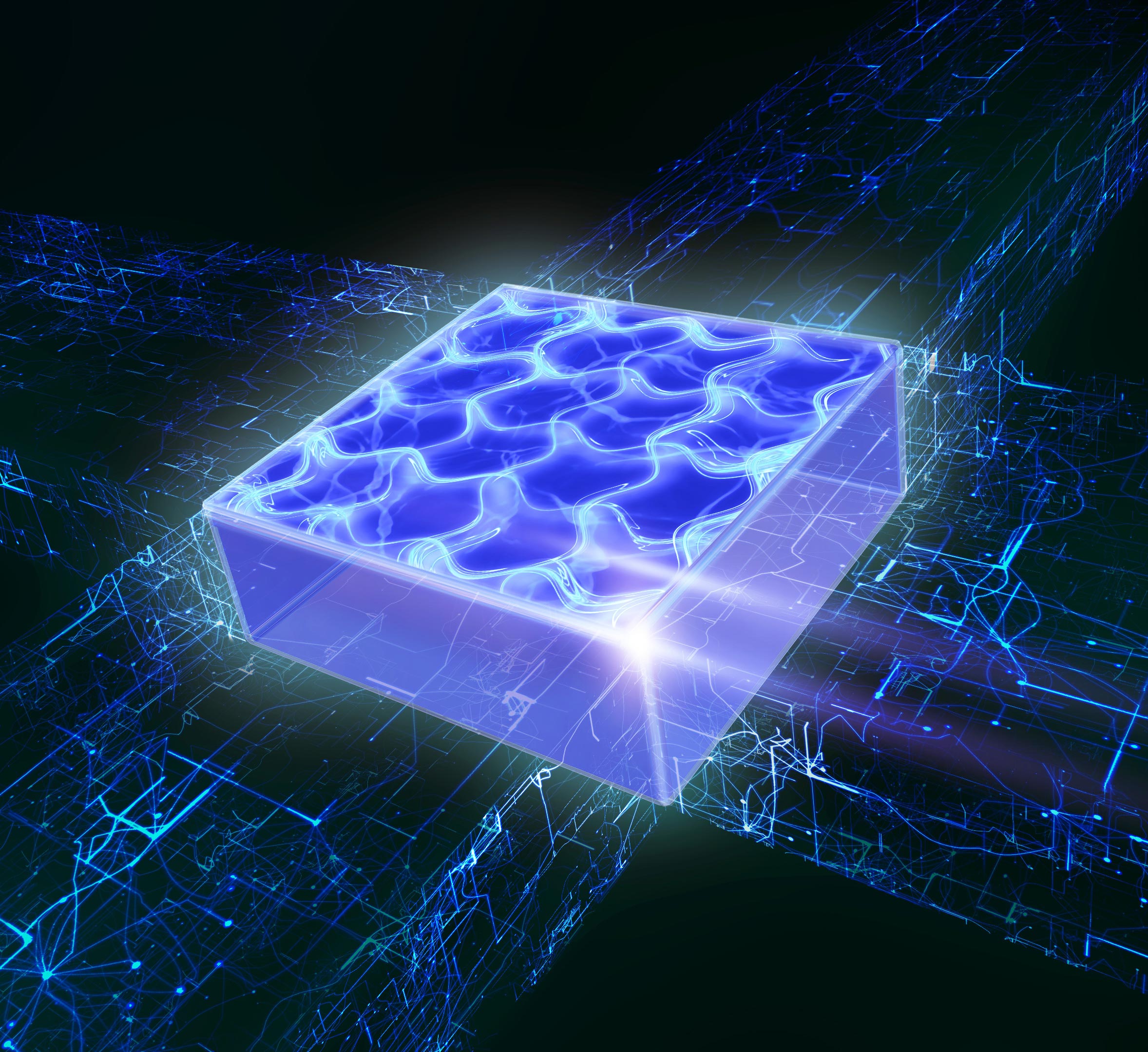
Two-dimensional supersolid quantum gas produced in the laboratory for the first time.
Quantum gases are very well suited for investigating the microscopic consequences of interactions in matter. Today, scientists can precisely control individual particles in extremely cooled gas clouds in the laboratory, revealing phenomena that cannot be observed in the everyday world. For example, the individual atoms in a Bose-Einstein condensate are completely delocalized. This means that the same atom exists at each point within the condensate at any given time.
Two years ago, the research group led by Francesca Ferlaino from the Department of Experimental Physics at the University of Innsbruck and the Institute of Quantum Optics and Quantum Information at the Austrian Academy of Sciences in Innsbruck managed for the first time to generate supersolid states in ultracold quantum gases of magnetic atoms. The magnetic interaction causes the atoms to self-organize into droplets and arrange themselves in a regular pattern.
“Normally, you would think that each atom would be found in a specific droplet, with no way to get between them,” says Matthew Norcia of Francesca Ferlaino’s team. “However, in the supersolid state, each particle is delocalized across all the droplets, existing simultaneously in each droplet. So basically, you have a system with a series of high-density regions (the droplets) that all share the same delocalized atoms.”
This bizarre formation enables effects such as frictionless flow despite the presence of spatial order (superfluidity).
New dimensions, New Effects to Explore
Until now, supersolid states in quantum gases have only ever been observed as a string of droplets (along one dimension). “In collaboration with theorists Luis Santos at Leibniz Universität Hannover and Russell Bisset in Innsbruck we have now extended this phenomenon to two dimensions, giving rise to systems with two or more rows of droplets,” explains Matthew Norcia. This is not only a quantitative improvement, but also crucially broadens the research perspectives.
“For example, in a two-dimensional supersolid system, one can study how vortices form in the hole between several adjacent droplets,” he says. “These vortices described in theory have not yet been demonstrated, but they represent an important consequence of superfluidity,” Francesca Ferlaino is already looking into the future. The experiment now reported in the journal Nature creates new opportunities to further investigate the fundamental physics of this fascinating state of matter.
New Research Field: Supersolids
Predicted 50 years ago, supersolidity with its surprising properties has been investigated extensively in superfluid helium. However, after decades of theoretical and experimental research, a clear proof of supersolidity in this system was still missing. Two years ago, research groups in Pisa, Stuttgart and Innsbruck independently succeeded for the first time in creating so-called supersolids from magnetic atoms in ultracold quantum gases. The basis for the new, growing research field of supersolids is the strong polarity of magnetic atoms, whose interaction characteristics enable the creation of this paradoxical quantum mechanical state of matter in the laboratory.
Reference: “Two-dimensional supersolidity in a dipolar quantum gas” by Matthew A. Norcia, Claudia Politi, Lauritz Klaus, Elena Poli, Maximilian Sohmen, Manfred J. Mark, Russell N. Bisset, Luis Santos and Francesca Ferlaino, 18 August 2021, Nature.
DOI: 10.1038/s41586-021-03725-7
The research was financially supported by the Austrian Science Fund FWF, the Federal Ministry of Education, Science and Research and the European Union, among others.
Never miss a breakthrough: Join the SciTechDaily newsletter.
Follow us on Google and Google News.
5 Comments
The only way to create condensed matter, such as that which exists in the core of our planet or in the axis of the proton is through building blocks, cubit. Ie the length is 2, the width is 1, the height is 1, when it is put in place as determined by the constellations pattern of organized nuclear energy, the photonic force must be equal to or greater than the mass, the matter, by delta, which is required to produce a magnetic moment of the engine or ying yang… so that the energy angular velocity carves out a space and reflects upon the density of its surrounding, the greater light and the lesser light. Seven times the opsis is the apsis… the full color spectrum only seven primary, and the x ray or gamma ray’s of black and white, so in 14 then 28 the lunar calendar, the tidal tables the shift in the Mesopotamia palate. The motion, so smooth yet so profound, the orbits of which one cannot but in symmetry is the sun, the moon the stars the peace of which we search but still prefer to not think for ourselves but let others do it for us. Perhaps when we go back to where we were schooled, well be here at this point in space even sooner… with a deadly viral immunodeficiency disease at our doors. Imagine our ancestors laughing as we labor through the transformation to renew ourselves each day constantly. He who believes in the Father and the son whom he sent will be passed from death to life.
what in the tarnation does this have to do with physical phenomena described by the generalized schrodingers?
Hmm… Temporal-spacial “grease”? Depends on how you look ON it… Quantum “Computing” or…
When the moon is in the seventh house and Jupiter aligns with Mars and peace will guide the planets and love will steer the stars, this is the dawning of supersolid states in quantum gases. Magnetic interaction causes atoms to self organize and arrange themselves in a regular pattern. Self organized matter, the foundation of connecting things…..this is heavy duty stuff. Farm Trout!
… when there is a talk about new dimensions one think is kind of there, but not clear after all.
For an example if we look at electromagnetic waves of light we know that there are two dimensions of vibration, one for an electric field and one for a magnetic field.
However, if you think about gravitational waves, are there different type of waves or where is that dimension. How do they compare…