

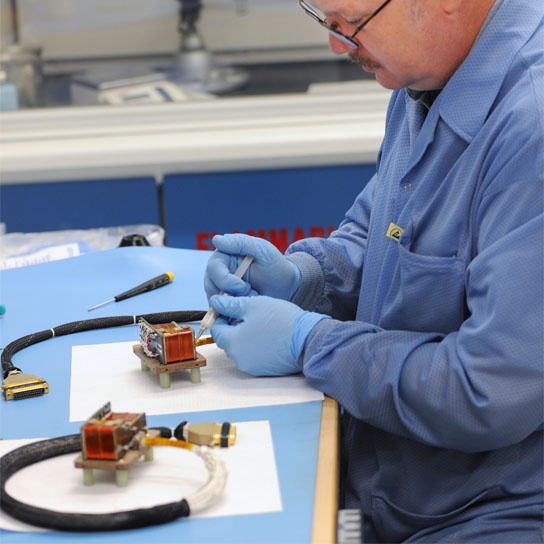
In preparation for the 2013 launch, scientists and engineers at NASA worked diligently to complete the magnetometers on schedule for the MAVEN mission. The magnetometers will measure the magnetic field at the location of the spacecraft and are important in understanding how the solar wind interacts with the planet’s atmosphere, causing charged particles to escape.
Magnetometers built by scientists and engineers at NASA Goddard Space Flight Center in Greenbelt, Md. for NASA’s Mars Atmosphere And Volatile EvolutioN (MAVEN) mission have been delivered to the University of California at Berkeley Space Sciences Laboratory for integration into the Particles and Field Package.
“The team worked hard and completed delivery of the magnetometers on schedule,” said Jack Connerney, Magnetometer Instrument Lead from NASA Goddard. “We are looking forward to launch, orbit insertion, and seeing the data come back.”
The pair of flux gate magnetometers measure the magnetic field at the location of the spacecraft. As part of the Particles and Fields Package, the magnetometer sensors are positioned at the outermost ends of the solar panels to keep them as far away as possible from stray magnetic fields generated by the spacecraft. Since the motion of escaping charged particles is governed by the magnetic field, this measurement is important in understanding how the solar wind interacts with the planet’s atmosphere and causes loss to space.
“The geometry of the magnetic field determines where particles go to and where they come from,” said Connerney.”If we want to understand particle motion, we need to visualize how the magnetic field behaves throughout the Mars environment.”
Scheduled for launch in late 2013, MAVEN will be the first mission devoted to understanding the Martian upper atmosphere. The goal of MAVEN is to determine the history of the loss of atmospheric gases to space through time, providing answers about Mars’s climate evolution. By measuring the current rate of escape to space and gathering enough information about the relevant processes, scientists will be able to infer how the planet’s atmosphere evolved in time.
The instrument is powered on during the spacecraft’s cruise to Mars. Once powered, it has a heart that beats once per second. Every second, the instrument sends a packet of data to the Particles and Fields Package. Each packet includes 32 vector samples of the magnetic field. The Particles and Fields Package accepts the data and passes it on to the spacecraft. The magnetic field vectors are also made available to the other instruments onboard the spacecraft in real-time.
MAVEN’s magnetometers were designed by a Goddard team that has a long and varied history of building magnetometers for space research. They have provided instruments for many previous and upcoming planetary and heliophysics missions.
The MAVEN spacecraft will carry three instrument suites. The Particles and Fields Package, built by the University of California at Berkeley with support from the University of Colorado at Boulder’s Laboratory for Atmospheric and Space Physics (CU/LASP) and NASA Goddard, contains six instruments that will characterize the solar wind and the ionosphere of the planet. The Remote Sensing Package, built by CU/LASP, will determine the global characteristics of the upper atmosphere and ionosphere. The Neutral Gas and Ion Mass Spectrometer, provided by NASA Goddard, will measure the composition and isotopes of neutral ions.
“The magnetometer is the first of the science instruments to be completed and delivered,” said Bruce Jakosky, MAVEN Principal Investigator from CU/LASP. “It’s really exciting to see the payload now starting to come together. This is an important milestone in our path toward getting to Mars and using our measurements to answer questions about the history of the Martian atmosphere.”
NASA Goddard manages the project and is building two of the science instruments for the mission. In addition to the principal investigator coming from CU/LASP, the university provides science operations, is building science instruments, and leads education/public outreach. Lockheed Martin of Littleton, Colo., is building the spacecraft and is responsible for mission operations. The University of California at Berkeley Space Sciences Laboratory is building science instruments for the mission. NASA’s Jet Propulsion Laboratory, Pasadena, California, provides navigation support, the Deep Space Network, and the Electra telecommunications relay hardware and operations.
Never miss a breakthrough: Join the SciTechDaily newsletter.
Follow us on Google and Google News.