
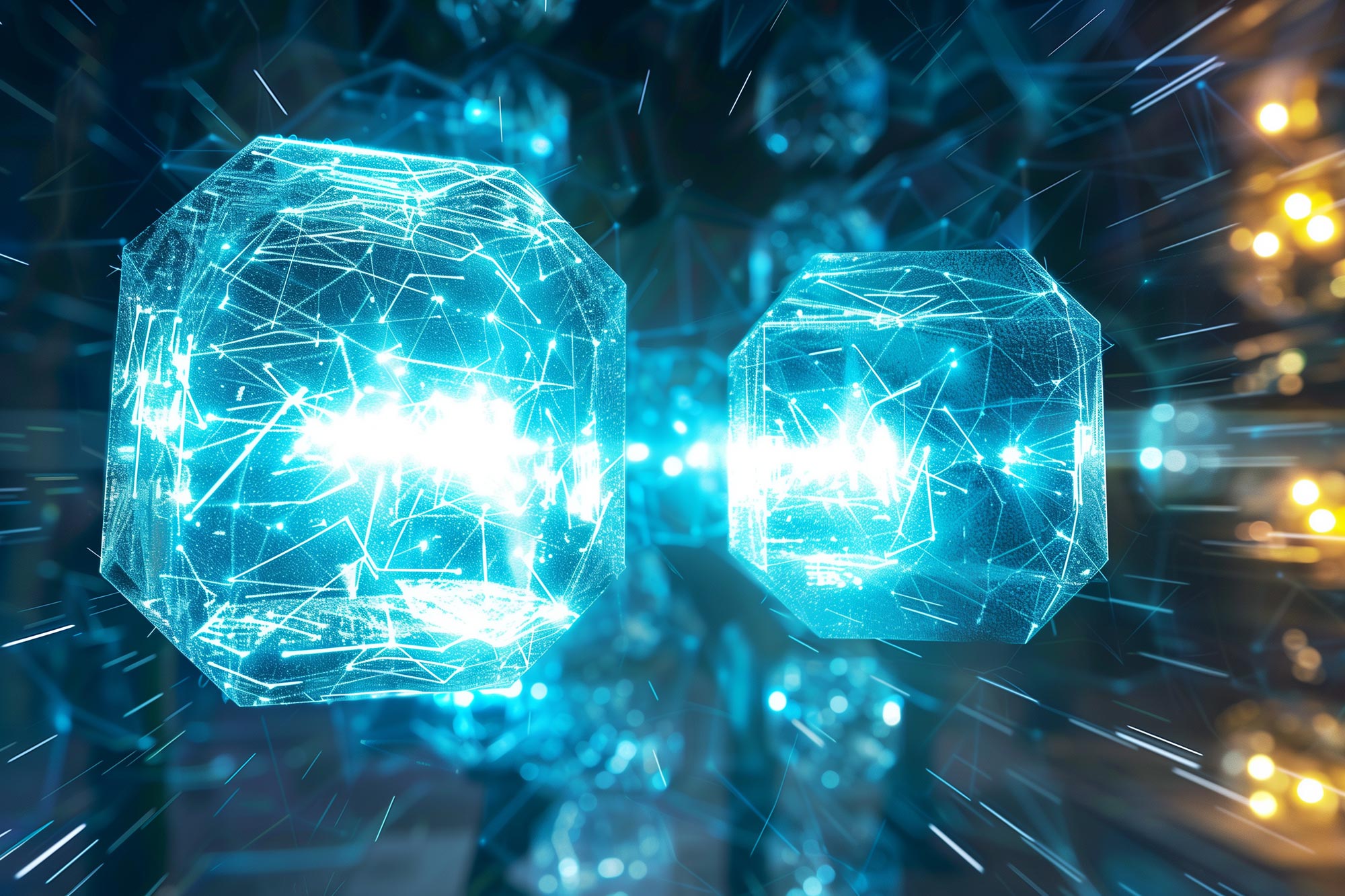
By combining surface codes with lattice surgery, researchers have shown how logical qubits can be manipulated and entangled while remaining protected from errors.
Quantum computers are often described as a glimpse of a faster, more powerful future. The catch is that today’s devices are fragile in a way ordinary computers are not. Their biggest headache is decoherence, the gradual loss of the delicate quantum behavior that makes them useful in the first place. When decoherence sets in, it can trigger two common kinds of mistakes: bit flips and phase flips.
A bit flip is the more intuitive problem. A qubit that should represent ‘0’ can unexpectedly behave like ‘1’. A phase flip is stranger but just as damaging. Even if a qubit stays in a superposition, the relationship between its components can suddenly switch, turning a positive phase into a negative one and scrambling the computation.
One promising workaround is to avoid relying on any single physical qubit. Instead, researchers spread one logical qubit across many physical qubits and run error correction routines repeatedly. The idea is to keep the information stable long enough to matter. But storage is only the beginning. A quantum computer has to perform actions on that protected information, especially quantum gates, which are the basic steps used to build quantum algorithms.
Fault-Tolerant Quantum Operations
That is where a new demonstration comes in. The group led by D-PHYS Professor Andreas Wallraff, working with the Paul Scherrer Institute (PSI) and the theory team of Professor Markus Müller at RWTH Aachen University and Forschungszentrum Jülich, showed a way to carry out a quantum operation between superconducting logical qubits while correcting errors that arise during the operation itself. The results were published in Nature Physics.
Quantum error correction is very different from classical error correction. In classical computing, you can copy a bit many times, check the copies later, and use a majority vote to recover from a flip. That logic breaks down in quantum mechanics because measuring a qubit can destroy the information you are trying to protect, and unknown quantum states cannot be duplicated in the first place.
“With qubits, things are a lot more complicated,” says Dr Ilya Besedin, postdoctoral researcher in Wallraff’s group and co-leading author of the study together with PhD student Michael Kerschbaum.
Instead of copying, quantum error correction hides information across multiple qubits using entanglement, so that no single qubit carries the whole message. The difficulty increases further because the system must handle phase flip errors as well, a type of failure that classical machines never face.
Error correction with surface codes
One way to ensure that bit- and phase-flip errors are corrected is to use so-called surface codes. In these codes, the state of a qubit is stored in several physical data qubits. Error correction is achieved by measuring repeatedly the quantum states of so-called stabilizers, which make up the logical qubit together with data qubits.
Stabilizers are measured using extra qubits that are connected to data qubits in such a way that reading them out reveals any changes – in bit value (Z-type stabilizer) or phase (X-type stabilizer) – occurring between measurements, thus enabling their correction. Data qubits, on the other hand, are never read out: they store the error-corrected qubit state.
The situation changes when one wants to perform a quantum logical operation, such as a controlled-NOT gate, between two logical qubits. In particular, one must also correct for any errors occurring during the operation.
“Performing a logical operation in this fault-tolerant way would be relatively easy if we could move our qubits around and connect them arbitrarily to each other,” says Kerschbaum. In two-dimensional arrays of superconducting qubits, however, each qubit is fixed in space, and only physical qubits that are spatially close to each other are connected and can interact with one another.
Splitting the square
“Lattice surgery is a way of dealing with this constraint,” says Kerschbaum.
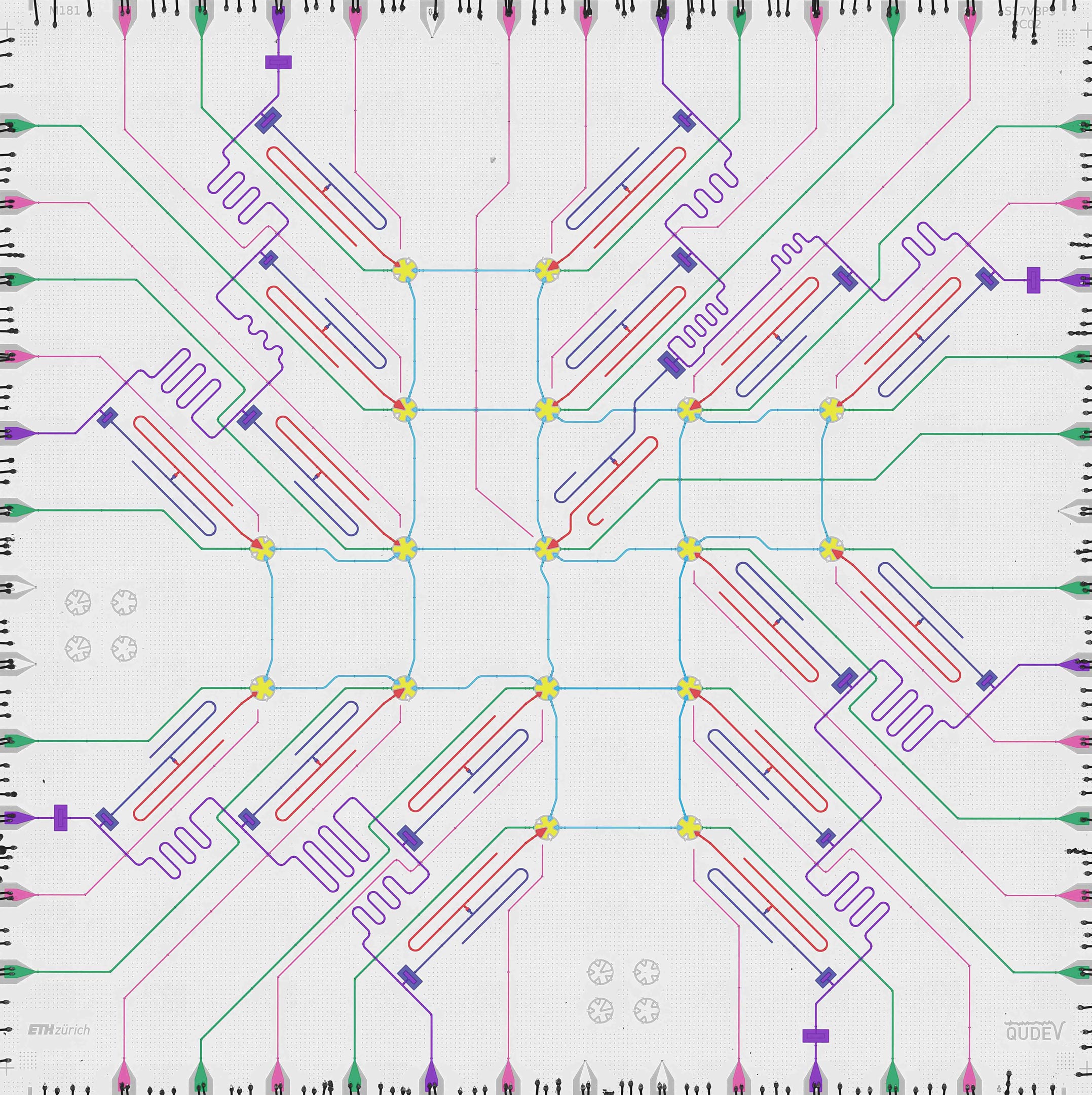
In their experiment, he and his colleagues initially performed error correction on a single logical qubit that was encoded by seventeen physical qubits. The data qubits and the stabilizers were arranged in a roughly square shape. For a few cycles, the researchers read out the stabilizers every 1.66 microseconds, performing bit-flip and phase-flip error correction.
When the time for surgery came, three data qubits along the middle of the square were read out, effectively splitting the surface-code square into two halves. Additionally, the readout of the X-type stabilizers was halted.
“The end result of this operation was that we had two logical qubits entangled with each other,” explains Besedin. During the surgery, bit-flip errors were corrected; afterwards, bit-flip error correction could continue on the two resulting halves. This operation isn’t yet a quantum controlled-NOT gate, but it can be turned into one through a series of such splits together with merging operations.
Reference: “Lattice surgery realized on two distance-three repetition codes with superconducting qubits” by Ilya Besedin, Michael Kerschbaum, Jonathan Knoll, Ian Hesner, Lukas Bödeker, Luis Colmenarez, Luca Hofele, Nathan Lacroix, Christoph Hellings, François Swiadek, Alexander Flasby, Mohsen Bahrami Panah, Dante Colao Zanuz, Markus Müller and Andreas Wallraff, 30 January 2026, Nature Physics.
DOI: 10.1038/s41567-025-03090-6
Never miss a breakthrough: Join the SciTechDaily newsletter.
Follow us on Google and Google News.
4 Comments
The end result of this operation was that you had two logical qubits entangled with each other.
VERY GOOD.
Please ask researchers to think deeply:
How many logical qubits should theoretically exist in nature? Why?
Are these science?
Example 1
Two sets of cobalt-60 are manually rotated in opposite directions, and even without detection, people around the world know that they will not be symmetrical because these two objects are not mirror images of each other at all. However, a group of so-called physicists and so-called academic publications do not believe it. They conducted experiments and the results were indeed asymmetric, but they still firmly believed that these two objects were mirror images of each other, and the asymmetry was due to a violation of the previous natural laws (CP violation). In the history of science, there can never be a dirtier and uglier operation and explanation than this.
—— Excerpted from https://scitechdaily.com/what-happens-when-light-gains-extra-dimensions/#comment-947619.
Example 2
Please see how the so-called “mystery of θ – τ” is explained: θ and τ are completely identical in all measurable physical properties such as mass, lifetime, charge, spin, etc. However, experimental observations have shown that the θ meson decays into two π mesons, while the τ meson decays into three π mesons, making it difficult for physicists to explain why they are so similar. Physicist Martin Block proposed a highly challenging idea: θ and τ are the same particle, but in weak interactions, parity is not conserved. An easy to understand explanation is the following analogy:: There are two boxes of apples with identical weight, color, and taste. However, when one box is opened, there are two apples, while when the other box is opened, there are three apples. This confuses the old farmer who buys apples. He circled around the orchard and came up with a highly challenging idea: these two boxes of apples are not from the same tree, so they are the same.
—— Excerpted from https://scitechdaily.com/what-happens-when-light-gains-extra-dimensions/#comment-947686.
Physics needs more people and publications who truly care about physics, rather than so-called peer-reviewed publications that are severely poisoned and polluted by pseudoscience and pseudo academia.
Everyone who has a reverence for natural laws and regulations deserves respect.