
Close Menu
    Facebook X (Twitter) Instagram
    SciTechDaily
    • Biology
    • Chemistry
    • Earth
    • Health
    • Physics
    • Science
    • Space
    • Technology
    Facebook X (Twitter) Pinterest YouTube RSS
    SciTechDaily
    Home»Technology»Physicists Take First Step Towards Quantum Dot Based Spin Qubit Registers
    Technology

    Physicists Take First Step Towards Quantum Dot Based Spin Qubit Registers

    By Prof. Lieven Vandersypen, QuTech/Kavli Institute of Nanoscience/TU DelftJanuary 25, 20181 Comment4 Mins Read
    Facebook Twitter Pinterest Telegram LinkedIn WhatsApp Email Reddit
    Share
    Facebook Twitter LinkedIn Pinterest Telegram Email Reddit
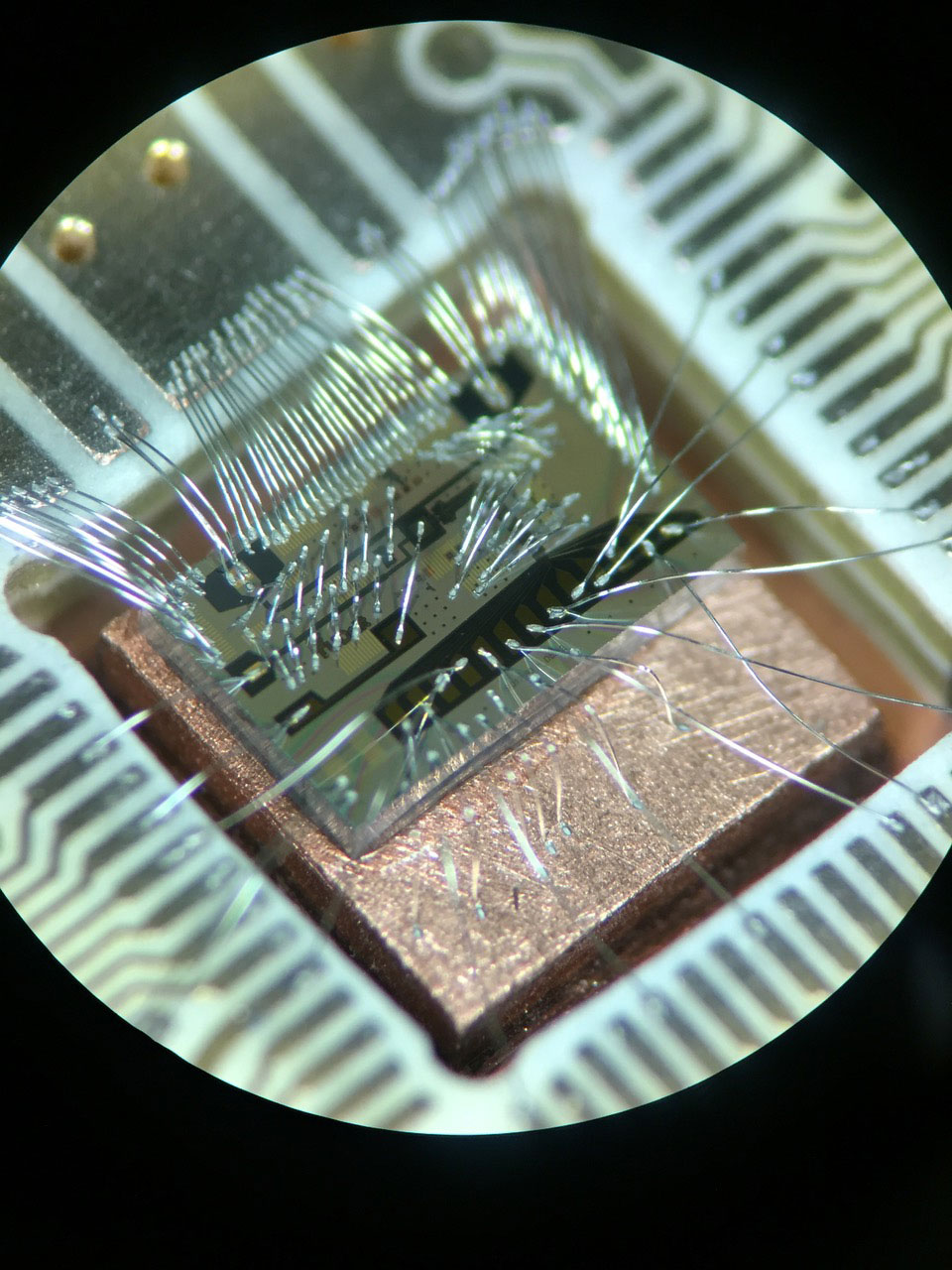
    Researchers Develop Silicon Quantum Chip
    The quantum computer of the future will be able to carry out computations far beyond the capacity of today’s computers. Credit: TU Delft

    The worldwide race to create more, better, and reliable quantum processors is progressing fast, as a team of TU Delft scientists led by Professor Vandersypen has realized yet again. In a neck-and-neck race with their competitors, they showed that quantum information of an electron spin can be transported to a photon, in a silicon quantum chip. This is important in order to connect quantum bits across the chip and allow to scale up to large numbers of qubits. Their work was published today in the journal Science.

    The quantum computer of the future will be able to carry out computations far beyond the capacity of today’s computers. Quantum superpositions and entanglement of quantum bits (qubits) make it possible to perform parallel computations. Scientists and companies worldwide are engaged in creating increasingly better quantum chips with more and more quantum bits. QuTech in Delft is working hard on several types of quantum chips.

    Familiar material

    The core of the quantum chips is made of silicon. “This is a material that we are very familiar with,” explains Professor Lieven Vandersypen of QuTech and the Kavli Institute of Nanoscience Delft, “Silicon is widely used in transistors and so can be found in all electronic devices.” But silicon is also a very promising material for quantum technology. Ph.D. candidate Guoji Zheng: “We can use electrical fields to capture single electrons in silicon for use as quantum bits (qubits). This is an attractive material as it ensures the information in the qubit can be stored for a long time.”
    Quantum Race Accelerates Development of Silicon Quantum Chip
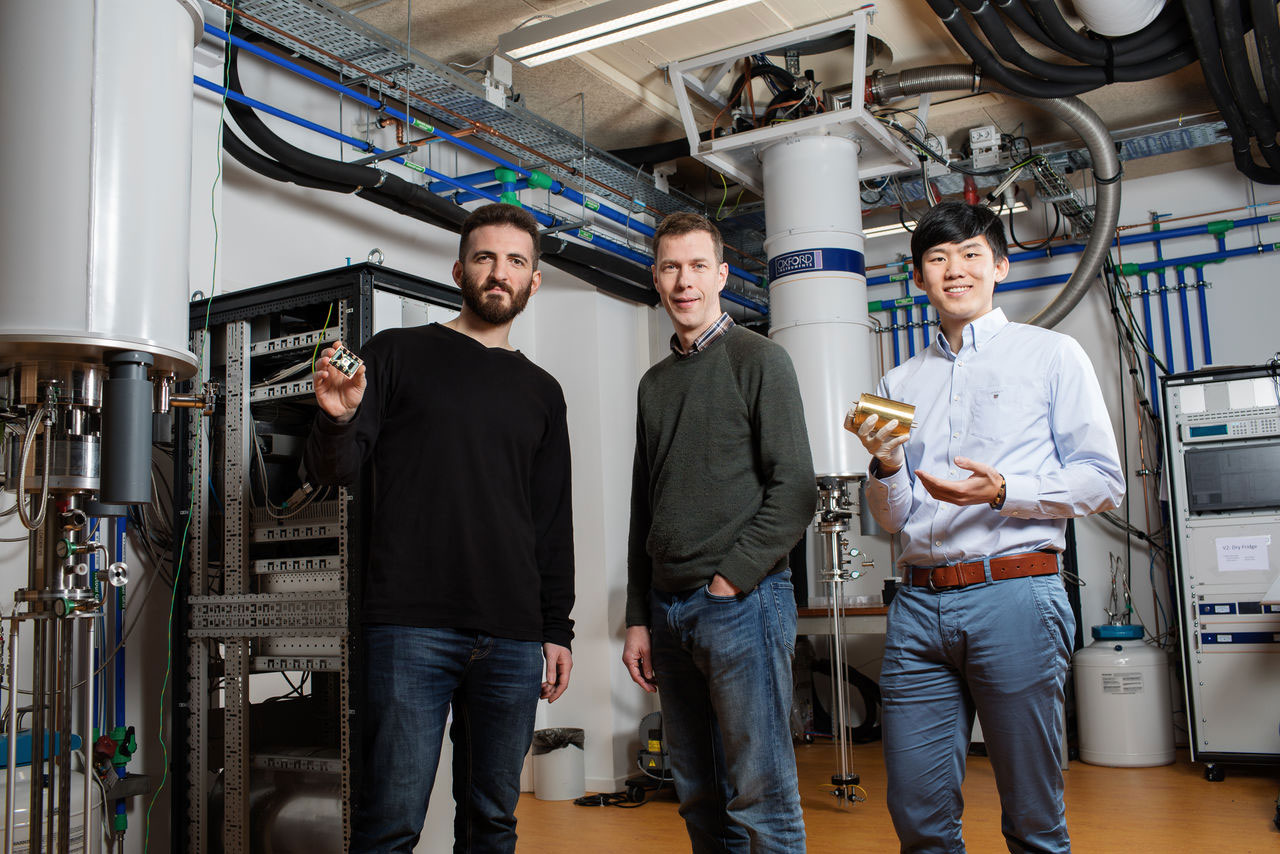
    Researchers from left to right: Nodar Samkharadze, Lieven Vandersypen and Guoji Zheng. TU Delft/Marieke de Lorijn

    Large systems

    Making useful computations requires large numbers of qubits and it is this upscaling to large numbers that is providing a challenge worldwide. “To use a lot of qubits at the same time, they need to be connected to each other; there needs to be good communication”, explains researcher Nodar Samkharadze. At present, the electrons that are captured as qubits in silicon can only make direct contact with their immediate neighbors. Nodar: “That makes it tricky to scale up to large numbers of qubits.”

    Neck-and-neck race

    Other quantum systems use photons for long-distance interactions. For years, this was also a major goal for silicon. Only in recent years have various scientists made progress on this. The Delft scientists have now shown that a single electron spin and a single photon can be coupled on a silicon chip. This coupling makes it possible in principle to transfer quantum information between a spin and a photon. Guoji Zheng: “This is important to connect distant quantum bits on a silicon chip, thereby paving the way to upscaling quantum bits on silicon chips.”
    Scientists Develop Silicon Quantum Chip
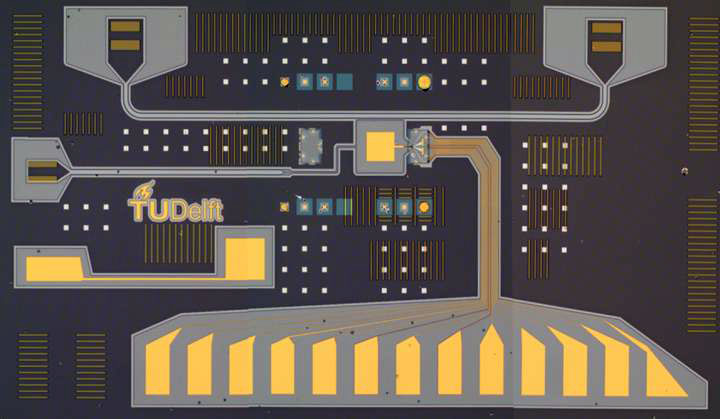
    The quantum computer of the future will be able to carry out computations far beyond the capacity of today’s computers. TU Delft

    On to the next step

    Vandersypen is proud of his team: “My team achieved this result in a relatively short time and under great pressure from worldwide competition.” It is a true Delft breakthrough: “The substrate is made in Delft, the chip created in the Delft cleanrooms, and all measurements carried out at QuTech,” adds Nodar Samkharadze. The scientists are now working hard on the next steps. Vandersypen: “The goal now is to transfer the information via a photon from on electron spin to another.”

    Reference: “Strong spin-photon coupling in silicon” by N. Samkharadze, G. Zheng, N. Kalhor, D. Brousse, A. Sammak, U. C. Mendes, A. Blais, G. Scappucci and L. M. K. Vandersypen, 25 Jan 2018, Science.
    DOI: 10.1126/science.aar4054

    Never miss a breakthrough: Join the SciTechDaily newsletter.
    Follow us on Google and Google News.

    Computer Science Quantum Computing Quantum Technology Qubits TU Delf
    Share. Facebook Twitter Pinterest LinkedIn Email Reddit

    Related Articles

    Digital “Demon”: A Surprisingly Simple Method That Improves Quantum Computing Accuracy by 20X

    Random Hardware Errors Make a Quantum Computing Future Unlikely

    Quantum Computers Learn to Check Their Own Answers

    New Photon Detectors – A Crucial Step Toward Quantum Chips

    Silicon Qubits Could Be the Key to a Quantum Revolution

    USC Study Validates Large-Scale Quantum Chip

    Quantum Computing Continues to Move Forward

    New Spin Technique Moves Quantum Computers a Step Closer

    Yale Physicists Observe Quantum Information While Preserving Its Integrity

    1 Comment

    1. APJ Smart Works on February 19, 2018 10:40 pm

      Thanks for this helpful information I agree with all points you have given to us. I will follow all of them.

      Reply
    Leave A Reply Cancel Reply

    • Facebook
    • Twitter
    • Pinterest
    • YouTube

    Don't Miss a Discovery

    Subscribe for the Latest in Science & Tech!

    Trending News

    New Study Reveals Why Ozempic Works Better for Some People Than Others

    Climate Change Is Altering a Key Greenhouse Gas in a Way Scientists Didn’t Expect

    New Study Suggests Gravitational Waves May Have Created Dark Matter

    Scientists Discover Why the Brain Gets Stuck in Schizophrenia

    Scientists Engineer “Tumor-Eating” Bacteria That Devour Cancer From Within

    Even “Failed” Diets May Deliver Long-Term Health Gains, Study Finds

    NIH Scientists Discover Powerful New Opioid That Relieves Pain Without Dangerous Side Effects

    Collapsing Plasma May Hold the Key to Cosmic Magnetism

    Follow SciTechDaily
    • Facebook
    • Twitter
    • YouTube
    • Pinterest
    • Newsletter
    • RSS
    SciTech News
    • Biology News
    • Chemistry News
    • Earth News
    • Health News
    • Physics News
    • Science News
    • Space News
    • Technology News
    Recent Posts
    • This 15,000-Year-Old Discovery Changes What We Know About Early Human Creativity
    • 35-Million-Year-Old Mystery: Strange Arachnid Discovered Preserved in Amber
    • Revolutionary Gas Turbine Generates Power Without Air Compression
    • Is AI Really Just a Tool? It Could Be Altering How You See Reality
    • JWST Reveals a “Forbidden” Planet With a Baffling Composition
    Copyright © 1998 - 2026 SciTechDaily. All Rights Reserved.
    • Science News
    • About
    • Contact
    • Editorial Board
    • Privacy Policy
    • Terms of Use

    Type above and press Enter to search. Press Esc to cancel.