
Close Menu
    Facebook X (Twitter) Instagram
    SciTechDaily
    • Biology
    • Chemistry
    • Earth
    • Health
    • Physics
    • Science
    • Space
    • Technology
    Facebook X (Twitter) Pinterest YouTube RSS
    SciTechDaily
    Home»Biology»Pikaia Gracilens Revealed as Possible Genetic Ancestors to All Vertebrates
    Biology

    Pikaia Gracilens Revealed as Possible Genetic Ancestors to All Vertebrates

    By SciTechDailyMarch 6, 20123 Comments2 Mins Read
    Facebook Twitter Pinterest Telegram LinkedIn WhatsApp Email Reddit
    Share
    Facebook Twitter LinkedIn Pinterest Telegram Email Reddit
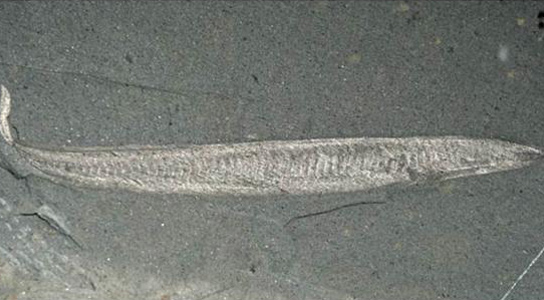
    pikaia-gracilens
    Pikaia gracilens was a fish-like worm 505 million years ago.

    The Middle Cambrian Pikaia gracilens, from 505 million years ago, was a fish-like worm, which has the possible dubious distinction of being one of humanity’s earliest genetic ancestors. These fish-like worms had the beginning of spines, including a notochord and a nerve chord, which wasn’t obvious to distinguish initially. The researchers published their findings in the journal Biological Letters.

    Jean-Bernard Caron, a paleontologist at the Royal Ontario Museum, co-authored the study with lead author Simon Conway Morris. In the ’70s, Morris suggested that the lancelet-like species could be one of the earliest members of the Phylum Chordata, the class of species that spawned animals with spines, such as all vertebrate animals that naturally include humans. He didn’t have any proof of his assertions.
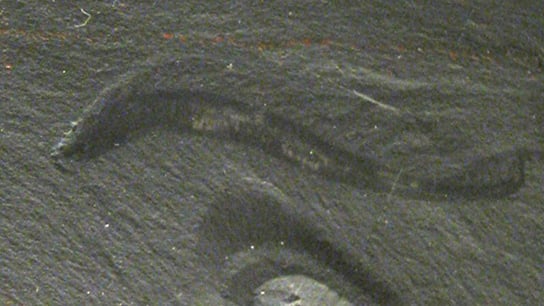
    pikaia-gracilens-fossil

    There appeared to be something like a notochord, which is a primitive spine that forms in embryos of all vertebrates. In the ’90s, more P. gracilens specimens were collected and all of them were subjected to an electron microscope. Researchers were able to identify myomeres, which are bands of muscles that are the precursors of skeletal spines.

    This would make it one of the earliest known chordates but the fossil record isn’t precise enough to know more about P. gracilens’ soft tissues. P. gracilens was about the length of a human thumb, flat, with the head the size of a period. It had two tentacles at the front. The researchers found no evidence of eyes in their specimens.

    There is a possibility of species convergences, but the researchers think that the evidence of myomeres, notochord, and gills is enough to indicate that they are part of the precursors of vertebrates.

    Reference: “Pikaia gracilens Walcott, a stem-group chordate from the Middle Cambrian of British Columbia” by Simon Conway Morris and Jean-Bernard Caron, 4 March 2012, Biological Letters.
    DOI: 10.1111/j.1469-185X.2012.00220.x

    Never miss a breakthrough: Join the SciTechDaily newsletter.
    Follow us on Google and Google News.

    Ancestor Cambrian Genetics Paleontology Spines Vertebrates
    Share. Facebook Twitter Pinterest LinkedIn Email Reddit

    Related Articles

    Climate Change Drove Mastodons to Migrate Vast Distances Back and Forth Across North America

    Ancient Genomes Suggest the Real Reason Woolly Rhinos Went Extinct

    Researchers Discover “Ghost Worms” Mostly Unchanged Since the Age of Dinosaurs, Despite 140 Million Years of Evolution

    New Fossils of Ancient Snake With Hind Legs Reveals Tantalizing Details of Evolution

    Lichens Are Way Younger Than Scientists Thought – Likely Evolved Millions of Years After Plants

    DNA Methylation Data Offers First Glimpse at What Ancient Denisovans May Have Looked Like

    Geneticists Grow Fish with Limbs to Duplicate Evolutionary Pressure

    Molecular Analysis of Dinosaur Osteocytes Indicates Presence of Endogenous Molecules

    Researchers Calculate That DNA Has a 521 Year Half-Life

    3 Comments

    1. John Ashton on March 6, 2012 5:10 pm

      Why “dubious distinction”. What’s dubious about the distinction? What kind of writing is that?

      Reply
      • Len on March 7, 2012 7:59 am

        Thank you John. Glad to know that I am not the only one who doesn’t hate human beings.

        Reply
    2. hugjug on December 12, 2013 12:46 pm

      I am related to a fish?!?!

      Reply
    Leave A Reply Cancel Reply

    • Facebook
    • Twitter
    • Pinterest
    • YouTube

    Don't Miss a Discovery

    Subscribe for the Latest in Science & Tech!

    Trending News

    Scientists Discover Bizarre 100-Million-Year-Old Insect With Giant Claws

    Scientists Discover “Good” Gut Microbes That Could Protect Against Autism and ADHD

    Scientists Reveal That Eating Almonds Every Day Could Transform Your Gut, Metabolism, and Appetite

    Scientists May Have Solved Two of Fusion Energy’s Biggest Problems at Once

    Scientists Discover Hidden “Switch” That Burns Fat and Could Treat Bone Disease

    After 50 Years of Mystery, Researchers Identify New Human Blood Group

    Beyond Pain Relief: Scientists Discover a Protein That Could Stop Osteoarthritis in Its Tracks

    Scientists Discover Why Alcohol Prevents the Liver From Healing, Even After You Quit

    Follow SciTechDaily
    • Facebook
    • Twitter
    • YouTube
    • Pinterest
    • Newsletter
    • RSS
    SciTech News
    • Biology News
    • Chemistry News
    • Earth News
    • Health News
    • Physics News
    • Science News
    • Space News
    • Technology News
    Recent Posts
    • Exercise Changes the Heart in a Way Researchers Never Expected
    • Scientists Warn Ultra-Processed Foods Could Be Hurting Your Brain
    • Your Liver May Be Filling With Plastic – and Scientists Are Alarmed
    • Goodbye Plastic? Scientists Create New Supermaterial That Could Transform Modern Manufacturing
    • Scientists Uncover Hidden Biological Differences Between Men and Women’s Immune Systems
    Copyright © 1998 - 2026 SciTechDaily. All Rights Reserved.
    • Science News
    • About
    • Contact
    • Editorial Board
    • Privacy Policy
    • Terms of Use

    Type above and press Enter to search. Press Esc to cancel.