
Close Menu
    Facebook X (Twitter) Instagram
    SciTechDaily
    • Biology
    • Chemistry
    • Earth
    • Health
    • Physics
    • Science
    • Space
    • Technology
    Facebook X (Twitter) Pinterest YouTube RSS
    SciTechDaily
    Home»Technology»Pioneering Framework Could Reduce Energy Demand in Homes and Buildings
    Technology

    Pioneering Framework Could Reduce Energy Demand in Homes and Buildings

    By Lawrence Berkeley National LaboratoryApril 2, 20212 Comments2 Mins Read
    Facebook Twitter Pinterest Telegram LinkedIn WhatsApp Email Reddit
    Share
    Facebook Twitter LinkedIn Pinterest Telegram Email Reddit
    Thermal Interactions Schematic
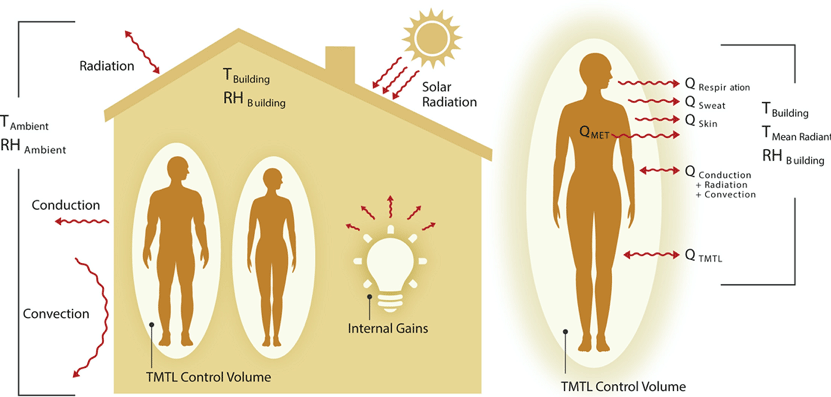
    Schematic of thermal interactions with the environment and energy transfers that are needed for the theoretical minimum thermal load (TMTL) calculation. Credit: Julia Laser and Josh Bauer, NREL

    Researchers make the case for shifting how we think about heating and cooling needs in buildings.

    Heating and cooling buildings is a large part of global energy demand and a significant source of CO2 and greenhouse gas emissions, and in the coming decades the energy demand for heating and cooling – also known as thermal energy – is expected to grow considerably. Scientists and engineers have made many advances in lowering building energy demand by improving energy efficiency in building technologies and reducing energy loss through the building walls and windows.

    Now, researchers are concerned that simply tackling the problem through energy-efficient technology and design will reach its practical limits. So researchers from Lawrence Berkeley National Laboratory (Berkeley Lab), the National Renewable Energy Laboratory, and UC Berkeley have pioneered a new framework that determines the minimum thermal energy required to keep building occupants comfortable.

    In a study recently published in the journal Joule, they make the case for calculating the theoretical minimum thermal load in order to dramatically lower the energy required for heating and cooling buildings.

    Orders of Magnitude in Energy Reduction

    “Our work shows that current thermal loads in buildings are more than an order of magnitude higher than the theoretical minimum thermal load,” said Ravi Prasher, Berkeley Lab’s Associate Lab Director for Energy Technologies and the corresponding author of the paper. “In fact, the theoretical minimum thermal load showed that in residential buildings the energy used for heating or cooling an entire building for occupant comfort could be between 19 to 40 times lower.”

    The theoretical minimum thermal load does not calculate the amount of heating or cooling that would be needed to make an uncomfortable space comfortable, but rather it sets up a new baseline for occupant comfort with different building parameters. By calculating this baseline, the researchers are identifying the physical limit for reduced thermal energy use, that is, the point at which further reduction in thermal energy would cause occupant discomfort.

    Read more at the Building Technology & Urban Systems Division website.

    Reference: “Theoretical Minimum Thermal Load in Buildings” by Chuck Booten, Prakash Rao, Vi Rapp, Roderick Jackson and Ravi Prasher, 20 January 2021, Joule.
    DOI: 10.1016/j.joule.2020.12.015

    Never miss a breakthrough: Join the SciTechDaily newsletter.
    Follow us on Google and Google News.

    Climate Change DOE Energy Lawrence Berkeley National Laboratory
    Share. Facebook Twitter Pinterest LinkedIn Email Reddit

    Related Articles

    Artificial Photosynthesis: New Device Advances Commercial Viability of Solar Fuels

    Turning Up the Heat: Thermal Energy Storage Could Help Decarbonize Buildings

    New All-Season Smart-Roof Coating Enables Year-Round Energy Savings

    Zero-Emissions Rail and Securing the Grid With Big Batteries on Wheels

    Experts Predict Wind Energy Costs to Drop Significantly in the Future

    New Chemistry for Cleaner Combustion Engines – From New Clues to the Origins of the Universe

    X-ray Experiments and Machine Learning Innovation Could Trim Years off Battery R&D

    Getting to Net Zero Carbon Emissions – and Even Net Negative – Is Surprisingly Feasible and Affordable

    Battery Breakthrough to Give Flight to Electric Aircraft and Boost Long-Range Electric Cars

    2 Comments

    1. Zack the Physicist on April 3, 2021 4:32 am

      Dear pioneers, Zero Energy houses are already invented.

      Reply
    2. Me Here on April 3, 2021 5:45 pm

      What a poimtless article!

      It alludes to something truely significant; but gives *nothing* by way of detail.

      I do not come here (every day, many times each day0, only to be teased with stuff that require me to go elsewhere (and subscribe elsewhere) to get the full story.

      Damn, but are your journalistic standards dropping faster than a rock in an Bose–Einstein condensate.

      Reply
    Leave A Reply Cancel Reply

    • Facebook
    • Twitter
    • Pinterest
    • YouTube

    Don't Miss a Discovery

    Subscribe for the Latest in Science & Tech!

    Trending News

    What Causes Chronic Pain? Scientists Identify Key Culprit in the Brain

    Semaglutide Shows Surprising Mental Health Benefits in Massive 100,000-Person Study

    This Liquid Snapped Instead of Flowing and Scientists Were Shocked

    Breakthrough Alzheimer’s Drug Rewires the Brain Instead of Just Clearing Plaques

    Scientists Discover Hidden “Footprint of Death” That Could Transform How We Fight Disease

    A Simple Nose Swab Could Detect Alzheimer’s Years Before Symptoms Appear

    Scientists Just Rewrote the Timeline of Complex Life on Earth

    Teenager’s Fossil Find Leads to Discovery of Shark Teeth in 5 Million-Year-Old Whale Skull

    Follow SciTechDaily
    • Facebook
    • Twitter
    • YouTube
    • Pinterest
    • Newsletter
    • RSS
    SciTech News
    • Biology News
    • Chemistry News
    • Earth News
    • Health News
    • Physics News
    • Science News
    • Space News
    • Technology News
    Recent Posts
    • Even “Failed” Diets May Deliver Long-Term Health Gains, Study Finds
    • Childhood Junk Food May Rewire the Brain for Life
    • NIH Scientists Discover Powerful New Opioid That Relieves Pain Without Dangerous Side Effects
    • Breakthrough Study Reveals Why Damaged Nerves Struggle To Heal
    • 20-Year Study Reveals Cholera’s Surprising Weakness
    Copyright © 1998 - 2026 SciTechDaily. All Rights Reserved.
    • Science News
    • About
    • Contact
    • Editorial Board
    • Privacy Policy
    • Terms of Use

    Type above and press Enter to search. Press Esc to cancel.