
Close Menu
    Facebook X (Twitter) Instagram
    SciTechDaily
    • Biology
    • Chemistry
    • Earth
    • Health
    • Physics
    • Science
    • Space
    • Technology
    Facebook X (Twitter) Pinterest YouTube RSS
    SciTechDaily
    Home»Space»Plasma-Spewing Quasar Shines Light on Early Galaxy Formation
    Space

    Plasma-Spewing Quasar Shines Light on Early Galaxy Formation

    By Eduardo Bañados, Carnegie Institution For ScienceJuly 9, 2018No Comments3 Mins Read
    Facebook Twitter Pinterest Telegram LinkedIn WhatsApp Email Reddit
    Share
    Facebook Twitter LinkedIn Pinterest Telegram Email Reddit
    Quasar with the Brightest Radio Emission
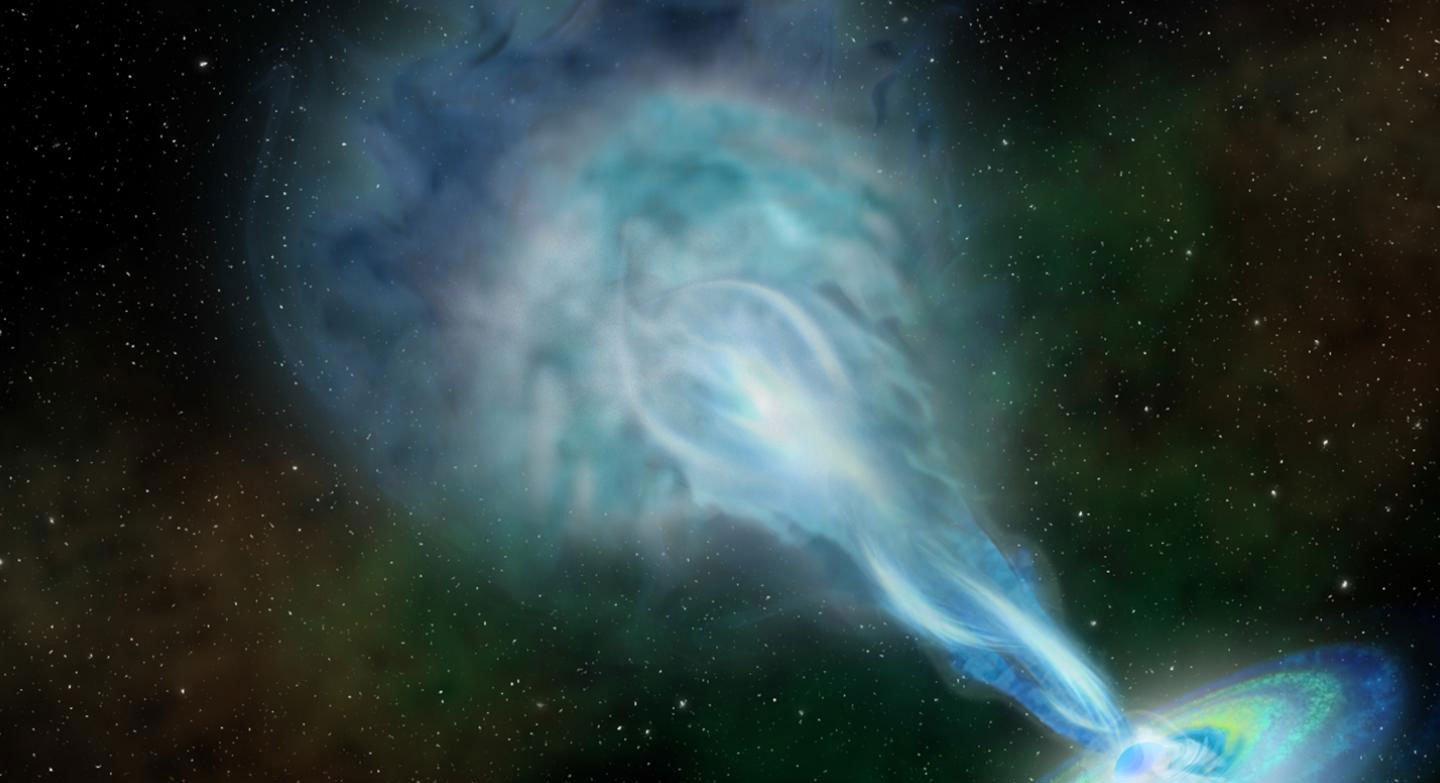
    This is an artist’s conception of a radio jet spewing out fast-moving material from the newly discovered quasar, which formed within the first billion years of the universe’s existence. Credit: Artwork by Robin Dienel, courtesy of Carnegie Institution for Science

    Carnegie’s Eduardo Bañados led a team that found a quasar with the brightest radio emission ever observed in the early universe, due to it spewing out a jet of extremely fast-moving material.

    Bañados’ discovery was followed up by Emmanuel Momjian of the National Radio Astronomy Observatory, which allowed the team to see with unprecedented detail the jet shooting out of a quasar that formed within the universe’s first billion years of existence.

    The findings, published in two papers in The Astrophysical Journal, will allow astronomers to better probe the universe’s youth during an important period of transition to its current state.

    Quasars are comprised of enormous black holes accreting matter at the centers of massive galaxies. This newly discovered quasar, called PSO J352.4034-15.3373, is one of a rare breed that doesn’t just swallow matter into the black hole but also emits a jet of plasma traveling at speeds approaching that of light. This jet makes it extremely bright in the frequencies detected by radio telescopes. Although quasars were identified more than 50 years ago by their strong radio emissions, now we know that only about 10 percent of them are strong radio emitters.

    What’s more, this newly discovered quasar’s light has been traveling nearly 13 billion of the universe’s 13.7 billion years to reach us here in Earth. P352-15 is the first quasar with clear evidence of radio jets seen within the first billion years of the universe’s history.

    “There is a dearth of known strong radio emitters from the universe’s youth and this is the brightest radio quasar at that epoch by an order of magnitude,” Bañados said.

    “This is the most-detailed image yet of such a bright galaxy at this great distance,” Momjian added.

    The Big Bang started the universe as a hot soup of extremely energetic particles that were rapidly expanding. As it expanded, it cooled and coalesced into neutral hydrogen gas, which left the universe dark, without any luminous sources, until gravity condensed matter into the first stars and galaxies. About 800 million years after the Big Bang, the energy released by these first galaxies caused the neutral hydrogen that was scattered throughout the universe to get excited and lose an electron, or ionize, a state that the gas has remained in since that time.

    It’s highly unusual to find radio jet-emitting quasars such as this one from the period just after the universe’s lights came back on.

    “The jet from this quasar could serve as an important calibration tool to help future projects penetrate the dark ages and perhaps reveal how the earliest galaxies came into being,” Bañados concluded.

    Reference: “A Powerful Radio-loud Quasar at the End of Cosmic Reionization” by Eduardo Bañados, Chris Carilli, Fabian Walter, Emmanuel Momjian, Roberto Decarli, Emanuele P. Farina, Chiara Mazzucchelli and Bram P. Venemans, 9 July 2018, The Astrophysical Journal Letters.
    DOI: 10.3847/2041-8213/aac511

    Never miss a breakthrough: Join the SciTechDaily newsletter.
    Follow us on Google and Google News.

    Astronomy Carnegie Institution for Science Cosmology Quasars
    Share. Facebook Twitter Pinterest LinkedIn Email Reddit

    Related Articles

    Astronomers Discover the Most Pristine Star Ever Found

    Was the James Webb Telescope Broken? The Real Culprit Was a Monster Black Hole

    Astronomers Discover Potential New Hunting Ground for Exoplanets

    Rare Quasar Quartet Reveals Massive Structure in Distant Universe

    Study Reveals Water on Earth is Older Than Our Sun

    Astronomers Solve Quasar Sequence Mystery

    Astronomers Make the Most Precise Measurement Yet of the Expanding Universe

    Radiation of Distant Quasar Reveals a Filament of the Cosmic Web

    Scientists Use Quasars To Probe Dark Energy & Measure Its Role in the Evolution of the Universe

    Leave A Reply Cancel Reply

    • Facebook
    • Twitter
    • Pinterest
    • YouTube

    Don't Miss a Discovery

    Subscribe for the Latest in Science & Tech!

    Trending News

    Scientists Uncover Promising New Strategy To Stop Parkinson’s in Its Tracks

    Experts Reveal the Surprising Cancer Link Behind a Common Vitamin

    This Strange “Golden Orb” Found 2 Miles Deep Stumped Scientists for Years

    Giant “Last Titan” Dinosaur Discovered in Thailand Was Bigger Than 9 Elephants

    This “Longevity Gene” May Protect the Brain From Aging and Dementia

    Common Cleaning Chemical Could Triple Your Risk of a Dangerous Liver Disease

    Scientists Discover Bizarre 100-Million-Year-Old Insect With Giant Claws

    Scientists Discover “Good” Gut Microbes That Could Protect Against Autism and ADHD

    Follow SciTechDaily
    • Facebook
    • Twitter
    • YouTube
    • Pinterest
    • Newsletter
    • RSS
    SciTech News
    • Biology News
    • Chemistry News
    • Earth News
    • Health News
    • Physics News
    • Science News
    • Space News
    • Technology News
    Recent Posts
    • Light-Matter Particles Could Revolutionize AI Computing
    • Scientists Warn Many Insects May Not Survive a Warming World
    • Hektoria Glacier Collapse Reveals How Fast Antarctica Can Fall Apart
    • Hidden Earthquake Threat: Oregon’s Fault May Be Closer to the Surface Than Scientists Thought
    • Scientists Use Smartwatch Data To Track the Hidden Health Effects of Air Pollution
    Copyright © 1998 - 2026 SciTechDaily. All Rights Reserved.
    • Science News
    • About
    • Contact
    • Editorial Board
    • Privacy Policy
    • Terms of Use

    Type above and press Enter to search. Press Esc to cancel.