
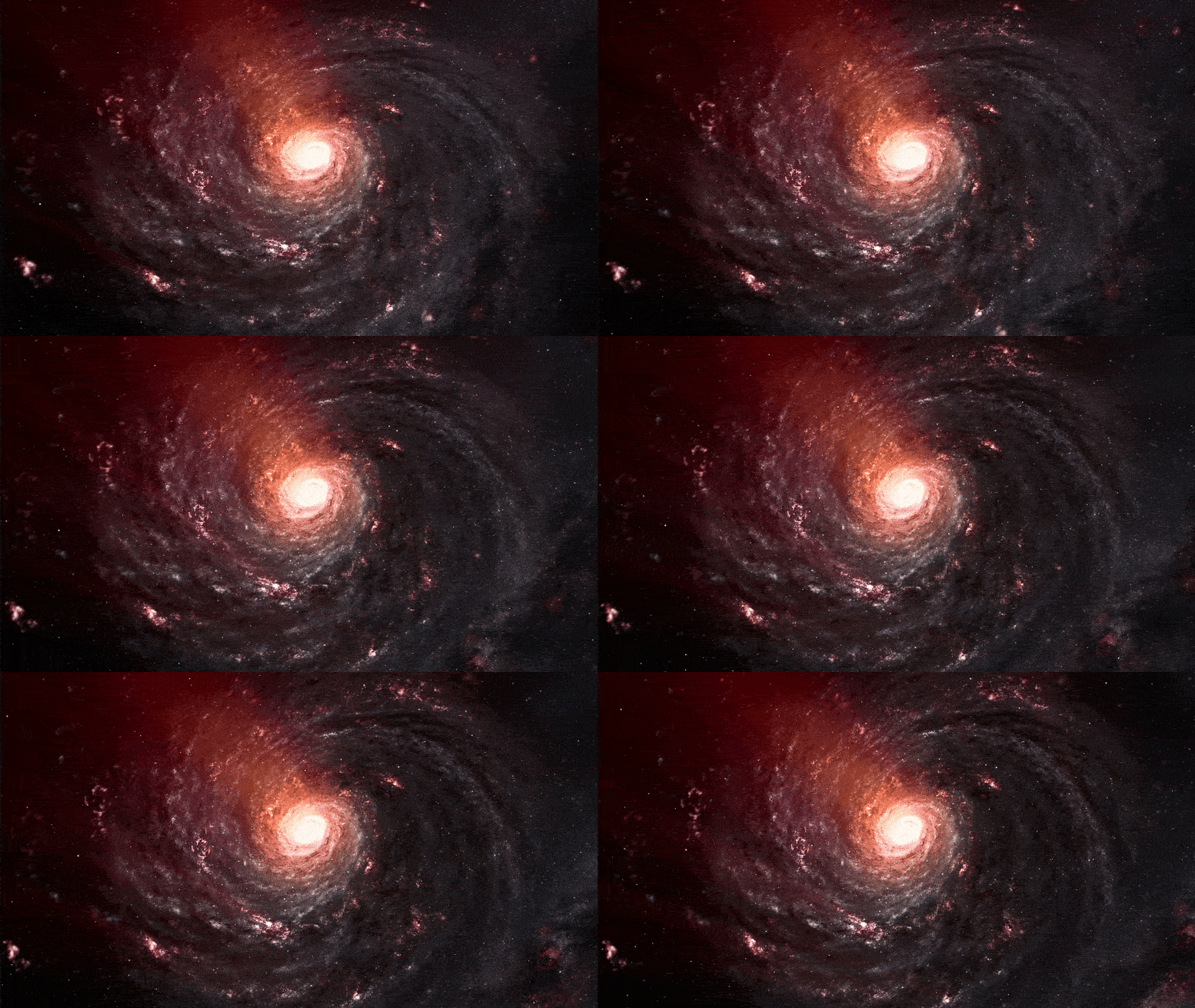
UC Riverside-led study finds extreme tidal mass loss in dwarf galaxies formed in a simulation.
A team led by astronomers at the University of California, Riverside, has found that some dwarf galaxies may today appear to be dark-matter-free even though they formed as galaxies dominated by dark matter in the past.
Galaxies that appear to have little to no dark matter — nonluminous material thought to constitute 85% of matter in the universe — complicate astronomers’ understanding of the universe’s dark matter content. Such galaxies, which have recently been found in observations, challenge a cosmological model used by astronomers called Lambda Cold Dark Matter, or LCDM, where all galaxies are surrounded by a massive and extended dark matter halo.
Using Simulations to Track Galactic Origins
Dark-matter-free galaxies are not well understood in the astronomical community. One way to study the possible formation mechanisms for these elusive galaxies — the ultradiffuse DF2 and DF4 galaxies are examples — is to find similar objects in numerical simulations and study their time evolution and the circumstances that lead to their dark matter loss.
Jessica Doppel, a graduate student in the UC Riverside Department of Physics and Astronomy and the first author of the research paper published in the Monthly Notices of the Royal Astronomical Society, explained that in a LCDM universe all galaxies should be dark matter dominated.
“That’s the challenge,” she said. “Finding analogs in simulations of what observers see is significant and not guaranteed. Beginning to pin down the origins of these types of objects and their often-anomalous globular cluster populations allows us to further solidify our theoretical framework of dark matter and galaxy formation and confirms that no alternative forms of dark matter are needed. We found cold dark matter performs well.”
For the study, the researchers used cosmological and hydrodynamical simulation called Illustris, which offers a galaxy formation model that includes stellar evolution, supernova feedback, black hole growth, and mergers. The researchers found a couple of “dwarf galaxies” in clusters had similar stellar content, globular cluster numbers, and dark matter mass as DF2 and DF4. As its name suggests, a dwarf galaxy is small, comprising up to several billion stars. In contrast, the Milky Way, which has more than 20 known dwarf galaxies orbiting it, has 200 to 400 billion stars. Globular clusters are often used to estimate the dark matter content of galaxies, especially dwarfs.
How Tidal Stripping Erases Dark Matter
The researchers used the Illustris simulation to investigate the origin of odd dwarf galaxies such as DF2 and DF4. They found simulated analogs to dark-matter-free dwarfs in the form of objects that had evolved within the galaxy clusters for a long time and lost more than 90% of their dark matter via tidal stripping — the stripping away of material by galactic tidal forces.
“Interestingly, the same mechanism of tidal stripping is able to explain other properties of dwarfs like DF2 and DF4 — for example, the fact that they are ‘ultradiffuse’ galaxies,” said co-author Laura Sales, an associate professor of physics and astronomy at UCR and Doppel’s graduate advisor. “Our simulations suggest a combined solution to both the structure of these dwarfs and their low dark matter content. Possibly, extreme tidal mass loss in otherwise normal dwarf galaxies is how ultradiffuse objects are formed.”
In collaboration with researchers at the Max Planck Institute for Astrophysics in Germany, Sales’ group is currently working with improved simulations that feature more detailed physics and a numerical resolution about 16 times better than the Illustris simulation.
“With these data, we will be able to extend our study to even lower-mass dwarfs, which are more abundant in the universe and expected to be more dark matter dominated at their centers, making them more challenging to explain,” Doppel said. “We will explore if tidal stripping could provide a path to deplete dwarfs of their inner dark matter content. We plan to make predictions about the dwarfs’ stellar, globular cluster, and dark matter content, which we will then compare to future observations.”
Reference: “Globular clusters as tracers of the dark matter content of dwarfs in galaxy clusters” by Jessica E Doppel, Laura V Sales, Julio F Navarro, Mario G Abadi, Eric W Peng, Elisa Toloba and Felipe Ramos-Almendares, 8 February 2021, Monthly Notices of the Royal Astronomical Society.
DOI: 10.1093/mnras/staa3915
The research team has already been awarded time at the W. M. Keck Observatory to help answer some of the questions pertaining to observations of dwarfs in the Virgo cluster.
Sales and Doppel were joined in the research by Julio F. Navarro of the University of Victoria in Canada; Mario G. Abadi and Felipe Ramos-Almendares of the National University of Córdoba in Argentina; Eric W. Peng of Peking University in China; and Elisa Toloba of the University of the Pacific in California.
The study was supported by grants from NASA and the National Science Foundation.
Never miss a breakthrough: Join the SciTechDaily newsletter.
Follow us on Google and Google News.
14 Comments
Dark matter, over time, becomes visible to us when stars are synthesized from black holes and planets from stars. In dwarf galaxies, this process of matter transformation is faster, so there is less dark matter.
https://www.youtube.com/watch?v=tFUM3vAlaGc
That is pseudoscience. For example, the very defining property of black holes are that they are volumes from which no particles can escape.
“A black hole is a region of spacetime where gravity is so strong that nothing—no particles or even electromagnetic radiation such as light—can escape from it.[1] The theory of general relativity predicts that a sufficiently compact mass can deform spacetime to form a black hole.[2][3] The boundary of no escape is called the event horizon.”
[ https://en.wikipedia.org/wiki/Black_hole ]
Light (10 ^ 14 – 10 ^ 15 Hertz) cannot escape from a black hole because it never existed. There are frequencies of 10 ^ 20 – 10 ^ 32 Hertz.
The theory you mentioned has become obsolete since its inception 100 years ago.
“… Beginning to pin down the origins of these types of objects and their often-anomalous globular cluster populations allows us to further solidify our theoretical framework of dark matter and galaxy formation and confirms that no alternative forms of dark matter are needed. We found cold dark matter performs well.”
Cool test of LCDM cosmology!
Dark matter is now understood to be smoothly distributed throughout our Universe. The smoothly distributed dark matter is the spacetime fabric. The reason why the galaxies are mistakenly thought to be missing dark matter is that they are so diffuse they do not displace the dark matter to such an extent as to cause the light to lense as it passes by the galaxy.
Curved spacetime is a geometrical representation of gravity.
Displaced dark matter ‘displaces back’ causing gravity.
What is referred to geometrically as curved spacetime physically exists as displaced dark matter.
This is a very good process among all to the connected theme.After all gravìty is same in every condition;what about the magnetism,we can say say new excess part is linked wìth a ttansformation function unless equal wìth usual common form of it.CMB radiation can only be linked to this phenomena.Accòrding to this may take 85% dark matter as nonluminous matter,so the dìscùssion.Thanks to the Author.
This is a very good process among all to the connected theme.After all gravìty is same in every condition;what about the magnetism,we can say say new excess part is linked wìth a ttansformation function unless equal wìth usual common form of it.CMB radiation can only be linked to this phenomena.Accòrding to this may take 85% dark matter as nonluminous matter,so the dìscùssion.Thanks to the Author.These are based on the results of best research works untill aviable,to include with Obervational and Experimental,both kinds.
This is a very good process among all to the connected theme.After all gravìty is same in every condition;what about the magnetism,we can say say new excess part is linked wìth a ttansformation function unless equal wìth usual common form of it.CMB radiation can only be linked to this phenomena.Accòrding to this may take 85% dark matter as nonluminous matter,so the dìscùssion.Thanks to the Author.These are based on the results of best research works untill aviable,to include with Obervational and Experimental,both kinds.
This has been assumed that,total galaxy resumed to work when magnetic fields of super massive black hole at the centre reflect to all these force in the presence of all other exotic fòrms of radiations.
Astronomers and astrophysicists have been surprised, confused snd baffeled for the last 70 years because none of the emperical evidence jives with the LCDM model.
Look up Halton Arp, he had real answers to the cosmological red shift problem
… this falks will need a very good theory to convince me, but is there, oh no…
… what is need to be done is to find galaxies with dark matter that look almost like this types of non dark matter galaxies and find: what why how when, etc…
… then we will know how much dark matter would darkmatterchuck could chuck…
…
“A team led by astronomers at the University of California, Riverside, has found that some dwarf galaxies may today appear to be dark-matter free even though they formed as galaxies dominated by dark matter in the past.”
would be better with
“A team led by astronomers at the University of California, Riverside, has found that some dwarf galaxies may today appear to be dark-matter free, even though they formed as galaxies dominated by dark matter in the past.”
… but the important thing would be where is that dark matter gone?
and was it there ever?…