
UC Riverside-led team’s technique relied on determining the mass of galaxy clusters.
A top goal in cosmology is to precisely measure the total amount of matter in the universe, a daunting exercise for even the most mathematically proficient. A team led by scientists at the University of California, Riverside, has now done just that.
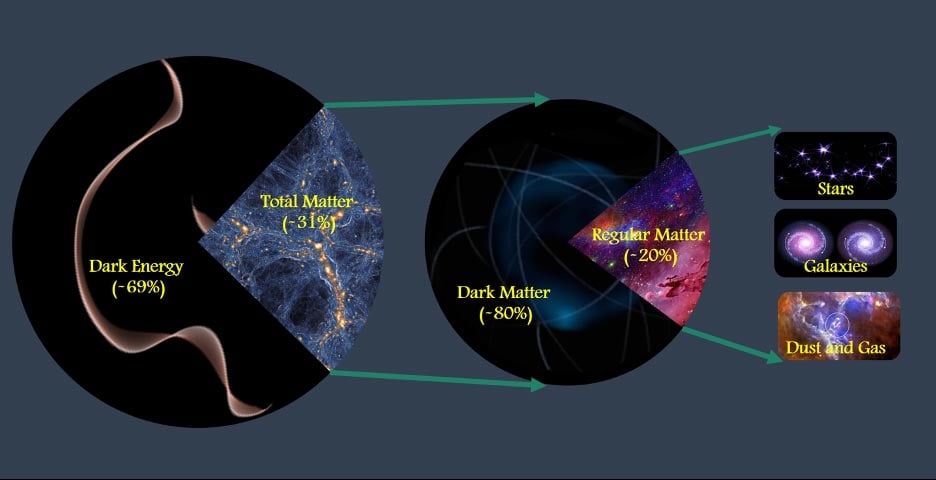
Reporting in the Astrophysical Journal, the team determined that matter makes up 31% of the total amount of matter and energy in the universe, with the remainder consisting of dark energy.
“To put that amount of matter in context, if all the matter in the universe were spread out evenly across space, it would correspond to an average mass density equal to only about six hydrogen atoms per cubic meter,” said first author Mohamed Abdullah, a graduate student in the UCR Department of Physics and Astronomy. “However, since we know 80% of matter is actually dark matter, in reality, most of this matter consists not of hydrogen atoms but rather of a type of matter which cosmologists don’t yet understand.”
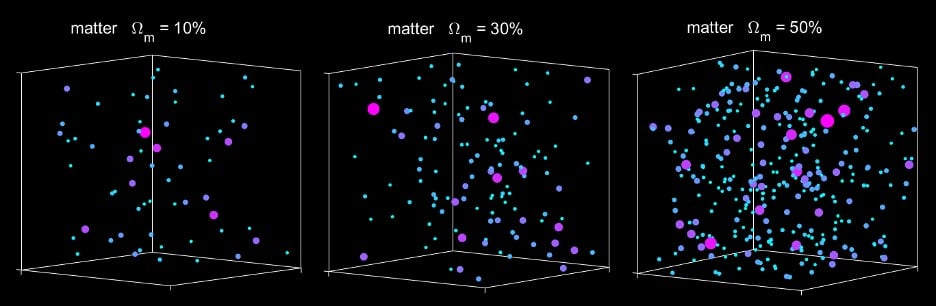
Abdullah explained that one well-proven technique for determining the total amount of matter in the universe is to compare the observed number and mass of galaxy clusters per unit volume with predictions from numerical simulations. Because present-day galaxy clusters have formed from matter that has collapsed over billions of years under its own gravity, the number of clusters observed at the present time is very sensitive to cosmological conditions and, in particular, the total amount of matter.
“A higher percentage of matter would result in more clusters,” Abdullah said. “The ‘Goldilocks’ challenge for our team was to measure the number of clusters and then determine which answer was ‘just right.’ But it is difficult to measure the mass of any galaxy cluster accurately because most of the matter is dark so we can’t see it with telescopes.”
To overcome this difficulty, the UCR-led team of astronomers first developed “GalWeight,” a cosmological tool to measure the mass of a galaxy cluster using the orbits of its member galaxies. The researchers then applied their tool to observations from the Sloan Digital Sky Survey (SDSS) to create “GalWCat19,” a publicly available catalog of galaxy clusters. Finally, they compared the number of clusters in their new catalog with simulations to determine the total amount of matter in the universe.
“We have succeeded in making one of the most precise measurements ever made using the galaxy cluster technique,” said coauthor Gillian Wilson, a professor of physics and astronomy at UCR in whose lab Abdullah works. “Moreover, this is the first use of the galaxy orbit technique which has obtained a value in agreement with those obtained by teams who used noncluster techniques such as cosmic microwave background anisotropies, baryon acoustic oscillations, Type Ia supernovae, or gravitational lensing.”
“A huge advantage of using our GalWeight galaxy orbit technique was that our team was able to determine a mass for each cluster individually rather than rely on more indirect, statistical methods,” said the third coauthor Anatoly Klypin, an expert in numerical simulations and cosmology.
By combining their measurement with those from the other teams that used different techniques, the UCR-led team was able to determine a best combined value, concluding that matter makes up 31.5±1.3% of the total amount of matter and energy in the universe.
Reference: “Cosmological Constraints on Ωm and σ8 from Cluster Abundances using the GalWCat19 Optical-spectroscopic SDSS Catalog” by Mohamed H. Abdullah, Anatoly Klypin and Gillian Wilson, 25 September 2020, Astrophysical Journal.
DOI: 10.3847/1538-4357/aba619
The study was supported by grants from the National Science Foundation and NASA.
Never miss a breakthrough: Join the SciTechDaily newsletter.
Follow us on Google and Google News.
4 Comments
This is a great example of how BOSS crushed the cosmology, since this new type of survey – albeit but also importantly low-z to start with – further strengthens the BOSS model.
“Because present-day galaxy clusters have formed from matter that has collapsed over billions of years under its own gravity, the number of clusters observed at the present time is very sensitive to cosmological conditions and, in particular, the total amount of matter. … Finally, they compared the number of clusters in their new catalog with simulations to determine the total amount of matter in the universe.
“We have succeeded in making one of the most precise measurements ever made using the galaxy cluster technique,” said coauthor Gillian Wilson, a professor of physics and astronomy at UCR in whose lab Abdullah works. “Moreover, this is the first use of the galaxy orbit technique which has obtained a value in agreement with those obtained by teams who used noncluster techniques such as cosmic microwave background anisotropies, baryon acoustic oscillations, Type Ia supernovae, or gravitational lensing.””
[ https://news.ucr.edu/articles/2020/09/28/scientists-precisely-measure-total-amount-matter-universe ]
They measure matter density Ω_m and structure clustering parameter σ_8, and they fall on top of Planck (Ω_m) and BOSS (σ_8), with another factor 3 lowered uncertainty.
Now they need to expand and check for robustness (especially since earlier similar methods did not do well), but meanwhile this is encouraging.
Punked. Right?
This is at best an improved estimate, hardly a precise measure. Since Dark matter and Dark energy are postulated, but not proven, there is no direct measure for them. “Measures” of the observable mass of galactic clusters are estimates in themselves. The scientific community loses credibility by overselling its accomplishments with such poorly conceived headlines as this.
Do you commenters do anything else?