
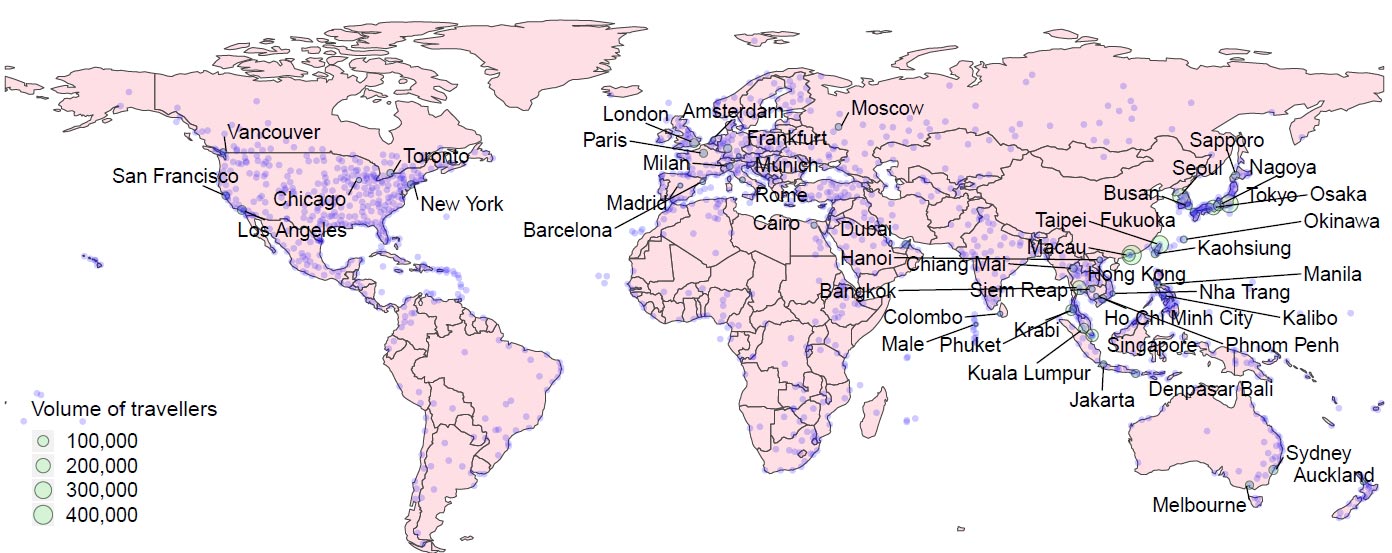
Experts in population mapping at the University of Southampton have identified cities and provinces within mainland China, and cities and countries worldwide, which are at high-risk from the spread of the 2019 Novel Coronavirus (2019-nCoV).
A report by the University’s WorldPop team has found Bangkok (Thailand) is currently the city most at risk from a global spread of the virus – based on the number of air travelers predicted to arrive there from the worst affected cities in mainland China. Hong Kong (China) is second on the list, followed by Taipei (Taiwan, the Republic of China). Sydney (12), New York (16), and London (19) are among 30 other major international cities ranked in the research.
The most ‘at-risk’ countries or regions worldwide are Thailand (1), Japan (2), and Hong Kong (3). USA is placed 6th on the list, Australia 10th, and the UK 17th.
Within mainland China, the cities of Beijing, Guangzhou, Shanghai, and Chongqing are all identified as high-risk by the researchers, along with the Chinese provinces of Guangdong, Zhejiang, Sichuan, and Henan.
Full data can be found in the report on the WorldPop website.
Andrew Tatem, Director of WorldPop and professor of Geography and Environmental Science at the University of Southampton, says: “It’s vital that we understand patterns of population movement, both within China and globally, in order to assess how this new virus might spread – domestically and internationally. By mapping these trends and identifying high-risk areas, we can help inform public health interventions, such as screenings and healthcare preparedness.”
The team at WorldPop used anonymized mobile phone and IP address data (2013-15)1, along with international air travel data (2018)2 to understand typical patterns of movement of people within China, and worldwide, during the annual 40-day Lunar New Year celebrations (including the seven-day public holiday from January 24 to 30).
From this, they identified 18 Chinese cities (including Wuhan) at high risk from the new coronavirus and established the volume of air passengers likely to be traveling from these cities to global destinations (over a three-month period). The team was then able to rank the top 30 most at-risk countries and cities around the world.
The researchers acknowledge that their analysis is based on ‘non-outbreak’ travel patterns, but highlight that a high proportion of people traveled with symptoms at an early stage of the outbreak, before restrictions were put in place. In fact, travel cordons are likely to have only coincided with the latter stages of peak population numbers leaving Wuhan for the holiday period. According to Wuhan authorities, it is likely more than five million people had already left the city.
Lead report author Dr. Shengjie Lai of the University of Southampton comments: “The spread of the new coronavirus is a fast-moving situation and we are closely monitoring the epidemic in order to provide further up-to-date analysis on the likely spread, including the effectiveness of the transport lockdown in Chinese cities and transmission by people returning from the Lunar New Year holiday, which has been extended to February 2.”
WorldPop at the University of Southampton conducted this research in collaboration with the University of Toronto, St Michael’s Hospital Toronto, the disease surveillance organization Bluedot in Toronto, and the China Centre for Disease Control and Prevention.
More SciTechDaily Coverage of 2019-nCoV:
- “Snake Pneumonia” – Coronavirus Outbreak in China Traced to Snakes by Genetic Analysis
- Research Underway to Address Threat of Novel Coronavirus That Recently Emerged in China
- Three Cases of Novel Coronavirus Reported in France
Never miss a breakthrough: Join the SciTechDaily newsletter.
Follow us on Google and Google News.
5 Comments
Could this be “the one”!!
why are you so enthusiastic about this being “the one”?
Why are governments so brain dead to control this virus?
When you got leaders like the lame duck Trudeau who does nothing
What do you expect?
The country should have stopped travel in and out of the country long ago, But what do you expect when governments want to rid the world of it’s population,
This is a biological war and it deters them from a physical war,
So you know who started it China !
Probably with the secret societies help
Then we can obviously blame it back on the Papacy Just like Pike told them how to start world war one and two, back in the 1800’s
Why is Wuhan not glowing on this map?
This is a map of how it will probably spread FROM Wuhan and TO WHERE. Not showing where the reported cases are highest.