

Walking and Physical Activity Linked to Lower Dementia Risk
According to a new study led by the Herbert Wertheim School of Public Health and Human Longevity Science at the University of California San Diego, older women who engage in more daily walking and moderate-to-vigorous physical activity have a lower likelihood of developing mild cognitive impairment or dementia.
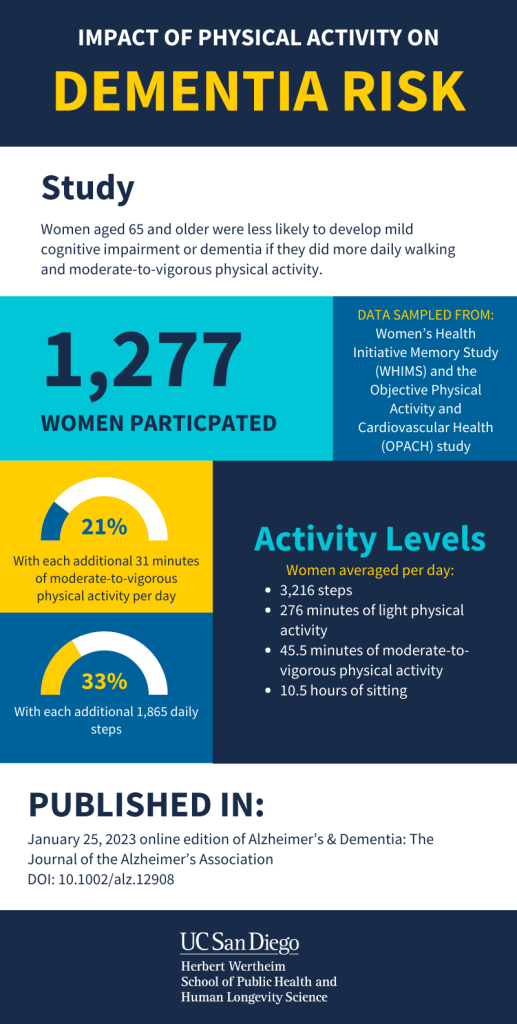
The team recently published their findings in Alzheimer’s & Dementia: The Journal of the Alzheimer’s Association. They reported that among women 65 years or older, each additional 31 minutes of moderate-to-vigorous physical activity per day was linked to a 21% lower risk of developing mild cognitive impairment or dementia. Additionally, each additional 1,865 daily steps was associated with a 33% lower risk.
“Given that the onset of dementia begins 20 years or more before symptoms show, the early intervention for delaying or preventing cognitive decline and dementia among older adults is essential,” said senior author Andrea LaCroix, Ph.D., M.P.H., Distinguished Professor at the Herbert Wertheim School of Public Health and Human Longevity Science at UC San Diego.

While there are several types, dementias are debilitating neurological conditions that can cause loss of memory, the ability to think, problem solve or reason. Mild cognitive impairment is an early stage of memory loss or thinking problems that is not as severe as dementia.
According to the United States Department of Health and Human Services, dementia affects more than 5 million people in this country. That number is expected to double by 2050.
More women live with and are at higher risk of developing dementia than men.
Physical Activity in Dementia Prevention
“Physical activity has been identified as one of the three most promising ways to reduce the risk of dementia and Alzheimer’s disease. Prevention is important because once dementia is diagnosed, it is very difficult to slow or reverse. There is no cure,” said LaCroix.
However, because few large studies have examined device measures of movement and sitting in relation to mild cognitive impairment and dementia, much of the published research on the associations of physical activity and sedentary behavior with cognitive decline and dementia is based on self-reported measures, said first author, Steven Nguyen, Ph.D., M.P.H., a postdoctoral scholar at the Herbert Wertheim School of Public Health.

For this study, the researchers sampled data from 1,277 women as part of two Women’s Health Initiative (WHI) ancillary studies — the WHI Memory Study (WHIMS) and the Objective Physical Activity and Cardiovascular Health (OPACH) study. The women wore research-grade accelerometers and went about their daily activities for up to seven days to obtain accurate measures of physical activity and sitting.
Movement’s Protective Effect
The activity trackers showed the women averaged 3,216 steps, 276 minutes in light physical activities, 45.5 minutes of moderate-to-vigorous physical activity, and 10.5 hours of sitting per day. Examples of light physical activity could include housework, gardening, or walking. Moderate-to-vigorous physical activity could include brisk walking.
The study findings also showed that higher amounts of sitting and prolonged sitting were not associated with a higher risk of mild cognitive impairment or dementia.
Together, this information has clinical and public health importance as there is little published information on the amount and intensity of physical activity needed for a lower dementia risk said Nguyen.
“Older adults can be encouraged to increase the movement of at least moderate intensity and take more steps each day for a lower risk of mild cognitive impairment and dementia,” said Nguyen.
“The findings for steps per day are particularly noteworthy because steps are recorded by a variety of wearable devices increasingly worn by individuals and could be readily adopted.”
The authors said further research is needed among large diverse populations that include men.
Reference: “Accelerometer-measured physical activity and sitting with incident mild cognitive impairment or probable dementia among older women” by Steve Nguyen, Andrea Z. LaCroix, Kathleen M. Hayden, Chongzhi Di, Priya Palta, Marcia L. Stefanick, JoAnn E. Manson, Stephen R. Rapp, Michael J. LaMonte and John Bellettiere, 25 January 2023, Alzheimer’s & Dementia.
DOI: 10.1002/alz.12908
The study was funded, in part, by the National Institute on Aging and the National Heart, Lung, and Blood Institute. The Women’s Health Initiative was funded by the National Heart, Lung, and Blood Institute.
Never miss a breakthrough: Join the SciTechDaily newsletter.
Follow us on Google and Google News.
2 Comments
Activity levels as reported exclude approximately 8 hours of sleep as an inactive period. I question the average of 10.5 hours of Sitting for these Women. I would expect that most Women are Standing much longer than Sitting throughout the day while performing household duties (cooking, cleaning, washing, taking care of grandchildren, taking care of spouse) and are very lucky to take a break Sitting for an hour during a typical day.
It quite good and useful for me.