
Close Menu
    Facebook X (Twitter) Instagram
    SciTechDaily
    • Biology
    • Chemistry
    • Earth
    • Health
    • Physics
    • Science
    • Space
    • Technology
    Facebook X (Twitter) Pinterest YouTube RSS
    SciTechDaily
    Home»Space»Progress 82 Cargo Craft Safely in Orbit Following Launch – Heading to Space Station
    Space

    Progress 82 Cargo Craft Safely in Orbit Following Launch – Heading to Space Station

    By NASAOctober 25, 2022No Comments3 Mins Read
    Facebook Twitter Pinterest Telegram LinkedIn WhatsApp Email Reddit
    Share
    Facebook Twitter LinkedIn Pinterest Telegram Email Reddit
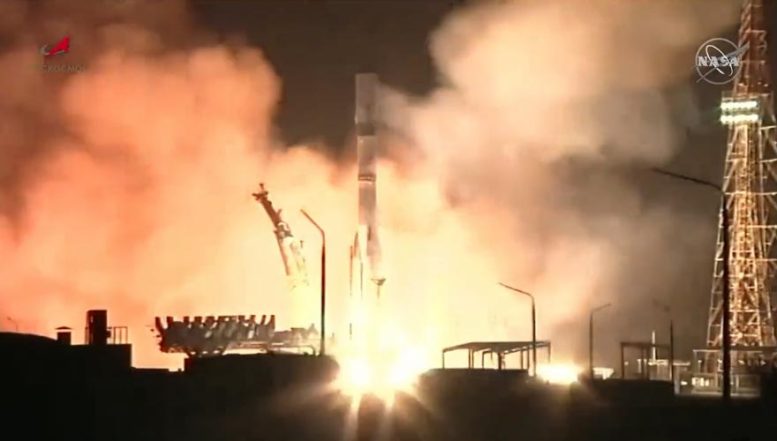
    Progress 82 Cargo Craft Lift Off
    The Progress 82 cargo craft lifted off at 8:20 p.m. EDT on a Soyuz rocket from the Baikonur Cosmodrome in Kazakhstan. Credit: Roscosmos/NASA TV

    At 8:20 p.m. EDT (5:20 a.m. Baikonur time) on Tuesday, October 25, the uncrewed Roscosmos Progress 82 launched on a Soyuz rocket from the Baikonur Cosmodrome in Kazakhstan. It is now safely in orbit and headed for the International Space Station (ISS).

    On its way to meet up with the orbiting laboratory and its Expedition 68 crew members, the resupply ship reached preliminary orbit and deployed its solar arrays and navigational antennas as planned.


    The uncrewed Roscosmos Progress 82 cargo craft launched to the International Space Station from the Baikonur Cosmodrome in Kazakhstan on October 25, 2022, atop a Soyuz booster rocket. Progress is filled with almost three tons of supplies and will dock to the Poisk module after completing a two-day rendezvous. The resupply vehicle will remain docked to the space station until early next year. Credit: NASA

    Progress will dock to the space-facing side of the Poisk module two days from now, on Thursday, October 27, at 10:49 p.m. EDT (7:49 p.m. PDT). Live coverage on NASA TV of rendezvous and docking will begin at 10:15 p.m. EDT.

    Progress will deliver almost three tons of food, fuel, and supplies to the ISS.
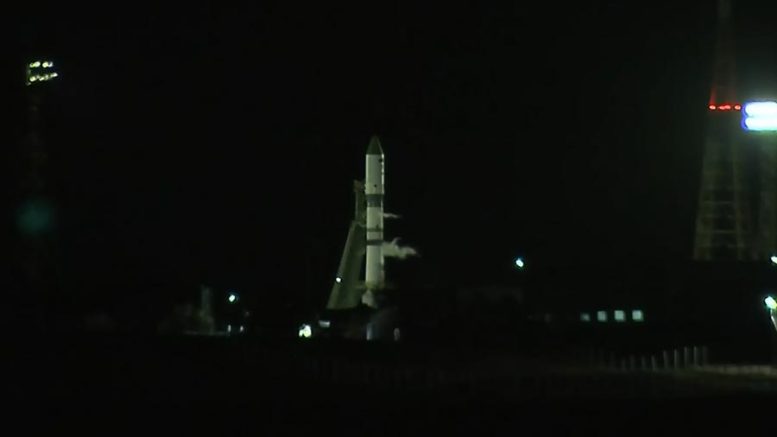
    Progress 82 Cargo Craft Launchpad
    The Progress 82 cargo craft is seen on the launchpad at Baikonur Cosmodrome in Kazakhstan. Credit: Roscosmos/ NASA TV

    Meanwhile, the four astronauts and three cosmonauts aboard the station spent the day today focused on numerous state-of-the-art science experiments benefiting humans both in space and on Earth. Ranging from space botany, human research, and microgravity physics, the research helps crew members adjust to long-term missions in weightlessness and provide innovations enhancing products and services on Earth.

    Frank Rubio, NASA Flight Engineer, spent Tuesday morning nourishing and monitoring vegetables growing inside the Columbus laboratory module. The XROOTS investigation explores soilless methods, or hydroponic and aeroponic techniques, to grow crops in space and sustain crews living off the Earth.

    Rubio also joined his fellow flight engineers, Josh Cassada and Nicole Mann, both from NASA, and Koichi Wakata from the Japan Aerospace Exploration Agency (JAXA) for eye scans using the Human Research Facility’s ultrasound device. The optic exams give researchers insight into how microgravity affects the eye’s shape, pressure, retinas, and vision.

    Progress 82 Cargo Craft Baikonur Cosmodrome Launch Pad
    The Progress 82 cargo craft stands atop its rocket at the Baikonur Cosmodrome launch pad in Kazakhstan during pre-launch processing. Credit: RSC/Energia

    Mann, who also cleaned and inspected U.S. module hatch seals, joined Wakata and pointed their cameras outside the station photographing the condition of solar array components. In addition, Wakata turned on an Astrobee robotic free-flyer to demonstrate its use of wireless technology, or radio frequency identification, to manage cargo inventory on the space station. Cassada worked inside the Zarya module to maximize storage space.

    Commander Sergey Prokopyev configured research hardware in the Columbus module to explore plasma crystals, or highly-charged microparticles, to gain fundamental space physics knowledge and possibly improve the design of future spacecraft. Cosmonauts Dmitri Petelin and Anna Kikina took turns studying future planetary spacecraft and robotic piloting techniques. Petelin then went on and explored how the digestion system adapts to microgravity, while Kikina observed Earth’s nighttime atmospheric glow in the near-ultraviolet wavelength.

    Never miss a breakthrough: Join the SciTechDaily newsletter.
    Follow us on Google and Google News.

    International Space Station NASA
    Share. Facebook Twitter Pinterest LinkedIn Email Reddit

    Related Articles

    SpaceX Just Launched Robots, Atomic Clocks, and Mars Tech Into Orbit

    Watch Live: NASA Astronaut Don Pettit Returns to Earth on His 70th Birthday After 220 Days in Space

    Space Station Commander Swap, SpaceX Dragon Launch, and Birthday Earth Return All in One Weekend

    Dawn Docking, New Discoveries: NASA and Russian Crew Begin Space Station Mission

    Meet NASA’s SpaceX Crew-11: The Astronauts Launching to Shape Humanity’s Future in Space

    New Beginnings in Space As Astronauts Step Into Their Zero-Gravity Home

    NASA’s Crew-9 Returns After 286-Day Mission With a Spectacular Splashdown in the Gulf of America

    NASA’s SpaceX Crew-9 Splashes Down Off Coast of Florida

    SpaceX Dragon Undocks With NASA Crew-9 Members for Return to Earth

    Leave A Reply Cancel Reply

    • Facebook
    • Twitter
    • Pinterest
    • YouTube

    Don't Miss a Discovery

    Subscribe for the Latest in Science & Tech!

    Trending News

    Monster Storms on Jupiter Unleash Lightning Beyond Anything on Earth

    Scientists Create “Liquid Gears” That Spin Without Touching

    The Simple Habit That Could Help Prevent Cancer

    Millions Take These IBS Drugs, But a New Study Finds Serious Risks

    Scientists Unlock Hidden Secrets of 2,300-Year-Old Mummies Using Cutting-Edge CT Scanner

    Bread Might Be Making You Gain Weight Even Without Eating More Calories

    Scientists Discover Massive Magma Reservoir Beneath Tuscany

    Europe’s Most Active Volcano Just Got Stranger – Here’s Why Scientists Are Rethinking It

    Follow SciTechDaily
    • Facebook
    • Twitter
    • YouTube
    • Pinterest
    • Newsletter
    • RSS
    SciTech News
    • Biology News
    • Chemistry News
    • Earth News
    • Health News
    • Physics News
    • Science News
    • Space News
    • Technology News
    Recent Posts
    • 25-Year Study Uncovers Hidden Paths and Early Warning Signs of Blood Cancer
    • Not Just Snoring – New Research Reveals Sleep Apnea May Be Damaging Your Muscles
    • Scientists Discover a Surprising Reason Intermittent Fasting Extends Life
    • Scientists Discover a New Meteor Shower From a Mysterious Crumbling Asteroid
    • This Simple Fruit Wash Could Make Produce Safer and Last Days Longer
    Copyright © 1998 - 2026 SciTechDaily. All Rights Reserved.
    • Science News
    • About
    • Contact
    • Editorial Board
    • Privacy Policy
    • Terms of Use

    Type above and press Enter to search. Press Esc to cancel.