
Close Menu
    Facebook X (Twitter) Instagram
    SciTechDaily
    • Biology
    • Chemistry
    • Earth
    • Health
    • Physics
    • Science
    • Space
    • Technology
    Facebook X (Twitter) Pinterest YouTube RSS
    SciTechDaily
    Home»Space»Quadrantids Meteor Shower Offers Winter Skywatching Spectacle
    Space

    Quadrantids Meteor Shower Offers Winter Skywatching Spectacle

    By Royal Astronomical SocietyJanuary 3, 2022No Comments3 Mins Read
    Facebook Twitter Pinterest Telegram LinkedIn WhatsApp Email Reddit
    Share
    Facebook Twitter LinkedIn Pinterest Telegram Email Reddit
    Quadrantids Meteor Shower
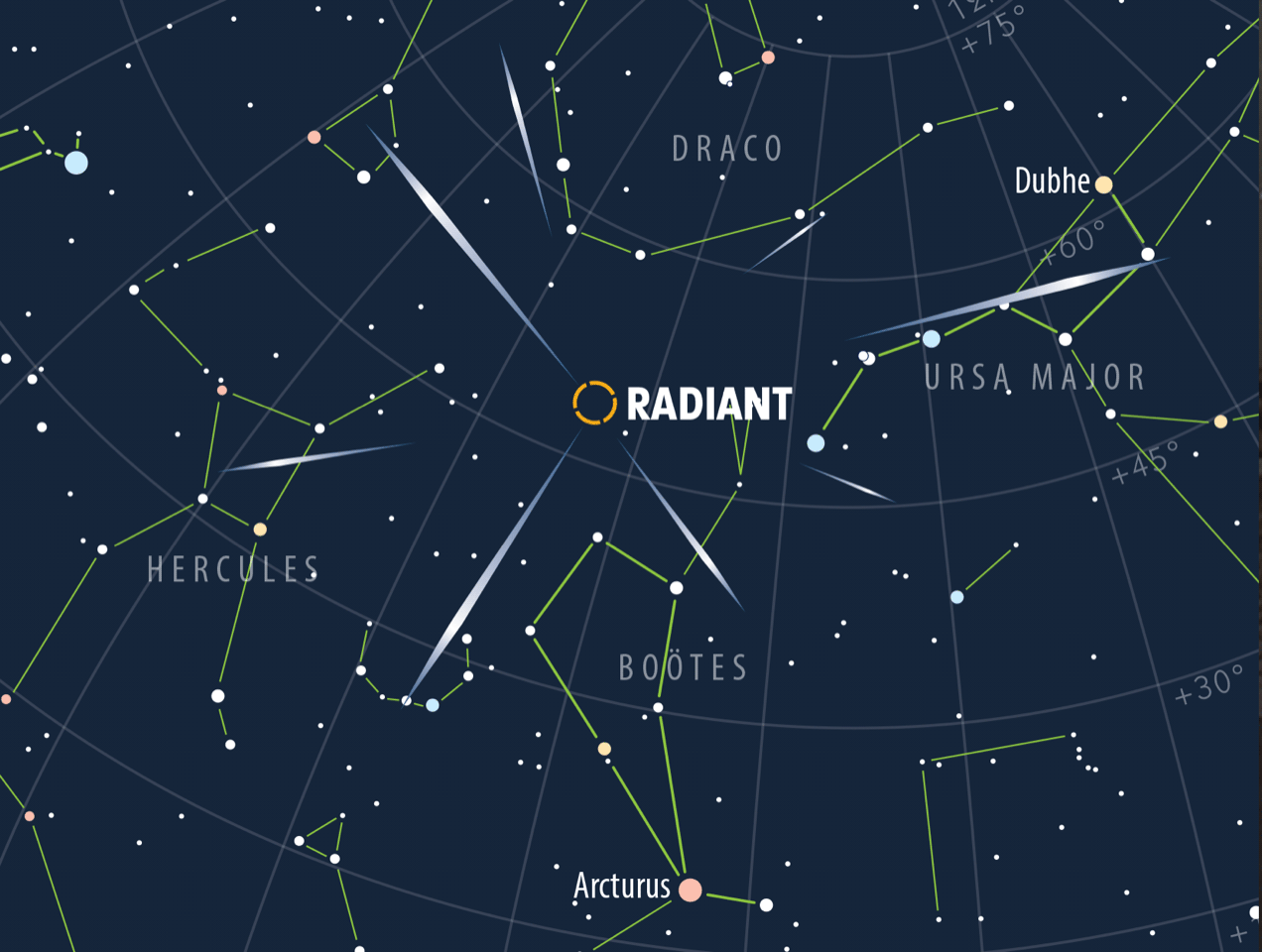
    A finder chart depicting the location of the radiant of the Quadrantids meteor shower, from Astronomy Now magazine. Credit: Astronomy Now/Greg Smye-Rumsby (CC BY 4.0)

    The 2022 Quadrantids, peaking January 3-4, could show 50+ meteors hourly, best viewed at 20:40 GMT under a dark, new Moon sky.

    Northern hemisphere stargazers can look forward to what could be 2022’s best meteor shower on January 3-4. Observers enjoying dark skies could see 50 or more meteors an hour that night, as the Quadrantids shower reaches its peak.

    Meteors are the result of small particles entering the Earth’s atmosphere at high speed, typically around 40 km (25 miles) per second for the Quadrantids. The pieces of debris heat up due to friction with the air, and are usually destroyed in under a second at altitudes above 80 km (50 mi). The superheated air around the meteor glows briefly, and is visible from the ground as a streak of light known as a ‘shooting star’.

    Throughout the year between six and ten random ‘sporadic’ meteors are visible each hour. During a shower, the Earth passes through a cloud of debris left behind by comets and asteroids, and so many more meteors are seen entering the atmosphere. The Quadrantids are associated with the near-Earth asteroid (196256) 2003 EH1, which may be an extinct comet seen by Chinese astronomers in 1490.

    Meteor showers appear to emanate from a radiant point, in this case named for the defunct constellation Quadrans Muralis, and now sited in the constellation Bootes, near the famous Plough asterism. The diagram above, courtesy of Astronomy Now, depicts the radiant of the shower.

    This year the shower peak is predicted to be at 20:40 GMT on January 3. This is quite sharply defined, and the number of meteors drops off by 50% two hours later. To offset this, more meteors tend to be seen when the radiant is higher in the sky, and also in the hours before dawn, so UK observers could see a decent display throughout the night.

    This time the Moon will be just past New, so its light will not interfere with the view and there will be a real benefit from watching the meteor shower under dark skies away from the lights of towns and cities.

    Unlike many astronomical events, meteor showers are easy to watch and no special equipment is needed. A meteor shower is best observed with the naked eye, and a reclining chair, a warm blanket, and a hot drink make viewing much more comfortable on a cold January night.

    Never miss a breakthrough: Join the SciTechDaily newsletter.
    Follow us on Google and Google News.

    Astronomy Meteors Royal Astronomical Society
    Share. Facebook Twitter Pinterest LinkedIn Email Reddit

    Related Articles

    Artificial Intelligence Helps Resolve Long-Running Astrophysics Debate on Supermassive Black Holes

    Martian Meteorite Hunters: Paving the Way for Future Rovers To Search for Meteorites on Mars

    Planetary Shields Will Buckle Under Furious Stellar Winds From Their Dying Stars – Nearly Impossible for Life To Survive

    SuperBIT: A Low-Cost Telescope To Rival Hubble – Carried by a Balloon the Size of a Football Stadium

    Lucky Encounter: Solar Orbiter Spacecraft Flies Through the Tail of a Disintegrated Comet

    A Bug’s Life: Mountains on Neutron Stars May Be Only Fractions of Millimeters Tall

    Mysterious Population of Rogue Planets Spotted Near the Center of Our Galaxy

    Habitable Planets With Earth-Like Biospheres May Be Much Rarer Than Thought

    Potentially Hazardous 4,000 Year Comets Can Cause Meteor Showers on Earth

    Leave A Reply Cancel Reply

    • Facebook
    • Twitter
    • Pinterest
    • YouTube

    Don't Miss a Discovery

    Subscribe for the Latest in Science & Tech!

    Trending News

    Scientists Uncover Potential Brain Risks of Popular Fish Oil Supplements

    Scientists Discover a Surprising Way To Make Bread Healthier and More Nutritious

    After 60 Years, Scientists Uncover Unexpected Brain Effects of Popular Diabetes Drug Metformin

    New Research Uncovers Hidden Side Effects of Popular Weight-Loss Drugs

    Scientists Rethink Extreme Warming After Surprising Ocean Discovery

    Landmark Study Links Never Marrying to Significantly Higher Cancer Risk

    Researchers Discover Unknown Beetle Species Just Steps From Their Lab

    Largest-Ever Study Finds Medicinal Cannabis Ineffective for Anxiety, Depression, PTSD

    Follow SciTechDaily
    • Facebook
    • Twitter
    • YouTube
    • Pinterest
    • Newsletter
    • RSS
    SciTech News
    • Biology News
    • Chemistry News
    • Earth News
    • Health News
    • Physics News
    • Science News
    • Space News
    • Technology News
    Recent Posts
    • Common Blood Pressure Drug Shows Surprising Power Against Deadly Antibiotic-Resistant Superbug
    • Students Build Dark Matter Detector and Set New Experimental Limits
    • Scientists Discover Caffeine Can Repair Key Memory Circuits After Sleep Loss
    • Strange 65-Foot Dinosaur Discovered in Argentina
    • Researchers Uncover Source of Strange Deformation in Earth’s Largest Continental Rift
    Copyright © 1998 - 2026 SciTechDaily. All Rights Reserved.
    • Science News
    • About
    • Contact
    • Editorial Board
    • Privacy Policy
    • Terms of Use

    Type above and press Enter to search. Press Esc to cancel.