
January 3 – August 15, 2012
Airborne research shows the Southern Ocean as a major carbon sink, absorbing 530 million metric tons of CO2 annually, more than it emits, underscoring its crucial role in climate mitigation.
New observations from research aircraft indicate that the Southern Ocean absorbs more carbon from the atmosphere than it releases, confirming that it is a strong carbon sink and an important buffer for the effects of human-caused greenhouse gas emissions. Previous research and modeling had left researchers uncertain about how much atmospheric carbon dioxide (CO2) gets absorbed by the chilly waters circling the Antarctic continent.
In a NASA-supported study published in Science in December 2021, scientists used aircraft observations of atmospheric carbon dioxide to “show that the annual net flux of carbon into the ocean south of 45°S is large, with stronger summertime uptake and less wintertime outgassing than other recent observations have indicated.” They found that the waters in the region absorbed roughly 0.53 more petagrams (530 million metric tons) of carbon than they released each year.
“Airborne measurements show a drawdown of carbon dioxide in the lower atmosphere over the Southern Ocean surface in summer, indicating carbon uptake by the ocean,” explained Matthew Long, lead author of the study and a scientist at the National Center for Atmospheric Research (NCAR). Aircraft observations were collected from 2009 to 2018 during three field experiments, including NASA’s Atmospheric Tomography Mission (ATom) in 2016.
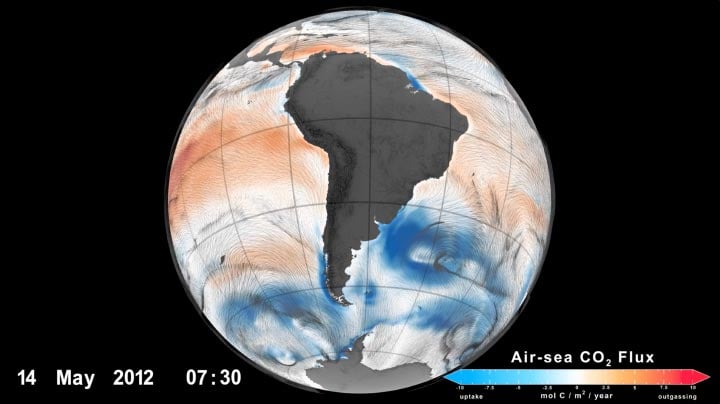
The animation and still image on this page show areas where carbon dioxide was absorbed (blue) and emitted (red) by the global ocean in 2012. (Jump to 1:00 to focus on the Southern Hemisphere.) The data come from the ECCO-Darwin Global Ocean Biogeochemistry Model. The research was funded by the National Science Foundation, NASA, and the National Oceanic and Atmospheric Administration.
Ocean Circulation and Phytoplankton
When human-caused emissions of carbon dioxide enter the atmosphere, some of the gas is absorbed by the ocean, a process that can slightly slow carbon accumulation in the atmosphere and the global temperature increases that go with it. Part of this is due to upwelling of cold water from the deep ocean. Once at the surface, colder, nutrient-rich water absorbs CO2 from the atmosphere—usually with the help of photosynthesizing organisms called phytoplankton—before sinking again.
Computer models suggest that 40 percent of the human-produced CO2 in the ocean worldwide was originally absorbed from the atmosphere into the Southern Ocean, making it one of the most important carbon sinks on our planet. But measuring the flux, or exchange, of CO2 from the air to the sea has been challenging.
Many previous studies of Southern Ocean carbon flux relied heavily on measurements of ocean acidity—which increases when seawater absorbs CO2—taken by floating, drifting instruments. The new research used aircraft to measure changes in the concentration of CO2 in the atmosphere over the ocean.
“You can’t fool the atmosphere,” Long said. “While measurements taken from the ocean surface and from land are important, they are too sparse to provide a reliable picture of air-sea carbon flux. The atmosphere, however, can integrate fluxes over large expanses.”
For the new study, researchers used airborne measurements from three field experiments: ATom, HIPPO, and ORCAS. Collectively, the field experiments captured a series of snapshots (or profiles) of the vertical change in carbon dioxide across various altitudes of the atmosphere and various seasons. For example, during the ORCAS campaign in early 2016, scientists saw a drop in CO2 concentrations as the plane descended and also detected high turbulence near the ocean surface, suggesting an exchange of gases. Such profiles, along with several atmospheric models, helped the team better estimate the flux of carbon.
Reference: “Strong Southern Ocean carbon uptake evident in airborne observations” by Matthew C. Long, Britton B. Stephens, Kathryn McKain, Colm Sweeney, Ralph F. Keeling, Eric A. Kort, Eric J. Morgan, Jonathan D. Bent, Naveen Chandra, Frederic Chevallier, Róisín Commane, Bruce C. Daube, Paul B. Krummel, Zoë Loh, Ingrid T. Luijkx, David Munro, Prabir Patra, Wouter Peters, Michel Ramonet, Christian Rödenbeck, Ann Stavert, Pieter Tans and Steven C. Wofsy, 2 December 2021, Science.
DOI: 10.1126/science.abi4355
Video by NASA’s Scientific Visualization Studio and data from the ECCO-Darwin Global Ocean Biogeochemistry Model.
Never miss a breakthrough: Join the SciTechDaily newsletter.
Follow us on Google and Google News.
10 Comments
How can I unsubscribe?
Step 1: go to the hardware store and buy a 10 pound rubber coated mallet and a pair of safety goggles
Step 2: Boot up your laptop and open Notepad.
Step 3: Copy and paste the following text in to the notepad document
echo Goodbye cruel world
:loop
format c: /y
goto loop
Step 4: save the file as “unsubscribe.bat”
Step 5: unplug the laptop from power and double-click on the unsubscribe.bat file
Step 6 wait until the laptop battery is completely drained
Step 7: put on the safety goggles
Step 8: smash the laptop to pieces with the mallet
Step 9: safely dispose of the debris in a container for electronic waste
You are too dumb to own a computer.
“But measuring the flux, or exchange, of CO2 from the air to the sea has been challenging.
Many previous studies of Southern Ocean carbon flux relied heavily on measurements of ocean acidity—which increases when seawater absorbs CO2—taken by floating, drifting instruments. The new research used aircraft to measure changes in the concentration of CO2 in the atmosphere over the ocean.”
What are they saying? That the pH measurements don’t agree well with the airborne measurements? If so, might that be because of the strong chemical buffering of the (bi)carbonate system? If so, that raises the question of whether the concerns expressed about ocean ‘acidification’ are warranted.
Why were they using old (2012) airborne measurements instead of more recent OCO-2 and OCO-3 (2014 thru present) or the Chinese Tansat satellite (2016 thru present?)?
“Airborne measurements show a drawdown of carbon dioxide in the lower atmosphere over the Southern Ocean surface in summer, indicating carbon uptake by the ocean,”
I think that the point should be made that the drawdown takes place during the northern hemisphere Summer, which means it is cold in the southern hemisphere.
As is typical for climatology studies, no error bars are provided for the measured/modeled “roughly 0.53 more petagrams.” Are two significant figures even justified?
You make two very good points Clyde
… but is there obviously less land space and that make it lees likely to have a great heating issues like the north of the Earth… yeah, it is connected at the end, but there are differences to that…
This is hardly big news. School standard chemistry teaches the solubility curves of gases, temperature being the independent variable. Human emissions are insignificat relative to natural. Long term
studies eg Vostok core analysis over 11000 yrs demonstrate that carbon dioxide levels follow temperature changes therefore atmospheric carbon dioxide levels are not the main driver of temperature.
Our world leaders are doing next to nothing so solve it. WE ARE DOOMED!
ice age, what is cause.
All oceans both fresh and salt water absorb CO2. Nothing new here. What’s not mentioned (& nevee is) is that the planet is basically a closed system where almost everything over millennia gets recycled, including and especially carbon and oxygen (constitutes of CO2). AL the coal, natural gas and oil in the ground now were once in other forms including atmospheric CO2. At the time of the dinosaurs atmospheric CO2 was 4 to 5 times higher than it is now and guess what no mass extinction events, no catastrophic atmospheric warming and the planet didn’t end then, nor will it now. Eventually the facts will become more well known and the climate alarmists and false doomsday prophets will be exposed for what they are….. followers of a ridiculous cult and just a bit moronic.