
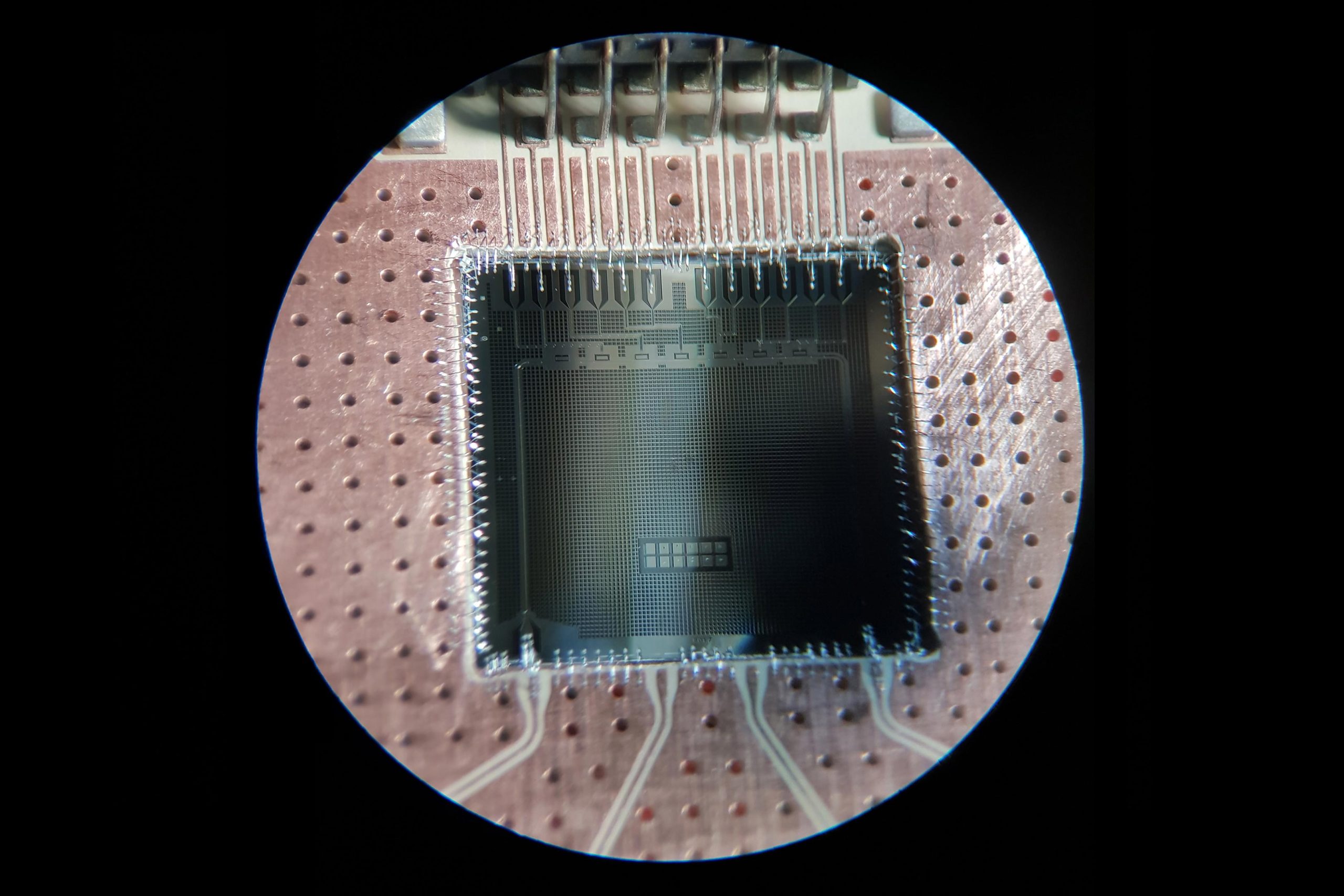
Imagine being able to see quantum objects with your own eyes — no microscopes needed. That’s exactly what researchers at TU Wien and ISTA have achieved with superconducting circuits, artificial atoms that are massive by quantum standards.
Unlike natural atoms, these structures can be engineered to have customizable properties, allowing scientists to control energy levels and interactions in ways never before possible. By coupling them, they’ve developed a method to store and retrieve light, laying the groundwork for revolutionary quantum technologies. These engineered systems also enable precise quantum pulses and act as a kind of quantum memory, offering an unprecedented level of control over light at the quantum level.
Gigantic Quantum Objects – Visible to the Naked Eye
Many quantum objects, such as individual molecules or atoms, are so small that they can only be observed with specialized microscopes. However, the quantum structures that Elena Redchenko studies at the Institute for Atomic and Subatomic Physics at TU Wien are different — they are large enough to be seen with the naked eye, though only with some effort. Measuring hundreds of micrometers across, these objects remain tiny by everyday standards but are immense in the realm of quantum physics.
These large quantum objects are superconducting circuits — structures that allow electric current to flow without resistance when cooled to low temperatures. Unlike natural atoms, which have fixed properties dictated by nature, these artificial structures can be precisely customized. This flexibility enables scientists to manipulate and study various quantum phenomena in a controlled environment. Often referred to as “artificial atoms,” their physical properties can be engineered to suit specific experiments.
By coupling these artificial atoms, researchers developed a system capable of storing and retrieving light — an essential step for future quantum experiments. This breakthrough was achieved by the research group of Johannes Fink at ISTA, with theoretical contributions from Stefan Rotter at the Institute for Theoretical Physics at TU Wien. The findings were recently published in Physical Review Letters.
Customized “Atoms” – Engineering Quantum Properties
A key property of quantum physics is that certain objects can only assume very specific energy values. “An electron moving around an atomic nucleus can assume a lower energy state or a higher energy state, but never a state in between,” says Elena Redchenko, the lead author of the current publication. “All values in between are simply not physically possible. With our artificial atoms, however, we can choose which energy values should be allowed. For each artificial atom, we can set exactly how large the distance between the physically permitted energy values should be.”
Microwaves are sent through a special metal wire (a resonator) that runs directly past the superconducting artificial atoms. These microwaves now influence the superconducting artificial atoms: some of the microwave radiation can pass from the wire into the artificial atoms – and back again. The strength of this interaction can also be specifically adjusted.
“We can show that photons are exchanged between the microwave in the wire and the artificial atoms in a precisely predictable way,” says Elena Rechenko. “This is only possible because our artificial atoms give us a huge amount of engineering freedom to customize our system to our exact requirements. This means we can now achieve things that would be unthinkable with atoms or other natural quantum objects.”
Quantum Light Pulses and Controlling Time
If the artificial atoms are adapted correctly, it is possible to create very special rhythms of light pulses. “We send a short classical microwave pulse into the wire, but the interaction with the artificial atoms can create a series of quantum pulses of light, separated by time intervals that we can control. It is like an on-chip quantum timer,” explains Elena Rechenko.
“In our work, we have shown how flexible this system is and how precisely it can be used for very different quantum experiments,” says Elena Rechenko. “For example, you can use it to generate individual, clearly separated photons – this is important for many experiments. But you can also use it to temporarily store photons for a certain period of time until they are released again – this is another technique that promises exciting new applications.”
Reference: “Observation of Collapse and Revival in a Superconducting Atomic Frequency Comb” by E. S. Redchenko, M. Zens, M. Žemlička, M. Peruzzo, F. Hassani, R. Sett, P. Zieliński, H. S. Dhar, D. O. Krimer, S. Rotter and J. M. Fink, 11 February 2025, Physical Review Letters.
DOI: 10.1103/PhysRevLett.134.063601
Never miss a breakthrough: Join the SciTechDaily newsletter.
Follow us on Google and Google News.
1 Comment
Imagine being able to see quantum objects with your own eyes — no microscopes needed. That’s exactly what researchers at TU Wien and ISTA have achieved with superconducting circuits, artificial atoms that are massive by quantum standards.
VERY GOOD!
Ask the researchers:
1. How do you define atoms?
2. Do the universe and atoms have commonalities?
3. How do you define vastness and smallness?
Scientific research guided by correct theories can enable researchers to think more. Can you get an Interpretation of Quantum Theory within the Framework of Topological Vortex Theory (TVT)? (https://scitechdaily.com/microscope-spacecrafts-most-precise-test-of-key-component-of-the-theory-of-general-relativity/#comment-875168). Can you get an Interpretation of Einstein’s Relativity within the Framework of Topological Vortex Theory (TVT)? (https://scitechdaily.com/microscope-spacecrafts-most-precise-test-of-key-component-of-the-theory-of-general-relativity/#comment-875170).
A topological vortex is a concept in physics that describes the natural gravitational field or the fluid-body coupled system. A topological vortex is formed by the interaction and balance of vortex and anti-vortex field pairs, which can be set into resonance by the body motion and interaction.
Topological Vortex Theory (TVT) treats space as an ideal fluid, posits that the topological vortex gravitational field is fundamental to the structure of the universe, and emphasizes the importance of topological phase transitions in understanding mass, inertia, and energy.
According to the Topological Vortex Theory (TVT), spins create everything, spins shape the world. There are substantial distinctions between Topological Vortex Theory (TVT) and traditional physical theories. Grounded in the inviscid, incompressible, and isotropic spaces, TVT introduces the concept of topological phase transitions and employs topological principles to elucidate the formation and evolution of matter in the universe, as well as the impact of interactions between topological vortices and anti-vortices on spacetime dynamics and thermodynamics.
Within TVT, low-dimensional spacetime matter serves as the foundation for high-dimensional spacetime matter, and the hierarchical structure of matter and its interaction mechanisms challenge conventional macroscopic and microscopic interpretations. The conflict between Quantum Physics and Classical Physics can be attributed to their differing focuses: Quantum Physics emphasizes low-dimensional spacetime matter, whereas Classical Physics centers on high-dimensional spacetime matter.
Subatomic particles in the quantum world often defy the familiar rules of the physical world. The fact repeatedly suggests that the familiar rules of the physical world are pseudoscience. In the familiar rules of the physical world, two sets of cobalt-60 can form the mirror image of each other by rotating in opposite directions, and should receive the Nobel Prize for physics.
Please witness the grand performance of some so-called peer review publications (including PRL, PNAS, Nature, Science, etc.). https://scitechdaily.com/microscope-spacecrafts-most-precise-test-of-key-component-of-the-theory-of-general-relativity/#comment-854286. Some so-called academic publications (including PRL, PNAS, Nature, Science, etc.) are addicted to their own small circles and have deviated from science for a long time.
As the background of various material interactions and movements, space exhibits inviscid, absolutely incompressible and isotropic physical characteristics. It may form various forms of spacetime vortices through topological phase transitions. Hence, vortex phenomena are ubiquitous in cosmic space, from vortices of quantum particles and living cells to tornados and black holes. Stars and radioactive elements are one of the most active topological nodes in spacetime. Utilizing them is more valuable and meaningful than simulating them. Small or micro power topology intelligent batteries may be the direction of future energy research and development for human society.
Under the topological vortex architecture, science and pseudoscience are clear at a glance. Topological Vortex Theory (TVT) can play a crucial role in elucidating the foundations of physics, establishing its principles, and combating pseudoscience. Therefore, TVT has been strongly opposed and boycotted by traditional so-called peer review publications (such as PRL, PNAS, Nature, Science, etc.).
These so-called peer review publications (including PRL, PNAS, Nature, Science, etc.) mislead the direction of science and are known for their various absurdities and wonders. They collude together, reference each other, and use so-called Impact Factor (IF) or the Nobel Prize to deceive people around.
Ask the so-called peer review publications (including PRL, PNAS, Nature, Science, etc.):
1. What are your criteria for distinguishing science from pseudoscience?
2. Is your Impact Factor (IF) the standard for distinguishing science from pseudoscience?
3. Is the Nobel Prize the standard for distinguishing science from pseudoscience?
4. What is the most important aspect of academic publications?
5. Is the most important aspect of academic publications being flashy and impractical articles?
Pseudo academic publications (including PRL, PNAS, Nature, Science, etc.) are neither inclusivity nor openness, nor transparency and fairness, and have already had a serious negative impact on the progress of science and technology. Some so-called peer review publications (including PRL, PNAS, Nature, Science, etc.) are addicted to their own small circle and no longer know what science is. They hardly know what is dirty and ugly.
Publications that mislead the public under the guise of scholarship are more reprehensible than ordinary publications. The field of physics faces an ongoing challenge in maintaining scientific rigor and integrity in the face of pervasive pseudoscientific claims. Fighting against rampant pseudoscience, physics still has a long way to go.
While my comments may be lengthy, they are necessary to combat the proliferation of rampant pseudoscience and to promote the advancement of science and technology, and also is all I can do.
Appreciate the SciTechDaily for its inclusivity, openness, transparency, and fairness. If the researchers are truly interested in cosmic matter, please read: A Brief History of the Evolution of Cosmic Matter (https://scitechdaily.com/microscope-spacecrafts-most-precise-test-of-key-component-of-the-theory-of-general-relativity/#comment-873523).