
Close Menu
    Facebook X (Twitter) Instagram
    SciTechDaily
    • Biology
    • Chemistry
    • Earth
    • Health
    • Physics
    • Science
    • Space
    • Technology
    Facebook X (Twitter) Pinterest YouTube RSS
    SciTechDaily
    Home»Technology»Quantum Breakthrough: Scientists Use Sound Waves To Enable the Future of the Internet
    Technology

    Quantum Breakthrough: Scientists Use Sound Waves To Enable the Future of the Internet

    By University of RochesterAugust 25, 2024No Comments4 Mins Read
    Facebook Twitter Pinterest Telegram LinkedIn WhatsApp Email Reddit
    Share
    Facebook Twitter LinkedIn Pinterest Telegram Email Reddit
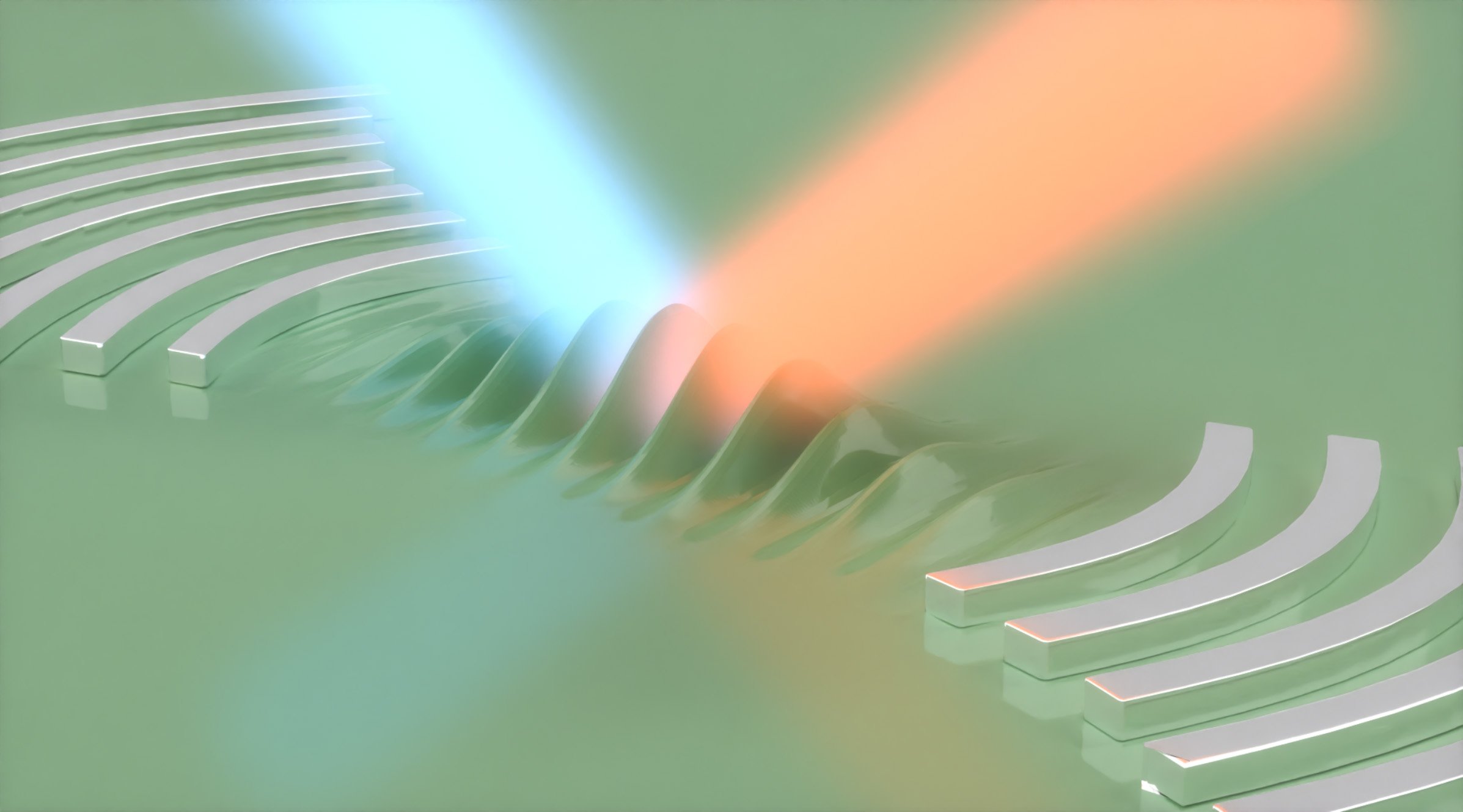
    Coherent Optical Coupling to Surface Acoustic Wave Devices
    Beams of light, shown in orange and blue, are shined on a surface acoustic wave resonator, where their interactions are controlled by a precisely designed cavity. Inside this echo chamber, the light becomes strongly coupled with the surface acoustic waves. Credit: University of Rochester illustration / Iyer et al.

    Researchers have developed new methods for coupling light to surface-gliding sound waves.

    Researchers at the University of Rochester have employed surface acoustic waves to tackle a major challenge in the development of a quantum internet.

    In a new study published in Nature Communications, scientists from Rochester’s Institute of Optics and Department of Physics and Astronomy describe a technique for pairing particles of light and sound that could be used to faithfully convert information stored in quantum systems—qubits—to optical fields, which can be transmitted over long distances.

    What are surface acoustic waves?

    Surface acoustic waves are vibrations that glide along the exterior of materials like a wave in the ocean or tremors along the ground during an earthquake. They are used for a variety of applications—many of the electrical components of our phones have surface acoustic wave filters—because they make very precise cavities that can be used for precise timing in uses like navigation. But scientists have begun using them in quantum applications as well.

    Renninger Lab University of Rochester
    Researchers at the University of Rochester, including optics graduate students Arjun Iyer (foreground) and Wendao Xu, designed acoustic cavities, or tiny echo chambers, to strongly couple surface acoustic waves with light. These devices are simple to fabricate, small in size, and have the ability to handle large amounts of power. Credit: University of Rochester photo / J. Adam Fenster

    “In the last 10 years, surface acoustic waves have emerged as a good resource for quantum applications because the phonon, or individual particle of sound, couples very well to different systems,” says William Renninger, associate professor of optics and physics.

    Using existing methods, surface acoustic waves are accessed, manipulated, and controlled through piezoelectric materials to turn electricity into acoustic waves and vice versa. However, these electric signals must be applied to mechanical fingers inserted into the middle of the acoustic cavity, which causes parasitic effects by scattering phonons in ways that have to be compensated for.

    Using light to manipulate surface acoustic waves

    Rather than coupling the phonons to electric fields, Renninger’s lab tried a less invasive approach, shining light on the cavities and eliminating the need for mechanical contact.

    “We were able to strongly couple surface acoustic waves with light,” says Arjun Iyer, an optics PhD student and first author of the paper. “We designed acoustic cavities, or tiny echo chambers, for these waves where sound could last for a long time, allowing for stronger interactions. Notably, our technique works on any material, not just the piezoelectric materials that can be electrically controlled.”

    Renninger’s team partnered with the lab of Associate Professor of Physics John Nichol to make the surface acoustic wave devices described in the study. In addition to producing strong quantum coupling, the devices have the added benefits of simple fabrication, small size, and the ability to handle large amounts of power.

    Beyond applications in hybrid quantum computing, the team says their techniques can be used for spectroscopy to explore the property of materials, as sensors, and to study condensed matter physics.

    Reference: “Coherent optical coupling to surface acoustic wave devices” by Arjun Iyer, Yadav P. Kandel, Wendao Xu, John M. Nichol and William H. Renninger, 11 May 2024, Nature Communications.
    DOI: 10.1038/s41467-024-48167-7

    The research was supported through the National Science Foundation, the Defense Advanced Research Projects Agency, and the Office of Naval Research.

    Never miss a breakthrough: Join the SciTechDaily newsletter.
    Follow us on Google and Google News.

    Internet Optics Photonics Quantum Information Science University of Rochester
    Share. Facebook Twitter Pinterest LinkedIn Email Reddit

    Related Articles

    New Method Revolutionizes Quantum Information Transfer Across Wavelengths

    AI Efficiency Breakthrough: How Sound Waves Are Revolutionizing Optical Neural Networks

    Pioneering Quantum Simulations on Photonic Chips: A New Era in Quantum Computing

    Tiny Photonic Chip Provides a Big Boost in Precision Optics

    Superconducting Silicon-Photonic Chip Developed for Quantum Communication

    New Photonic Chip for Isolating Light May Be Key to Miniaturizing Quantum Technology

    Quantum Photonics Breakthrough Promises a New Era of Powerful Optical Circuits

    Engineers Design New LED-Based Train Headlight Optimized for Energy Savings

    Newly Developed ‘Rochester Cloak’ Enhances Cloaking Abilities

    Leave A Reply Cancel Reply

    • Facebook
    • Twitter
    • Pinterest
    • YouTube

    Don't Miss a Discovery

    Subscribe for the Latest in Science & Tech!

    Trending News

    New “Nanozyme Hypothesis” Could Rewrite the Story of Life’s Origins

    Anatomy Isn’t Finished: The Human Body Still Holds Secrets

    “Pretty Close to Home”: The Hidden Earthquake Threat Beneath Seattle

    The Surprising Reason You Might Want To Sleep Without a Pillow

    Scientists Say This Natural Hormone Reverses Obesity by Targeting the Brain

    35-Million-Year-Old Mystery: Strange Arachnid Discovered Preserved in Amber

    Is AI Really Just a Tool? It Could Be Altering How You See Reality

    JWST Reveals a “Forbidden” Planet With a Baffling Composition

    Follow SciTechDaily
    • Facebook
    • Twitter
    • YouTube
    • Pinterest
    • Newsletter
    • RSS
    SciTech News
    • Biology News
    • Chemistry News
    • Earth News
    • Health News
    • Physics News
    • Science News
    • Space News
    • Technology News
    Recent Posts
    • Saturn’s Magnetic Shield Isn’t What Scientists Expected
    • Hidden Oceans of Magma Could Be Protecting Alien Life
    • After Decades of Searching, Astronomers Finally Track Down the Universe’s Missing Hydrogen
    • Scientists Capture Hidden Electron Patterns Inside Quantum Materials
    • New Study Challenges Alzheimer’s Theories: It’s Not Just About Plaques
    Copyright © 1998 - 2026 SciTechDaily. All Rights Reserved.
    • Science News
    • About
    • Contact
    • Editorial Board
    • Privacy Policy
    • Terms of Use

    Type above and press Enter to search. Press Esc to cancel.