
Close Menu
    Facebook X (Twitter) Instagram
    SciTechDaily
    • Biology
    • Chemistry
    • Earth
    • Health
    • Physics
    • Science
    • Space
    • Technology
    Facebook X (Twitter) Pinterest YouTube RSS
    SciTechDaily
    Home»Space»Red Velvet Mars – ExoMars Trace Gas Orbiter Captures Delightful Image
    Space

    Red Velvet Mars – ExoMars Trace Gas Orbiter Captures Delightful Image

    By European Space Agency (ESA)December 30, 20211 Comment2 Mins Read
    Facebook Twitter Pinterest Telegram LinkedIn WhatsApp Email Reddit
    Share
    Facebook Twitter LinkedIn Pinterest Telegram Email Reddit
    Red Velvet Mars Crater
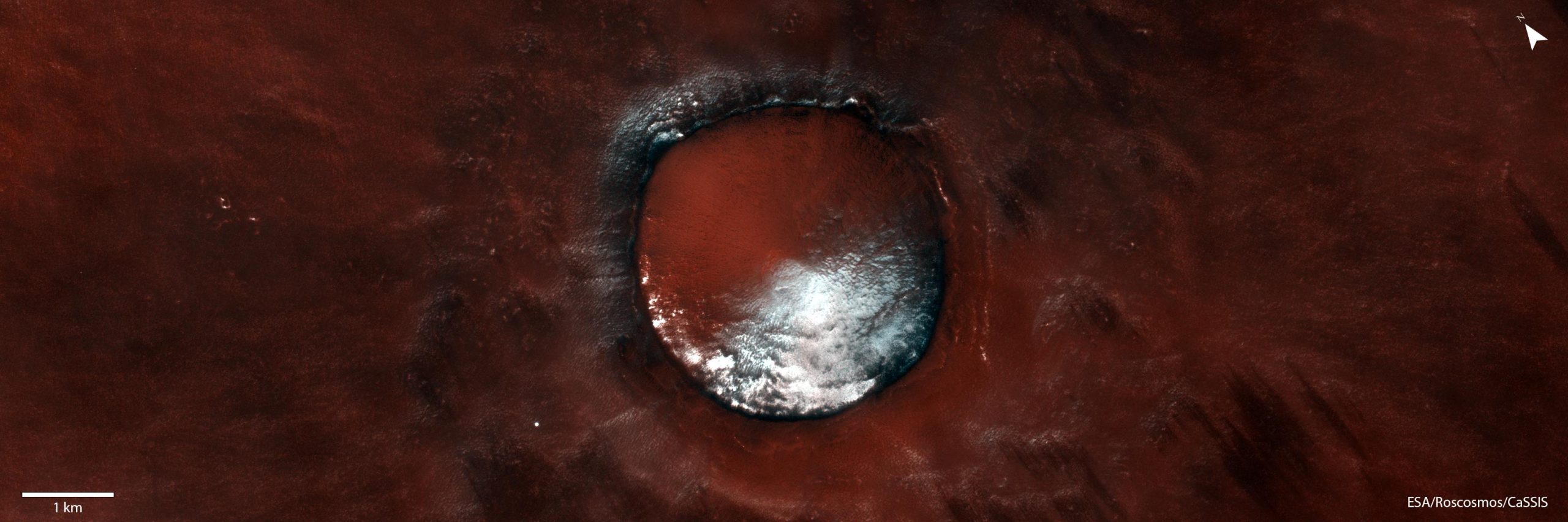
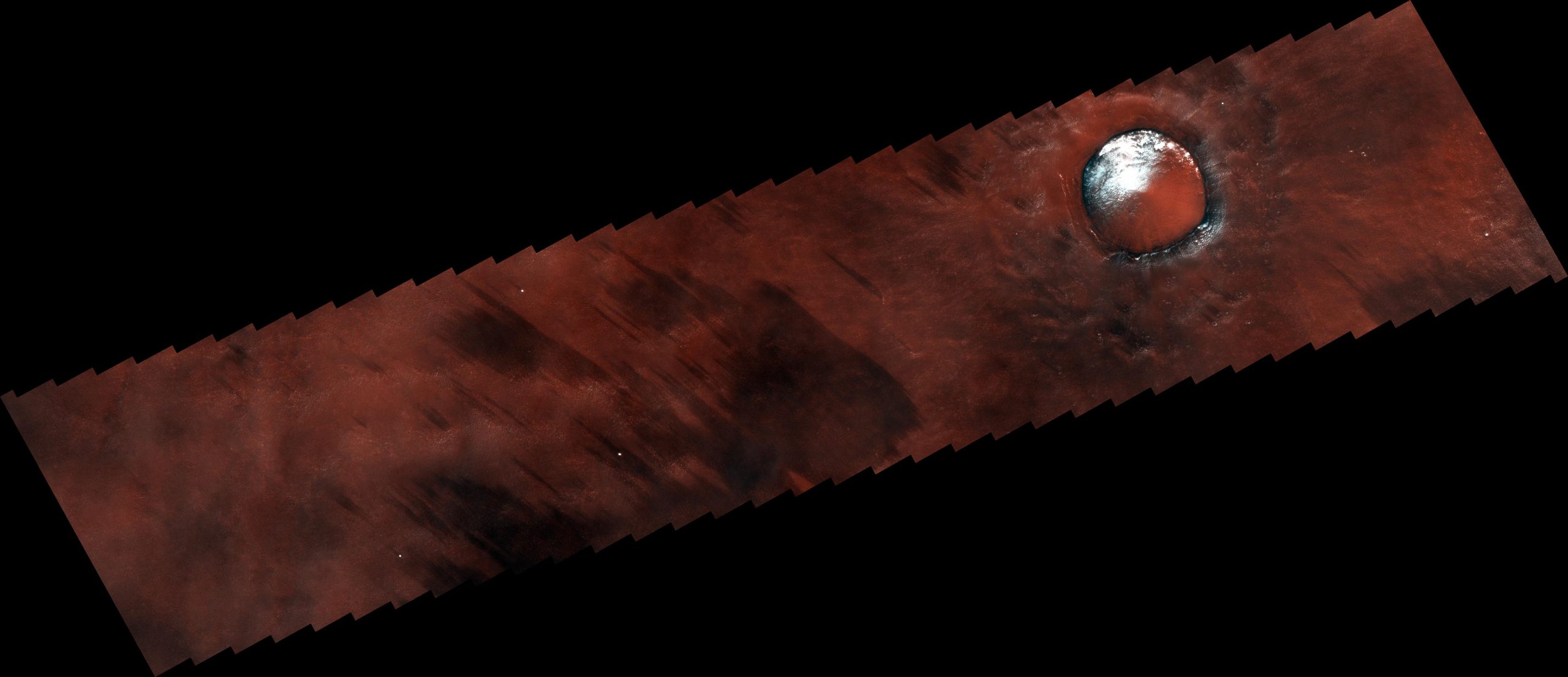
    This image showcases a 4 km-wide (2.5 mi-wide) crater located in Mars’ north polar region of Vastitas Borealis. The crater contains a partial filling of water ice. Credit: ESA/Roscosmos/CaSSIS, CC BY-SA 3.0 IGO

    ExoMars has captured a vivid image of a Martian crater filled with ice, dark volcanic rims, and landscapes reshaped by fierce winds.

    Like a sprinkle of powdered sugar on a rich red velvet cake, this scene from the ESA/Roscosmos ExoMars Trace Gas Orbiter captures the contrasting colors of bright white water-ice against the rusty red Martian soil.

    This delightful image was taken July 5, 2021, and soaks in the view of a 4 km-wide (2.5 mi-wide) crater in Mars’ north polar region of Vastitas Borealis, centered at 70.6 °N/230.3°E.

    The crater is partially filled with water ice, which is also particularly predominant on its north-facing slopes that receive fewer hours of sunlight on average throughout the year.

    The dark material clearly visible on the crater rim – giving it a somewhat scorched appearance – likely consists of volcanic materials such as basalt.
    Red Velvet Mars
    Credit: ESA/Roscosmos/CaSSIS, CC BY-SA 3.0 IGO

    Most of the surrounding terrain is ice-free, but has been shaped by ongoing aeolian processes. The streaks at the bottom right of the image are formed by winds that have removed the brighter iron oxide dust from the surface, exposing a slightly darker underlying substrate.  

    TGO arrived at Mars in 2016 and began its full science mission in 2018. The spacecraft is not only returning spectacular images, but also providing the best ever inventory of the planet’s atmospheric gases, and mapping the planet’s surface for water-rich locations. It will also provide data relay services for the second ExoMars mission comprising the Rosalind Franklin rover and Kazachok platform, when it arrives on Mars in 2023.

    Never miss a breakthrough: Join the SciTechDaily newsletter.
    Follow us on Google and Google News.

    European Space Agency ExoMars Mars Planets
    Share. Facebook Twitter Pinterest LinkedIn Email Reddit

    Related Articles

    Mars Unveils Its Nighttime Secret: Mesmerizing Green Glow Discovered

    The Devil’s in the Detail: Fascinating and Otherworldly Landscape on Mars

    Rolling Stones on Mars: More Than Meets the Eye

    ExoMars Discovers Hidden Water in Mars’ Grand Canyon – The Largest Canyon in the Solar System

    ExoMars Orbiter Captures Stunning Image of Volcanic Trenches on Mars

    Impact Crater Trio: ExoMars Trace Gas Orbiter Releases Stunning Image From Lunae Planum, Mars

    A New Chemistry: ExoMars Orbiter Discovers New Gas and Traces Water Loss on Mars

    Solis Dorsum, Mars – ExoMars Orbiter’s 20,000th Image

    “Puzzling and Surprising” New Gas Signatures Discovered by ExoMars Orbiter in the Martian Atmosphere

    1 Comment

    1. M Loveles on December 31, 2021 9:30 am

      Though us oldsters got to see the beginning of the space program, we will not live to see the advancements in technology or cosmic knowledge to come.
      Hoping we overcome our human flaws to fully witness the universe, as we can. Such a shame if we destroy ourselves.

      Reply
    Leave A Reply Cancel Reply

    • Facebook
    • Twitter
    • Pinterest
    • YouTube

    Don't Miss a Discovery

    Subscribe for the Latest in Science & Tech!

    Trending News

    JWST Finds a “Star” 100 Billion Times Brighter Than Any Star Should Be

    Scientists Find a Hidden Biological Link Across Different Forms of Autism

    Astronomers Discover a Ghostly River of Stars That Could Reveal Dark Matter

    Why Is Colorectal Cancer Rising in People Under 50? New Clues Point to the Environment

    Quantum Fluctuations Break a Crystal’s Symmetry Rules

    Why Does an Irregular Heartbeat Strike 40 Years Early in Some People?

    Scientists Reveal How ADHD Could Fuel Creative Thinking

    Scientists Find Just 3 Minutes of Sprinting Can Transform Blood Chemistry

    Follow SciTechDaily
    • Facebook
    • Twitter
    • YouTube
    • Pinterest
    • Newsletter
    • RSS
    SciTech News
    • Biology News
    • Chemistry News
    • Earth News
    • Health News
    • Physics News
    • Science News
    • Space News
    • Technology News
    Recent Posts
    • Common Vape Flavor May Disrupt Early Human Development
    • Ultra-Processed Foods Linked to 30% Higher Prostate Cancer Risk
    • More Screen Time, Better Thinking? An 8-Year Study Finds a Surprising Link
    • A Vast Clean Energy Source May Be Hiding Beneath Australia’s Red Soil
    • Scientists Uncover Signs of an Ancient Climate “Tipping Point”
    Copyright © 1998 - 2026 SciTechDaily. All Rights Reserved.
    • Science News
    • About
    • Contact
    • Editorial Board
    • Privacy Policy
    • Terms of Use

    Type above and press Enter to search. Press Esc to cancel.