
Close Menu
    Facebook X (Twitter) Instagram
    SciTechDaily
    • Biology
    • Chemistry
    • Earth
    • Health
    • Physics
    • Science
    • Space
    • Technology
    Facebook X (Twitter) Pinterest YouTube RSS
    SciTechDaily
    Home»Science»Redefining Human History: Scientists Uncover Advanced 1.1 Million-Year-Old Tools in China
    Science

    Redefining Human History: Scientists Uncover Advanced 1.1 Million-Year-Old Tools in China

    By Chinese Academy of Sciences HeadquartersMarch 9, 20241 Comment4 Mins Read
    Facebook Twitter Pinterest Telegram LinkedIn WhatsApp Email Reddit
    Share
    Facebook Twitter LinkedIn Pinterest Telegram Email Reddit
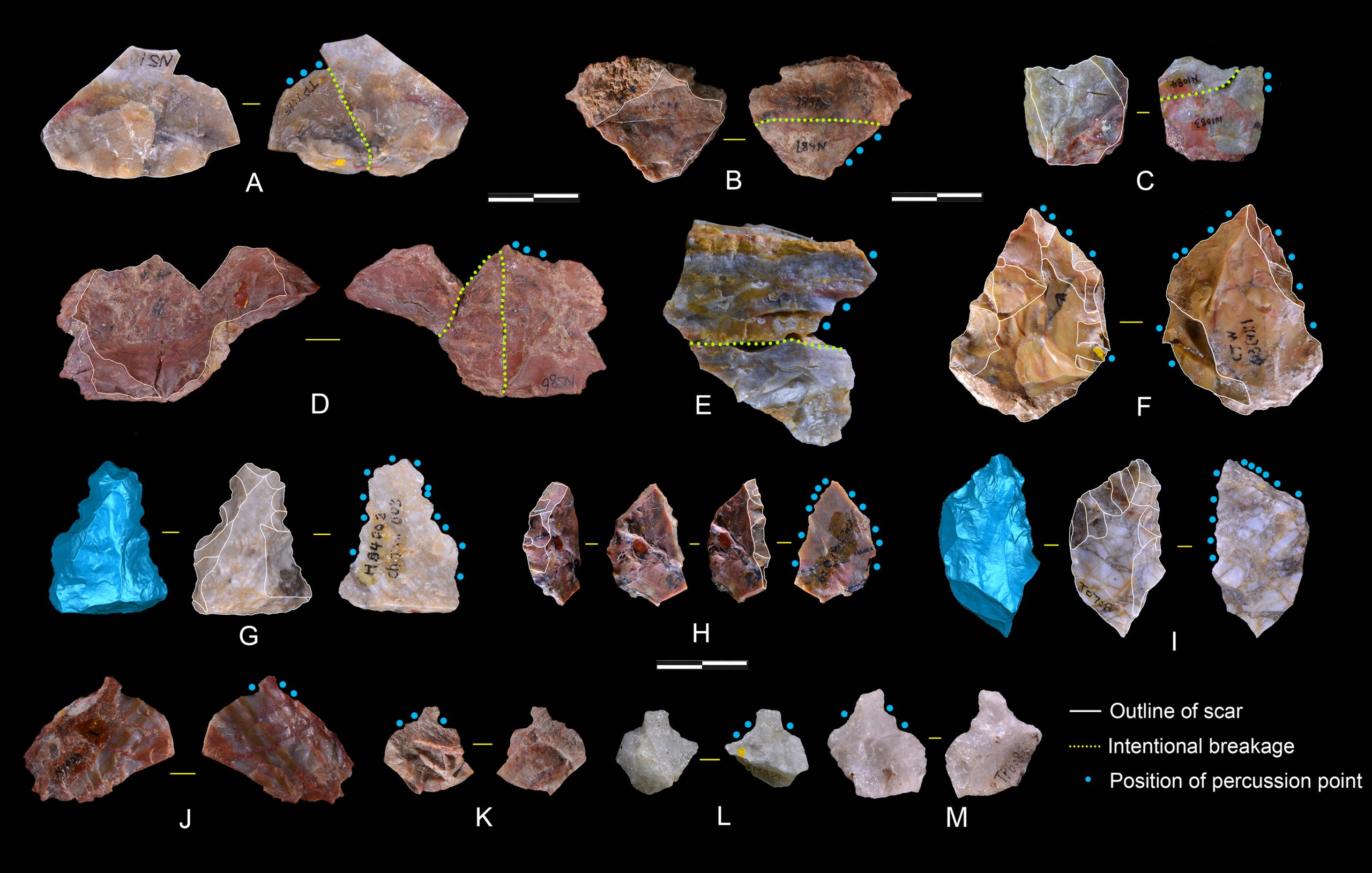
    Retouched Tool Patterns in the CJW Assemblage
    A groundbreaking study reveals that East Asia was inhabited by hominins with advanced tool-making skills equivalent to Mode 2 technology over 1.1 million years ago, challenging previous timelines and perceptions of early technological development in the region. This discovery, highlighting sophisticated techniques and planning, suggests a reevaluation of early human culture and connections across Eurasia. (A-E) Slender flakes are intentionally broken and used as blanks for retouching tipped tools. (G-I) Unifacially retouched points. (J-M) Borers. Credit: IVPP

    A new study from the Nihewan basin of China has revealed that hominins who possessed advanced knapping abilities equivalent to Mode 2 technological features occupied East Asia as early as 1.1 million years ago (Ma), which is 0.3 Ma earlier than the date associated with the first handaxes found in East Asia. This suggests that Mode 2 hominins dispersed into East Asia much earlier than previously thought.

    The study, which was conducted by a joint team led by Prof. PEI Shuwen from the Institute of Vertebrate Paleontology and Paleoanthropology (IVPP) of the Chinese Academy of Sciences and Prof. Ignacio de la Torre from the Institute of History the Spanish National Research Council (CSIC), was published in PNAS on Mar. 4 and provide insights into the early dispersals and adaptions of hominins in Eurasia.

    Advanced Tool-Making Techniques

    By reconstructing Cenjiawan refit sets from Nihewan basin, the research team discovered organized flaking techniques that aimed at producing slender flakes by core preparation on both the striking platform and flaking surface. The standardized operational process was not only shown by refit sets: Plenty of products detached at each stage of the process, thus providing strong evidence of standardized core preparation.
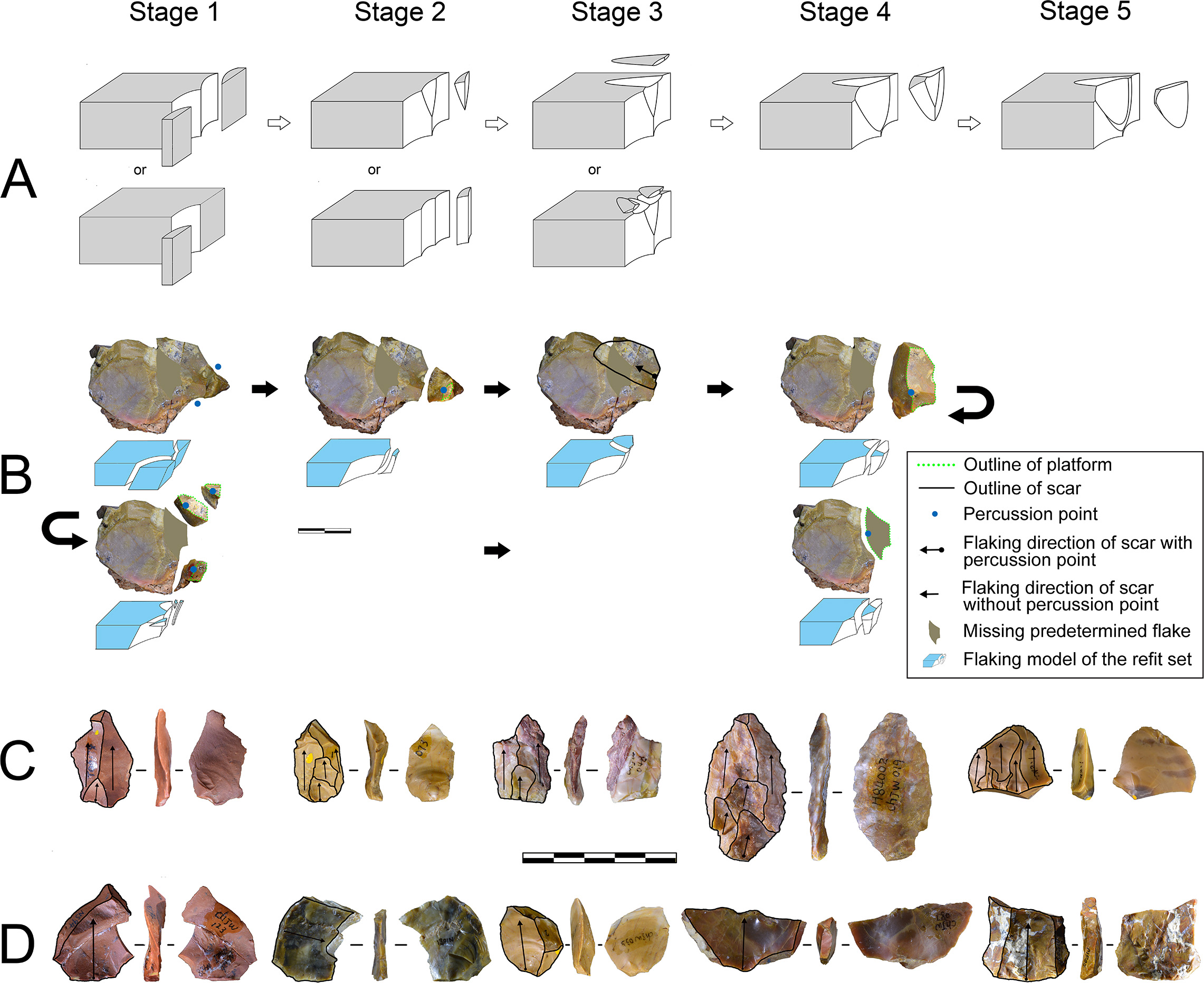
    Operational Scheme of Prepared Core Technology and Predetermined Products in CJW
    Operational scheme of prepared core technology (A and B) and predetermined products in CJW (C and D). Credit: IVPP

    Prepared core technologies were characterized by organized methods to obtain predetermined flakes that required detailed planning and a deep understanding of flaking mechanisms, which originated in the Acheulean and particularly more than 1.0 Ma.

    Regarding retouched tools, technological analysis of refitted products detached from the prepared core technology indicates intentional breakage of slender flakes in two halves. One or more of the resulting fragments were then selected as blanks for retouching, with the aiming of creating tipped tools with two convergent sides, thus significantly altering the original shape of blanks.

    In addition, patterns of retouching tools like points and borers, which showed standardization of tool shape, were also well documented in the Cenjiawan assemblage, thus suggesting complex mental templates among the Cenjiawan toolmakers.

    Complexity in Early Pleistocene Tool-Making

    The prepared core technology, standardized predetermined products, and retouching tool shapes, together with the high level of manual precision, fragmented reduction sequences, long reduction sequences, and organized management of raw materials documented in the Cenjiawan assemblage, provide compelling evidence for complex technical abilities and in-depth planning behaviors among Early Pleistocene hominins in East Asia.
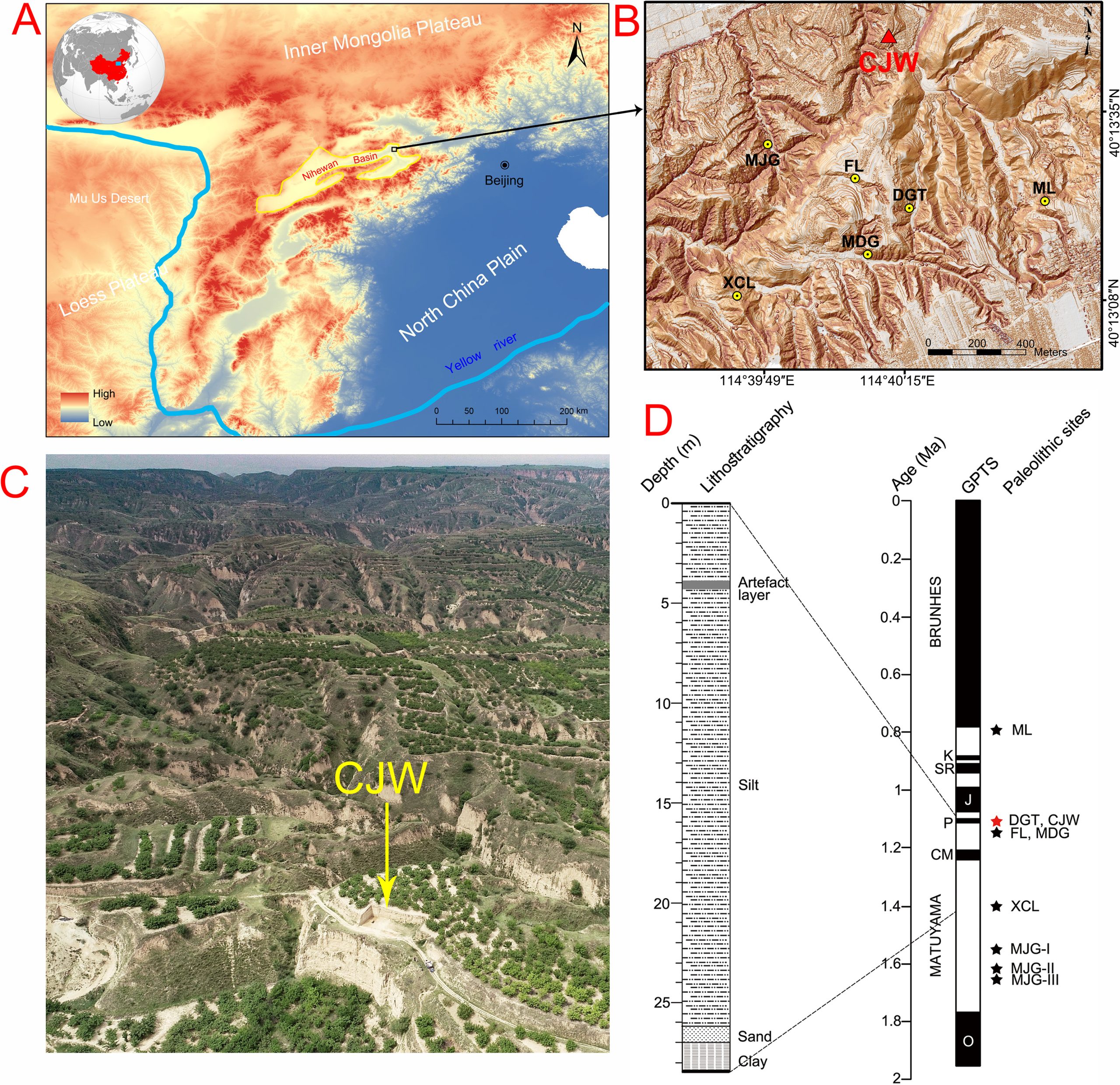
    The CJW Site and Lithology of the CJW Profile and Corresponding Magnetic Polarity Time Scale
    The CJW site and Lithology of the CJW profile and corresponding magnetic polarity time scale. Credit: IVPP

    “The advanced technological behaviors documented at the Cenjiawan site similar to those of Mode 2 technology, rather than the technical simplicity attributed to Mode 1”, said Dr. MA Dongdong, first author of the study, who conducted the research during his Ph.D at IVPP and currently is working as a postdoctoral researcher at the Institute of History of CISC.

    The Lower Paleolithic technology in China has long been regarded as simple (Oldowan-like/Mode 1) and homogeneous before the late Pleistocene. The compelling evidence in the Cenjiawan assemblage provides a new perspective in understanding the small debitage system in China and may force a reconsideration of current perceptions of technological stasis in East Asia.

    The authors argued that the technological features, rather than the mere presence or absence of specific tool types (e.g., handaxes), should be the basis for studying Early and Middle Pleistocene assemblages in East Asia. This enables a more integrated understanding of Mode 2 technology as well as the human cultural and biological connections between East Asia and other regions of the Old World.

    Reference: “Earliest Prepared core technology in Eurasia from Nihewan (China): Implications for early human abilities and dispersals in East Asia” by Dong-Dong Ma, Shu-Wen Pei, Fei Xie, Zhi Ye, Fa-Gang Wang, Jing-Yue Xu, Cheng-Long Deng and Ignacio de la Torre, 4 March 2024, Proceedings of the National Academy of Sciences.
    DOI: 10.1073/pnas.2313123121

    Never miss a breakthrough: Join the SciTechDaily newsletter.
    Follow us on Google and Google News.

    Archaeology Chinese Academy of Sciences Hominin Popular
    Share. Facebook Twitter Pinterest LinkedIn Email Reddit

    Related Articles

    Tiny Ancient Bird Discovered in China Shares Skull Features With Tyrannosaurus rex

    Five-Eyed 520-Million-Year-Old Fossil Reveals Arthropod Origin

    Sexual Intercourse of Ostracods Revealed Through 100-Million-Year-Old Amber Discovery

    Important Missing Piece of Human History Uncovered From Ancient DNA

    Human Populations Survived a Volcanic Super-Eruption 74,000 Years Ago – 5,000 Times Larger Than Mount St. Helen’s

    Earliest Interbreeding Between Ancient Human Populations Discovered – Evolutionary Puzzle Solved

    New Evidence Shows Humans Mastered Fire Earlier Than Thought

    Researchers Discover Two New Chinese Dinosaurs: Bannykus and Xiyunykus

    Million-Year-Old Ash in South African Cave Yields Evidence of Cooking

    1 Comment

    1. kamir bouchareb st on January 24, 2025 5:28 am

      thank you

      Reply
    Leave A Reply Cancel Reply

    • Facebook
    • Twitter
    • Pinterest
    • YouTube

    Don't Miss a Discovery

    Subscribe for the Latest in Science & Tech!

    Trending News

    Your Blood Pressure Reading Could Be Wrong Because of One Simple Mistake

    Astronomers Stunned by Ancient Galaxy With No Spin

    Physicists May Be on the Verge of Discovering “New Physics” at CERN

    Scientists Solve 320-Million-Year Mystery of Reptile Skin Armor

    Scientists Say This Daily Walking Habit May Be the Secret to Keeping Weight Off After Dieting

    New Therapy Rewires the Brain To Restore Joy in Depression Patients

    Giant Squid Detected off Western Australia in Stunning Deep-Sea Discovery

    Popular Sugar-Free Sweetener Linked to Liver Disease, Study Warns

    Follow SciTechDaily
    • Facebook
    • Twitter
    • YouTube
    • Pinterest
    • Newsletter
    • RSS
    SciTech News
    • Biology News
    • Chemistry News
    • Earth News
    • Health News
    • Physics News
    • Science News
    • Space News
    • Technology News
    Recent Posts
    • New Stroke Study Challenges Decades-Old Medical Beliefs
    • These Simple Plant Foods Are Linked to Lower Blood Pressure
    • Common Blood Pressure Drug Supercharges Cancer Treatment in Surprising New Study
    • Key Magic Mushroom Ingredient Increases Laziness and Reduces Aggression
    • Researchers Solve 15-Year Mystery Behind Cancer-Causing Gut Toxin
    Copyright © 1998 - 2026 SciTechDaily. All Rights Reserved.
    • Science News
    • About
    • Contact
    • Editorial Board
    • Privacy Policy
    • Terms of Use

    Type above and press Enter to search. Press Esc to cancel.